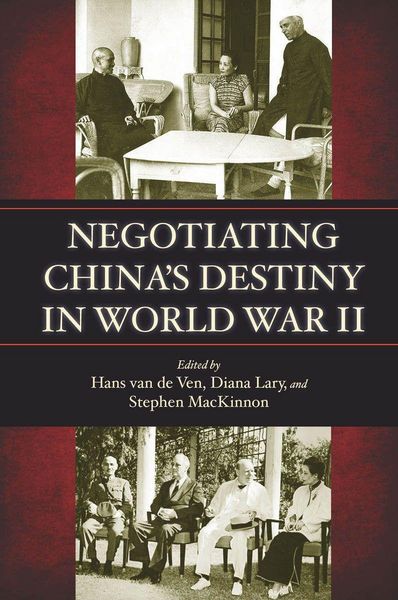
Produktbild: Negotiating China's Destiny in World War II

Negotiating China's Destiny in World War II

75,99 €

inkl. gesetzl. MwSt., Versandkostenfrei


Beschreibung

Produktdetails

Einband

Gebundene Ausgabe

Erscheinungsdatum

03.12.2014

Herausgeber

Hans van de Ven + weitere

Verlag

Stanford University Press

Seitenzahl

336

Maße (L/B/H)

24,1/16,1/2,5 cm

Gewicht

604 g

Sprache

Englisch

ISBN

978-0-8047-8966-0

Beschreibung

Rezension

"Although one might have wished to see more attention given to the role of Madame Chiang Kai-shek (Soong Mei-ling); her brother, T. V. Soong; and her brother-in-law, H. H. K'ung, in influencing the policies of Chiang, this is a minor quibble. Given the diversity of the contributors to this collection, their credentials, and the quality of their research, this book should be a must- read for any serious students of World War II and modern Chinese history. My advice to these folks: Grab it!"-Ronald Heiferman, American Historical Review "This book, a cohesive collection of essays by an international cast of scholars, stands out in its truly comprehensive treatment of China's international relations during WWII. It reveals not only the contorted diplomatic maneuvers pursued to insure China's survival, but also the determined efforts to 'negotiate China's destiny' to insure China's post-war international status. The book thus strengthens our understanding of how China's contemporary rise was in many ways rooted in the international transformation that accompanied the Pacific War."-Edward McCord, George Washington University "Brimming with new revelations and fresh insights, this book greatly advances our understanding of Chiang Kai-shek's diplomacy during World War II. There is no better introduction to the subject than this collection of penetrating essays by some of the world's leading scholars. The volume is filled with cutting-edge research for the specialists but is also accessible to the general public."-Qiang Zhai, author of China and the Vietnam Wars, 1950-1975 "By bringing in scholars from Asia, Europe, and North America, three premier experts on Chinese history-Hans van de Ven, Diana Lary, and Stephen R. MacKinnon-have masterfully put together this edited volume on China's experiences in World War II. The result of their efforts is a collection of well-researched essays answering many important questions left out of previous studies...This book should be read by all students of Chinese history, especially those interested in the Chinese experience in the twentieth century."-Xin Zhang, China Review International

Produktdetails

Einband

Gebundene Ausgabe

Erscheinungsdatum

03.12.2014

Herausgeber

Verlag

Stanford University Press

Seitenzahl

336

Maße (L/B/H)

24,1/16,1/2,5 cm

Gewicht

604 g

Sprache

Englisch

ISBN

978-0-8047-8966-0

Herstelleradresse

Libri GmbH
Europaallee 1
36244 Bad Hersfeld
DE

Email: gpsr@libri.de

Noch keine Bewertungen vorhanden

Verfassen Sie die erste Bewertung zu diesem Artikel

Helfen Sie anderen Kundinnen und Kunden durch Ihre Meinung.

Kundinnen und Kunden meinen

Bewertungen (0)

Die Leseprobe wird geladen.
  • Produktbild: Negotiating China's Destiny in World War II
  • Contents and Abstracts1France's Deluded Quest for Allies chapter abstract

    This chapter focuses on France's efforts to maintain a role in East Asian affairs and protect its control of French Indo-China. The chapter traces the decline of French influence to WWI, examines France's efforts to maintain a collective security approach before the outbreak of war, and analyzes how France tried to hold on to Indo-China during the war by following a policy of accommodating Japan while not alienating China - an impossibility.

    2British Diplomacy and Changing Views of Chinese Governmental Capability across the Sino-Japanese War, 1937-1945 chapter abstract

    Mitter traces an important change in UK Foreign Office attitudes during WWII. If before the war the British official mind was contemptuous of China, by the end of the war British Foreign Officials had developed a grudging respect for China and had accepted its status as one of the Big Five Powers. The war with Japan caused official Britain to accept British decline and move on to the unwinding of its imperial role.

    3An Imperial Envoy chapter abstract

    China's relations with Tibet have been, and are, a frequent source of difficulty. During WWII, they achieved a nadir, leading the Nationalists to appoint a high level representative who set out, with some success, to improve relations and push back againt growing British influence. Shen Zonglian was successful, but not to the degree that after the end of WWII Tibetan representatives accepted full incorporation into the Nationalist body politic.

    4The Evolution of the Relationship between the Chinese Communist Party and the Comintern during the Sino-Japanese War chapter abstract

    During WWII, Stalin's policy in East Asia aimed at drawing Japan into a quagmire in China so as to avoid fighting a war on two fronts. This meant supporting the Nationalists in China, the only force capable of providing serious resistance to the Japanese. However, the Soviets naturally also maintained relations with the Chinese Communists. Yang Kuisong analyzes how the CCP managed the frequently difficult relationship with the Soviets and how Mao Zedong was able to maintain a delicate balance between preserving the interest of the Chinese Communists and accommodating Soviet wishes.

    5Canada-China Relations in Wartime China chapter abstract

    Most scholarship on China's foreign relations during WWII has focused on US-China relations. While this volume breaks fundamentally with that tradition, Diana Lary demonstrates that even a small country such as Canada had a role to play. Individual Canadians such as Norman Bethune were at work in China during WWII, as did missionaries, diplomats, and journalists, while Chinese living in Canada, such as Quan Louie became significant public figures there. In developing a China policy, Canada also moved away from Britain.

    6Declaring W