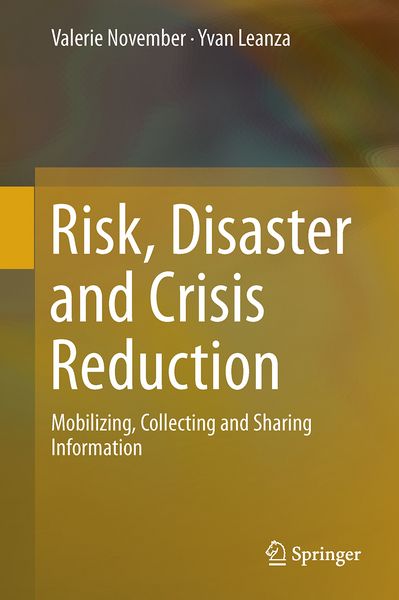
Risk, Disaster and Crisis Reduction Mobilizing, Collecting and Sharing Information
-
- Hardcover ausgewählt
- Taschenbuch
- eBook
-
Sprache:Englisch
98,99 €
UVP
109,99 €
inkl. gesetzl. MwSt.,
Beschreibung
Produktdetails
Einband
Gebundene Ausgabe
Erscheinungsdatum
20.10.2014
Abbildungen
XI, 184 p. 16 illus., 4 illus. in color.
Verlag
SpringerSeitenzahl
184
Maße (L/B/H)
24,1/16/1,7 cm
Gewicht
465 g
Auflage
2015
Sprache
Englisch
ISBN
978-3-319-08541-8
In the field of risks and crises, both the access to relevant information and its circulation are seen as crucial factors. Based on a new integrated theoretical model focusing on the stakeholder, the book proposes analysis of information reformulation and circulation in risk environments and crisis situations.
Simply circulating the information does not mean that it will be picked up by those who could benefit from it. This has been amply demonstrated by the various crises and catastrophes that have shaken the planet in recent years. In order to be able to deal with risk situations and crises, it must be possible for information – when it circulates – to be understood and interpreted by a wide range of stakeholders, working in fields such as health and natural or environmental risks. By observing closely, in three very different situations, the way in which information is gathered, processed, distributed and used, this book examines the countless reformulations, redefinitionsand even reorientations to which all information is subjected. This multiple reformatting, at least according to the hypothesis put forward in this book, is an important element in ensuring that the information produced circulates and reaches those for whom it is intended. The intention is then to analyze the way in which information circulates in situations of risk and crisis. In order to do it, the authors propose a new theoretical model based on different approaches. This model is anchored in the trend of research that has been oriented towards a wider understanding of risks and their territorial and social consequences. These ideas question the approach to risk which focuses primarily on technical aspects and probability. The model also draws from approaches to risk that focus on the stakeholders involved in the debates and the need for an integrated vision of risks. Risks are thus considered heterogeneous, plural and transcalar. The information flow about risks was studied first in the SHOC Room of the World Health Organization (WHO) in Geneva, a central place through which passes all information destined to managing world-wide epidemic risks. Then the research team monitored the constitution and the reception of a field library about risks management and reduction sent to Madagascar, an island systematically hit by cyclones. This following process has permitted the analysis of information dissemination during a crisis situation. The third field work was done in Cameroun to observe the use and transmission of information in two NGO specializing in sanitary risks prevention using traditional and biomedical conceptualization of health and illness. The book ends with a practical tool to assess and help the information circulation in risk and crisis situations.
Noch keine Bewertungen vorhanden
Verfassen Sie die erste Bewertung zu diesem Artikel
Helfen Sie anderen Kundinnen und Kunden durch Ihre Meinung.
Kurze Frage zu unserer Seite
Vielen Dank für Ihr Feedback
Wir nutzen Ihr Feedback, um unsere Produktseiten zu verbessern. Bitte haben Sie Verständnis, dass wir Ihnen keine Rückmeldung geben können. Falls Sie Kontakt mit uns aufnehmen möchten, können Sie sich aber gerne an unseren Kund*innenservice wenden.
zum Kundenservice