KI-Beratung Beta

  • Produktbild: Production of Biomass and Bioactive Compounds Using Bioreactor Technology
  • Produktbild: Production of Biomass and Bioactive Compounds Using Bioreactor Technology
- 12%

Production of Biomass and Bioactive Compounds Using Bioreactor Technology

12% sparen

144,99 € UVP 164,99 €

inkl. gesetzl. MwSt., Versandkostenfrei


Beschreibung

The bioactive compounds of plants have world-wide applications in pharmaceutical, nutraceutical and food industry with a huge market. In this book, a group of active researchers have addressed on the most recent advances in plant cell and organ cultures for the production of biomass and bioactive compounds...

Beschreibung

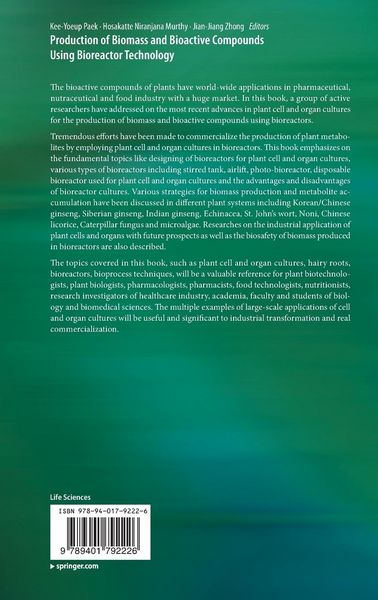
The bioactive compounds of plants have world-wide applications in pharmaceutical, nutraceutical and food industry with a huge market. In this book, a group of active researchers have addressed on the most recent advances in plant cell and organ cultures for the production of biomass and bioactive compounds using bioreactors.

Tremendous efforts have been made to commercialize the production of plant metabolites by employing plant cell and organ cultures in bioreactors. This book emphasizes on the fundamental topics like designing of bioreactors for plant cell and organ cultures, various types of bioreactors including stirred tank, airlift, photo-bioreactor, disposable bioreactor used for plant cell and organ cultures and the advantages and disadvantages of bioreactor cultures. Various strategies for biomass production and metabolite accumulation have been discussed in different plant systems including Korean/Chinese ginseng, Siberian ginseng, Indian ginseng, Echinacea, St. John’s wort, Noni, Chinese licorice, Caterpillar fungus and microalgae. Researches on the industrial application of plant cells and organs with future prospects as well as the biosafety of biomass produced in bioreactors are also described.

The topics covered in this book, such as plant cell and organ cultures, hairy roots, bioreactors, bioprocess techniques, will be a valuable reference for plant biotechnologists, plant biologists, pharmacologists, pharmacists, food technologists, nutritionists, research investigators of healthcare industry, academia, faculty and students of biology and biomedical sciences. The multiple examples of large-scale applications of cell and organ cultures will be useful and significant to industrial transformation and real commercialization.

Portrait


Kee-Yoeup Paek, Research Center for the Development of Advanced Horticultural Technology, Chungbuk National University, Cheongju 361-763, Republic of Korea.

Hosakatte Niranjana Murthy, Department of Botany, Karnatak University, Dharwad 580003, India.

Jian-Jiang Zhong, State Key Laboratory of Microbial Metabolism, School of Life Sciences and Biotechnology, Shanghai Jiao Tong University, 800 Dong-Chuan Road, Shanghai 200240, China.

Produktdetails

Einband

Gebundene Ausgabe

Erscheinungsdatum

13.10.2014

Abbildungen

XIV, 709 p. 216 illus., 95 illus. in color.

Herausgeber Kee-Yoeup Paek + weitere

Produktdetails

Einband

Gebundene Ausgabe

Erscheinungsdatum

13.10.2014

Abbildungen

XIV, 709 p. 216 illus., 95 illus. in color.

Herausgeber
Verlag Springer Netherland
Seitenzahl

709

Maße (L/B/H)

24,1/16/4,5 cm

Gewicht

1187 g

Auflage

2014

Sprache

Englisch

ISBN

978-94-017-9222-6

Herstelleradresse

Springer-Verlag KG
Sachsenplatz 4-6
1201 Wien
AT

Email: ProductSafety@springernature.com

Noch keine Bewertungen vorhanden

Verfassen Sie die erste Bewertung zu diesem Artikel

Helfen Sie anderen Kundinnen und Kunden durch Ihre Meinung.

Kundinnen und Kunden meinen

Bewertungen (0)

Die Leseprobe wird geladen.
  • Produktbild: Production of Biomass and Bioactive Compounds Using Bioreactor Technology
  • Produktbild: Production of Biomass and Bioactive Compounds Using Bioreactor Technology

  • Part I Bioreactor design, advantages and limitations of bioreactor cultures.-1 Design of bioreactors for plant cell and organ cultures.-2 Disposable bioreactors for cultivation of plant cell cultures.-3 Plant derived bioactive molecules: Culture vessels to bioreactors.- Part II Production of biomass and bioactive compounds from cell suspension cultures.-4 Production of carotenoids using microalgae cultivated in photobioreactors.-5 Submerged fermentation of medicinal fungus
    Cordyceps sinensis
    for production of biologically active mycelial biomass and exopolysaccharides.- 6 Ginseng cell culture for production of ginsenosides.-7 Production of biomass and bioactive compounds from cell suspension cultures of
    Panax quinquefolium
    L. and
    Glycyrrhiza uralensis
    Fisch.-Part III Production of biomass and bioactive compounds from organ cultures – shoot, embryo and adventitious root cultures.-8 Production of caffeic acid derivatives from adventitious root cultures of
    Echinacea purpurea
    (L.) Moench.-9 Adventitious root culture of
    Morinda citrifolia
    in bioreactors for production of bioactive compounds.-10 Production of biomass and bioactive compounds in adventitious root cultures of
    Eleutherococcus koreanum
    Nakai.-11 Production of adventitious root biomass and bioactive compounds from
    Hypericum perforatum
    L. through large scale bioreactor cultures.-12 Production of withanolides from cell and organ cultures of
    Withania somnifera
    (L.) Dunal.-13 Production of bioactive compounds of Siberian ginseng from somatic embryo suspension cultures in bioreactors.-14 Bioreactor culture of shoots and somatic embryos of medicinal plants for production of bioactive compounds.-15 Hairy roots: Production of metabolites to environmental restoration.-16 Mass production of
    Lilium
    bulbelets in bioreactors.-17
    In vitro
    production of
    Digitalis purpurea
    biomass using temporary immersion cultures.-18 Role of nitric oxidein adventitious roots development.-19 Melatonin-rich plants: Production, significance in agriculture and human health.-Part IV Strategies for production of bioactive compounds, large-scale cultures and metabolic engineering of selected metabolites.-20 Strategies for enhanced production of plant secondary metabolites from cell and organ cultures.-21 Metabolic engineering of selected secondary metabolites.-22 Theoretical basis of plant cell and tissue culture for production of biomass and bioactive compounds.-23 Isoprenoid production via plant cell cultures: biosynthesis, accumulation and scaling-up to bioreactors.-24 Production of ginsenosides from adventitious root cultures of
    Panax ginseng
    .-Part V Bio-safety assessments of plant cell and organ culture products.-25 Food ingredients from plant cell, tissue and organ cultures: biosafety and efficacy evaluations.-Part VI Physiological disorders in plants cultured in bioreactors.-26 Biochemical and physiological aspects of hyperhydricity in liquid culture system