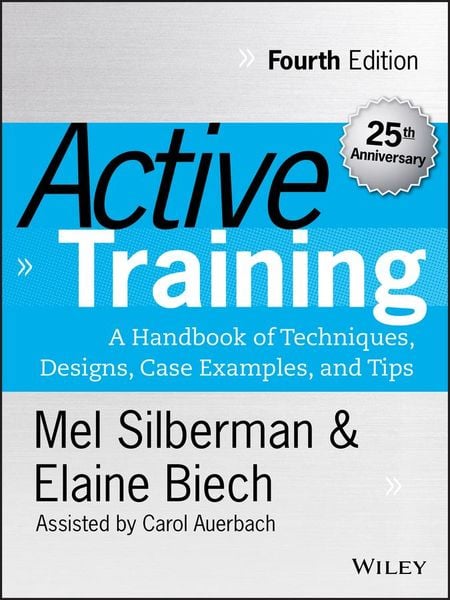
Active Training A Handbook of Techniques, Designs, Case Examples, and Tips
-
- Englisch ausgewählt
53,99 €
inkl. gesetzl. MwSt.,
Beschreibung
Produktdetails
Einband
Gebundene Ausgabe
Erscheinungsdatum
04.05.2015
Verlag
John Wiley & Sons IncSeitenzahl
448
Maße (L/B/H)
24,1/18,2/3,2 cm
Gewicht
884 g
Auflage
4th Revised edition
Sprache
Englisch
ISBN
978-1-118-97201-4
Active Training turns instructional design on its head by shifting the emphasis away from the instructor, and on to the learner. Comprehensively updated to reflect the many developments in the field, this new fourth edition covers the latest technologies and applications, the evolving role of the trainer, and how new business realities impact training, advancing new evidence-based best practices for new trainer tasks, skills, and knowledge. Up to date theory and research inform the practical tips and techniques that fully engage learners and help them get the most out of sessions, while updated workplace examples and revised templates and worksheets help bring these techniques into the classroom quickly. You'll gain insight into improving training evaluation by using Return on Expectations (ROE), learn how to extend the value of training programs through transfer of learning, and develop fresh, engaging methods that incorporate state-of-the-art applications.
Active Training designs offer just the right amount of content; the right balance of affective, behavioral, and cognitive learning; a variety of approaches; real-life problem solving; gradual skill-building; and engaging delivery that uses the participants' expertise as a foundation for learning. This book is the classic guide to employing Active Training methods effectively and appropriately for almost any topic.
* Learn how the trainer's role has changed
* Engage learners through any training delivery method
* Inspire collaboration and innovation through application
* Overcome the challenges trainers face in the new business environment
Active Training methods make training sessions fun, engaging, relevant, and most importantly, effective. Participants become enthusiastic about the material, and view sessions as interesting challenges rather than as means to fulfill requirements. To bring these widely endorsed methods into your training repertoire, Active Training is the complete practical handbook you need.
Noch keine Bewertungen vorhanden
Verfassen Sie die erste Bewertung zu diesem Artikel
Helfen Sie anderen Kundinnen und Kunden durch Ihre Meinung.
Kurze Frage zu unserer Seite
Vielen Dank für Ihr Feedback
Wir nutzen Ihr Feedback, um unsere Produktseiten zu verbessern. Bitte haben Sie Verständnis, dass wir Ihnen keine Rückmeldung geben können. Falls Sie Kontakt mit uns aufnehmen möchten, können Sie sich aber gerne an unseren Kund*innenservice wenden.
zum Kundenservice