KI-Beratung Beta

Gutscheinbedingungen

**Gültig bis 18.11.2026 auf englischsprachige Klassiker (klassiker-32728) online auf thalia.at und in der Thalia App. Einzelne Artikel können ausgeschlossen sein. Ausgenommen sind preisgebundene Artikel & eBooks. Pro Einkauf einmal einlösbar. Click & Collect nur bei Onlinevorabzahlung möglich. Keine Barauszahlung. Nicht kombinierbar mit anderen Aktionen und Gutscheinen. Gutschein wird auf max. 500€ Bestellwert angerechnet. Nicht gültig für Geschenkkarten, Versandkosten und Services.

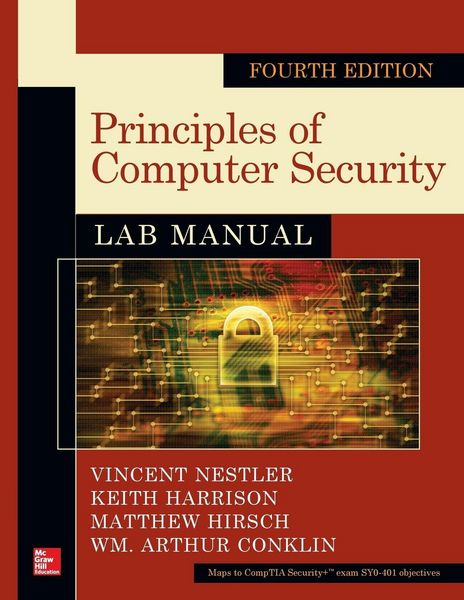
Produktbild: Principles of Computer Security Lab Manual, Fourth Edition

Principles of Computer Security Lab Manual, Fourth Edition

63,99 €

inkl. gesetzl. MwSt., Versandkostenfrei


Beschreibung

Publisher's Note: Products purchased from Third Party sellers are not guaranteed by the publisher for quality, authenticity, or access to any online entitlements included with the product.

Practice the Computer Security Skills You Need to Succeed!
  • 40+ lab exercises challenge you to solve problems based...

Beschreibung

Publisher's Note: Products purchased from Third Party sellers are not guaranteed by the publisher for quality, authenticity, or access to any online entitlements included with the product.


Practice the Computer Security Skills You Need to Succeed!

  • 40+ lab exercises challenge you to solve problems based on realistic case studies

  • Step-by-step scenarios require you to think critically

  • Lab analysis tests measure your understanding of lab results

  • Key term quizzes help build your vocabulary

  • Labs can be performed on a Windows, Linux, or Mac platform with the use of virtual machines

In this Lab Manual, you'll practice


  • Configuring workstation network connectivity

  • Analyzing network communication

  • Establishing secure network application communication using TCP/IP protocols

  • Penetration testing with Nmap, metasploit, password cracking, Cobalt Strike, and other tools

  • Defending against network application attacks, including SQL injection, web browser exploits, and email attacks

  • Combatting Trojans, man-in-the-middle attacks, and steganography

  • Hardening a host computer, using antivirus applications, and configuring firewalls

  • Securing network communications with encryption, secure shell (SSH), secure copy (SCP), certificates, SSL, and IPsec

  • Preparing for and detecting attacks

  • Backing up and restoring data

  • Handling digital forensics and incident response

Instructor resources available:


  • This lab manual supplements the textbook Principles of Computer Security, Fourth Edition, which is available separately

  • Virtual machine files

  • Solutions to the labs are not included in the book and are only available to adopting instructors

Produktdetails

Einband

Taschenbuch

Erscheinungsdatum

03.11.2014

Abbildungen

Illustrationen, nicht spezifiziert

Verlag Mcgraw Hill Higher Education

Produktdetails

Einband

Taschenbuch

Erscheinungsdatum

03.11.2014

Abbildungen

Illustrationen, nicht spezifiziert

Verlag Mcgraw Hill Higher Education
Seitenzahl

386

Maße (L/B/H)

28/21,6/2,1 cm

Gewicht

969 g

Auflage

4. Auflage

Sprache

Englisch

ISBN

978-0-07-183655-5

Herstelleradresse

Libri GmbH
Europaallee 1
36244 Bad Hersfeld
DE

Email: gpsr@libri.de

Noch keine Bewertungen vorhanden

Verfassen Sie die erste Bewertung zu diesem Artikel

Helfen Sie anderen Kundinnen und Kunden durch Ihre Meinung.

Kundinnen und Kunden meinen

Bewertungen (0)

  • Produktbild: Principles of Computer Security Lab Manual, Fourth Edition
  • Part I: Networking Basics: How Do Networks Work
    1. Workstation Network Con¿guration and Connectivity
    2. Network Transports
    3. Network Applications
    Part II: Vulnerabilities and Threats--How Can Systems Be Compromised
    4. Penetration Testing
    5. Attacks--Attacks Against Applications
    6. Escalating Privilege--Sniffing, Keylogging, Password-Cracking Attacks
    Part III: Prevention: How Do We Prevent Harm to Systems
    7. Hardening the Host Computer
    8. Securing Network Communications
    Part IV: Detection and Response: How Do We Detect and Respond to Attacks
    9. Preparing for and Detecting Attacks
    10. Digital Forensics