
Gutscheinbedingungen

**Gültig bis 06.07.2026 auf fremdsprachige Bücher online auf thalia.at, in der Thalia App ab einem Mindestbestellwert von 30€ und in allen Thalia Buchhandlungen in Österreich. In den Buchhandlungen nur gültig auf lagernde Ware. Einzelne Artikel können ausgeschlossen sein. Ausgenommen sind preisgebundene Artikel & eBooks. Pro Einkauf einmal einlösbar. Nur gültig gegen Vorlage oder im Onlineshop hinterlegter Bonuscard. Infos zur Einlösung in der Buchhandlung sind auf der Bonuscard-Vorteilspreisseite zu finden. Click & Collect nur bei Onlinevorabzahlung möglich. Keine Einlösung bei Scan & Go-Bezahlung. Keine Barauszahlung. Nicht kombinierbar mit anderen Aktionen und Gutscheinen. Gutschein wird auf max. 500€ Bestellwert angerechnet. Nicht gültig für Versandkosten und Services.

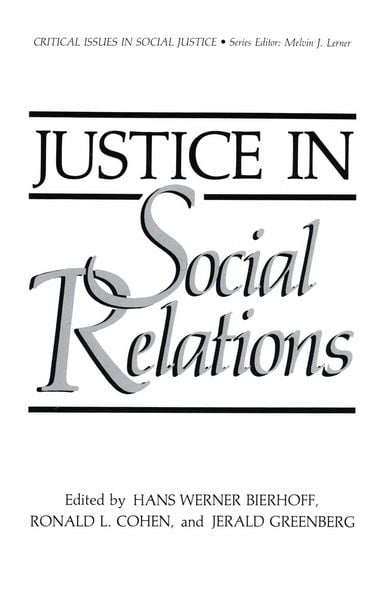
  • Produktbild: Justice in Social Relations
  • Produktbild: Justice in Social Relations

Justice in Social Relations

51,99 €

inkl. gesetzl. MwSt., Versandkostenfrei


Beschreibung

Produktdetails

Einband

Taschenbuch

Erscheinungsdatum

25.11.2012

Herausgeber

Hans Werner Bierhoff + weitere

Verlag

Springer Us

Seitenzahl

380

Maße (L/B/H)

22,9/15,2/2,1 cm

Gewicht

555 g

Auflage

Softcover reprint of the original 1st ed. 1986

Sprache

Englisch

ISBN

978-1-4684-5061-3

Beschreibung

Portrait

Hans W. Bierhoff, seit 1992 Professor am Lehrstuhl Sozialpsychologie an der Ruhr-Universität Bochum

Produktdetails

Einband

Taschenbuch

Erscheinungsdatum

25.11.2012

Herausgeber

Verlag

Springer Us

Seitenzahl

380

Maße (L/B/H)

22,9/15,2/2,1 cm

Gewicht

555 g

Auflage

Softcover reprint of the original 1st ed. 1986

Sprache

Englisch

ISBN

978-1-4684-5061-3

Herstelleradresse

Springer-Verlag KG
Sachsenplatz 4-6
1201 Wien
AT

Email: GPSR Kontakt

Noch keine Bewertungen vorhanden

Verfassen Sie die erste Bewertung zu diesem Artikel

Helfen Sie anderen Kundinnen und Kunden durch Ihre Meinung.

Kundinnen und Kunden meinen

Bewertungen (0)

  • Produktbild: Justice in Social Relations
  • Produktbild: Justice in Social Relations
  • I Conflict, Power, and Justice.- 1 Cooperation, Conflict, and Justice.- Cooperation-Competition: Initial Studies of Distributive Justice.- Conflict and Bargaining Studies: Conditions for Establishing a System of Justice.- Distributive Justice.- Experimental Studies of the Effects of Different Systems of Distributive Justice.- The Choice of Distribution System.- The Sense of Injustice.- Some Conclusions.- References.- 2 Justice and Power: An Exchange Analysis.- Power as a Determinant of Reward Distributions.- Power as a Determinant of Reactions to Injustice.- An Exchange Analysis and Some Preliminary Evidence.- Perceptions of Fairness in Exchange Networks.- The Perceived Origins of Inequality and Reactions to Injustice.- Concluding Comments: From Interpersonal to Intergroup Relations.- References.- 3 Justice Considerations in Interpersonal Conflict.- A Glance at the Literature.- Interpersonal Conflict: Definition, Delimitation, and Analytic Approach.- Interpersonal Justice.- Justice Considerations in Interpersonal Conflict: Conditions of Occurrence and Effects.- At the Intra-Individual Level: Justice Thoughts.- At the Interindividual Level: Justice Statements.- Justice Conflict.- Types and Psychological Concomitants of Justice Conflict.- The Justice Dispute.- Significance of Justice Conflict for the Outcome of the Primary Conflict.- Conclusions.- The Role of Different Justice Motivations.- Concluding Remarks.- References.- 4 Power and Justice in Intergroup Relations.- Justice and Power.- Private Problems and Public Issues.- The Effects of Power.- Endorsement, Authorization, and Legitimation.- Revolutionary Mobilization.- The Symbols of Justice.- Conclusion.- References.- II Theoretical Perspectives on Justice.- 5 Justice Ideology and Social Legitimation: A Revised Agenda for Psychological Inquiry.- Overview.- Personhood and Justice.- The Personhood Ideal.- Justice.- Enlarging Personhood.- Toward an Objective Base for Justice.- Bases of Legitimation.- Critique.- Caretaking and Receiving.- Vulnerability to Ideology.- Psychology and the Reproduction of Injustice.- Conclusion.- References.- 6 The Experience of Injustice: Toward a Better Understanding of its Phenomenology.- Retrospective Reports on Experiences of Injustice.- Procedure.- Results.- Discussion.- Role-Playing Investigation 1.- Role-Playing Investigation 2.- Categories of Cognitions and Feelings.- Objectivity of Coding.- Results.- Discussion.- Conclusion.- References.- 7 Thinking about Justice and Dealing with One’s Own Privileges: A Study of Existential Guilt.- The Concept of Existential Guilt.- Coping with One’s Own Privileges: An Empirical Study.- Sample.- Research Instruments.- Cognitive Analysis of Inequality and Existential Guilt.- Distributive Justice and Existential Guilt.- The Role of Perceived Control.- Felt Responsibility for and Attitude toward the Disadvantaged.- Belief in a Just World and Existential Guilt.- The Moderating Role of Centrality of Justice.- A Predictive Model for Existential Guilt.- Discriminating Existential Guilt from Empathie Distress.- Criterion Group Validity of Existential Guilt.- Concluding Remarks.- References.- 8 Rethinking Equity Theory: A Referent Cognitions Model.- Levels of Referent Outcomes.- Effects of Referent and Likelihood Cognitions.- Levels of Justification.- Distributive and Procedural Effects.- Context Effects.- Summary and Conclusion.- References.- III Norms and Justice.- 9 Social Context and Perceived Justice.- Justice in Interpersonal Relations: Equity or Equality.- Equity versus Equality and Response to Reward Allocation.- Gender Differences Revisited: Response to Equity and Equality.- The Other Way Around.- Just World, Expectations, and Scripts.- Summary.- References.- 10 Levels of Interest in the Study of Interpersonal Justice.- Levels of Interpersonal Justice Phenomena.- Specific Domains.- The Justice Motive.- Justice Principles as Different Forms of Social Interdependence.- Determination of Value and Perception of Inputs.- Postscript.- References.- 11 The Need Principle of Distributive Justice.- Traditional Theoretical Perspectives.- Consideration of Needs in Allocation Situations: Conclusions from Experiments.- Need Satisfaction as the Basis of Distributive Justice.- Prototypes of Relationships and Transaction Principles.- Empirical Findings.- Conclusion.- References.- 12 Group Categorization and Distributive Justice Decisions.- Reward Distribution Behavior as Reasoned Action.- Target Characteristics as Mediators of Norm Salience: A Role-Theory Analysis.- Group Categorization as a Mediator of the Influence of the Norm of Equity on Reward Distributions to Workers.- Supervisors’ Pay Allocations when Outgroup Norms are Unknown.- Supervisors’ Pay Allocations when Beliefs Exist about Workers’ Relevant Norms.- Implications of Reasoned-Action-Role-Theory Approach for Past and Future Work.- References.- 13 Children’s Use of Justice Principles in Allocation Situations: Focus on the Need Principle.- Cognitive Developmental Models of Distributive Justice.- Investigations into Concrete Allocation Behavior.- Studies of Distributive Justice.- Differentiation between Just and Unjust Aims.- Preschool Children’s Preferences for Justice Principles.- Primary School Children’s Preferences for Justice Principles.- Encouraging the Consideration of Need.- Summary and Concluding Remarks.- Distinguishing Just from Unjust.- Preference for Equality.- Instability in the Preference for Equality.- Children’s Social Knowledge.- The Need Principle.- References.- IV Applications of Justice Research.- 14 Two Rotten Apples Spoil the Justice Barrel.- Methods.- Subjects.- Procedures.- Results.- Preliminary Analyses.- Testing the Hypotheses.- Additional Analyses.- Discussion.- References.- 15 Justice as Fair and Equal Treatment before the Law: The Role of Individual Versus Group Decision Making.- Implicit Psychological Assumptions in the Law.- Equality before the Law as a Minimum Standard.- Equality before the Law as a General Desideratum.- Procedures to Ensure Equality before the Law in Legal Decision Making.- Individual versus Group Decision Making in the Legal Process.- Examples from a Comparative Legal Analysis.- Decision Making by Jurors, Juries, and Judges: Social Psychological Evidence.- Sentencing Councils and their Effects on Equal Treatment before the Law.- Method.- Results.- Discussion.- Conclusions.- References.- 16 The Psychology of Leadership Evaluation.- Factors Influencing Leadership Evaluations.- Research.- The Evaluation of Legal Authority.- The Evaluation of Political Authority.- Other Research.- Implications.- The Meaning of Procedural Justice.- When Is Procedural Justice Important?.- References.- 17 When Expectations and Justice Do Not Coincide: Blue-Collar Visions of a Just World.- Questioning the Contentment of the Disadvantaged.- Equity and Exchange.- Relative Deprivation.- Self-Blame and the Disadvantaged.- Hypotheses.- Method.- Subject Sample.- Locus of Control.- Political Ideology.- Videotape.- Expected, Satisfying, and Perfectly Just Pay-Plan Designs.- Results.- Political Profile.- Visions of a Perfectly Just World.- Discussion.- Limited Visions of Perfect Justice: Why?.- Cognitive Limits of Imagination.- The Generation of Radically Different Just World Views.- References.- 18 The Distributive Justice of Organizational Performance Evaluations.- Distributive Justice in the Context of Performance Appraisal.- Channels of Influence in Appraisal Systems.- Performance Appraisal and Organizational Justice.- A Taxonomy of Organizational Performance Evaluations as Outcomes.- The Input-Defining Function of Organizational Performance Evaluations.- Performance Evaluations as Ultimate and Penultimate Outcomes: Research Evidence.- Using Performance Evaluations to Qualify Reactions to Monetary Outcomes.- Using Performance Evaluations to Qualify Reactions to Job Titles as Outcomes.- Implications.- Implications for Conceptualizations of Distributive Justice.- Implications for Organizational Theory and Practice.- References.- Author Index.