
• Produktbild: Toxic Substances and Human Risk
  • Produktbild: Toxic Substances and Human Risk

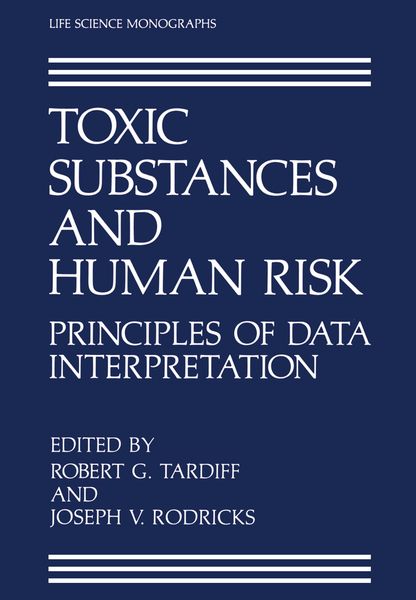
Toxic Substances and Human Risk Principles of Data Interpretation

Aus der Reihe Life Science Monographs

51,99 €

inkl. gesetzl. MwSt., Versandkostenfrei


Beschreibung

Produktdetails

Einband

Taschenbuch

Erscheinungsdatum

07.05.2012

Herausgeber

Robert G. Tardiff + weitere

Verlag

Springer Us

Seitenzahl

445

Maße (L/B/H)

24,4/17/2,5 cm

Gewicht

786 g

Auflage

1987

Sprache

Englisch

ISBN

978-1-4684-5292-1

Beschreibung

Produktdetails

Einband

Taschenbuch

Erscheinungsdatum

07.05.2012

Herausgeber

Verlag

Springer Us

Seitenzahl

445

Maße (L/B/H)

24,4/17/2,5 cm

Gewicht

786 g

Auflage

1987

Sprache

Englisch

ISBN

978-1-4684-5292-1

Herstelleradresse

Springer-Verlag GmbH
Tiergartenstr. 17
69121 Heidelberg
DE

Email: GPSR Kontakt

Noch keine Bewertungen vorhanden

Verfassen Sie die erste Bewertung zu diesem Artikel

Helfen Sie anderen Kundinnen und Kunden durch Ihre Meinung.

Kundinnen und Kunden meinen

Bewertungen (0)

  • Produktbild: Toxic Substances and Human Risk
  • Produktbild: Toxic Substances and Human Risk
  • I • Historical Perspectives And General Concepts.- 1 • Introduction.- 2 • Toxicologic Units.- Units Used in Animal Studies.- Units Used to Estimate Acceptable Human Exposure Levels.- Risk Indices Used in Epidemiology.- Appendix: Abbreviations of Toxicological Units.- References.- 3 • Dose-Response Relationships.- Dose-Response Curves.- The Probit Model.- Applications: Therapeutic Index and Margin of Safety.- Exploration of the “Threshold” Region.- Unusual Dose-Response Curves.- Other Dose-Response Models.- Summary and Conclusions.- References.- 4 • Factors Modifying Toxicity.- Species.- Strain.- Age.- Sex.- Nutrition.- Timing.- Lifestyle.- Health Status.- Summary and Conclusions.- References.- 5 • Statistical Interpretation of Toxicity Data.- Statistical Tests for Toxicity.- Estimation of Toxic Effects.- References.- II • Interpretation Of Information From Human Studies.- 6 • Clinical and Epidemiological Studies.- The Principal Types of Human Study.- Limitations of Epidemiological Study Designs.- Conclusion.- References.- 7 • Comprehensive Evaluation of Human Data.- The Nature of Epidemiological Reasoning.- Establishing Causality: Qualitative Aspects of Data Evaluation.- Quantitative Aspects of Data Evaluation.- Conclusions.- References.- III • Interpretation Of in Vivo Experimental Data For Evaluation Of Hazards To Humans.- 8 • Selection of Animal Models for DataInterpretation.- Healthy versus Diseased Animals.- Young, Mature, or Old Animals.- Nutritional Status of Animals.- References.- 9 • Toxicokinetics.- Basic Concepts of Toxicokinetics.- Parameters of First-Order Toxicokinetics.- Correlation of Toxicokinetics and Action.- Toxicokinetics and Toxicology.- A Basic Toxicokinetic Model for Toxicology.- Deduction of Toxicokinetics with Biophasic Steady-State Concentrations of Toxicant.- Toxicokinetics on Chronic Toxicant Administration When Tissues Are Not Equilibrated Instantaneously.- The Time Course of Toxicity on Acute Administration of a Toxicant.- Dose Dependences of Acute Toxicity with Nonsaturable Toxic Receptor Sites.- Dose Dependences of Acute Toxicities with Saturable Toxic Receptor Sites.- Deduction of Pharmacokinetic Properties of a Toxicant from Acute Toxicity Studies.- Critique of Models for Toxicity.- References.- 10 • Approaches to Intraspecies DoseExtrapolation.- Mathematical Models of Dose-Response Relationship.- Comparisons of Specific Models.- Extrapolation of Human Epidemiological Data.- Summary and Conclusions.- References.- 11 • Extrapolation from Animal Data.- Evolutionary Theory As the Practical Basis of Predictive Toxicology.- Guiding Principles for Animal Extrapolation.- Generalizations of Practical Value.- Animal Models for High-Risk Groups.- Quantitative Risk Assessment.- Conclusion.- References.- 12 • Approaches to Route Extrapolation.- The Stokinger-Woodward Approach.- First-Pass Effects.- Summary.- References.- 13 • Application of in Vivo Data onChemical-Biological Interactions.- Metabolism, Detoxification, and Bioactivation.- Use of Covalent Binding Data in Interpreting Results of Toxicity Studies.- Information Necessary for More Predictive Use of Covalent Binding Data in Risk Assessment.- Conclusions.- References.- 14 • Computer-Assisted Prediction of Toxicity.- Cautions Regarding Applicability of Models.- Statistical Methodology.- Estimator for Rat Oral LD50.- Estimator for Probability of Mutagenicity.- Estimator for Probability of Carcinogenicity.- Estimator for Probability of Teratogenicity.- Interspecies and Other Models.- Summary.- References.- IV • Interpretation Of In Vitro Experimental Data For Evaluation Of Hazards To Humans.- 15 • Assessment of the Hazard of Genetic Toxicity.- Terminology.- Human Health Effects Associated with Exposure to Genotoxic Agents.- Methods to Identify the Hazard of Genetic Toxicity.- Assessment of Genetic Risk.- Limitations of Quantitative and Qualitative Extrapolation.- Conclusions.- References.- 16 • Evaluation of Xenobiotic Metabolism.- Categories of Toxic Chemicals.- Metabolic Activation.- Characteristics of Reactive Metabolites.- Strategies for Studying the Reactivity of a Toxic Chemical.- Limitations and Perturbations of the Toxic Response.- The Role of Metabolic Studies in the Evaluation of Toxicity.- Extrapolation from in Vitro Experiments to Living Animals.- Summary.- References.- V • Risk Analysis.- 17 • Exposure Assessment.- Expressions of Exposure.- Conventional Approaches.- An Alternative Approach: “Backward Tracing”.- Example of Backward Tracing: Soaps and Detergents.- Some Observations on Backward Tracing.- References.- 18 • Comprehensive Risk Assessment.- Definitions of Terms.- Analytic Stages.- Defining the Risk Question.- Data Collection.- Evaluation of Individual Studies of Toxicity and Dose Response.- Critical Data Points.- Comprehensive Evaluation of Toxicity Data.- Combining the Evidence.- Other Schemes.- Conclusion.- Human Exposure Assessment.- Risk Characterization.- Selection of Studies and Data Points for Risk Assessment.- Options for Data Selection.- Criteria for Data Selection.- Negative and Presumably Conflicting Data.- Uncertainties Introduced in Data Selection.- Utilization of Selected Data.- Interspecies Extrapolation.- Final Risk Assessment.- References.