KI-Beratung Beta

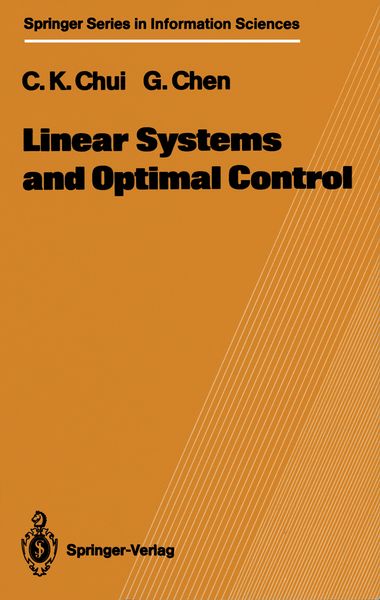
  • Produktbild: Linear Systems and Optimal Control
  • Produktbild: Linear Systems and Optimal Control
Band 18

Linear Systems and Optimal Control

49,99 €

inkl. gesetzl. MwSt., Versandkostenfrei


Beschreibung

A knowledge of linear systems provides a firm foundation for the study of optimal control theory and many areas of system theory and signal processing. State-space techniques developed since the early sixties have been proved to be very effective. The main objective of this book is to present a brief...

Beschreibung

A knowledge of linear systems provides a firm foundation for the study of optimal control theory and many areas of system theory and signal processing. State-space techniques developed since the early sixties have been proved to be very effective. The main objective of this book is to present a brief and somewhat complete investigation on the theory of linear systems, with emphasis on these techniques, in both continuous-time and discrete-time settings, and to demonstrate an application to the study of elementary (linear and nonlinear) optimal control theory. An essential feature of the state-space approach is that both time-varying and time-invariant systems are treated systematically. When time-varying systems are considered, another important subject that depends very much on the state-space formulation is perhaps real-time filtering, prediction, and smoothing via the Kalman filter. This subject is treated in our monograph entitled "Kalman Filtering with Real-Time Applications" published in this Springer Series in Information Sciences (Volume 17). For time-invariant systems, the recent frequency domain approaches using the techniques of Adamjan, Arov, and Krein (also known as AAK), balanced realization, and oo H theory via Nevanlinna-Pick interpolation seem very promising, and this will be studied in our forthcoming monograph entitled "Mathematical Ap proach to Signal Processing and System Theory". The present elementary treatise on linear system theory should provide enough engineering and mathe of these two subjects.

Produktdetails

Einband

Taschenbuch

Erscheinungsdatum

15.04.2014

Abbildungen

VIII, 155 p. 1 illus.

Verlag Springer Berlin

Produktdetails

Einband

Taschenbuch

Erscheinungsdatum

15.04.2014

Abbildungen

VIII, 155 p. 1 illus.

Verlag Springer Berlin
Seitenzahl

155

Maße (L/B/H)

23,5/15,5/1 cm

Gewicht

265 g

Auflage

Softcover reprint of the original 1st ed. 1989

Sprache

Englisch

ISBN

978-3-642-64787-1

Herstelleradresse

Springer-Verlag KG
Sachsenplatz 4-6
1201 Wien
AT

Email: ProductSafety@springernature.com

Noch keine Bewertungen vorhanden

Verfassen Sie die erste Bewertung zu diesem Artikel

Helfen Sie anderen Kundinnen und Kunden durch Ihre Meinung.

Kundinnen und Kunden meinen

Bewertungen (0)

  • Produktbild: Linear Systems and Optimal Control
  • Produktbild: Linear Systems and Optimal Control
  • 1. State-Space Descriptions.- 1.1 Introduction.- 1.2 An Example of Input-Output Relations.- 1.3 An Example of State-Space Descriptions.- 1.4 State-Space Models.- Exercises.- 2. State Transition Equations and Matrices.- 2.1 Continuous-Time Linear Systems.- 2.2 Picard’s Iteration.- 2.3 Discrete-Time Linear Systems.- 2.4 Discretization.- Exercises.- 3. Controllability.- 3.1 Control and Observation Equations.- 3.2 Controllability of Continuous-Time Linear Systems.- 3.3 Complete Controllability of Continuous-Time Linear Systems.- 3.4 Controllability and Complete Controllability of Discrete-Time Linear Systems.- Exercises.- 4. Observability and Dual Systems.- 4.1 Observability of Continuous-Time Linear Systems.- 4.2 Observability of Discrete-Time Linear Systems.- 4.3 Duality of Linear Systems.- 4.4 Dual Time-Varying Discrete-Time Linear Systems.- Exercises.- 5. Time-Invariant Linear Systems.- 5.1 Preliminary Remarks.- 5.2 The Kalman Canonical Decomposition.- 5.3 Transfer Functions.- 5.4 Pole-Zero Cancellation of Transfer Functions.- Exercises.- 6. Stability.- 6.1 Free Systems and Equilibrium Points.- 6.2 State-Stability of Continuous-Time Linear Systems.- 6.3 State-Stability of Discrete-Time Linear Systems.- 6.4 Input-Output Stability of Continuous-Time Linear Systems.- 6.5 Input-Output Stability of Discrete-Time Linear Systems.- Exercises.- 7. Optimal Control Problems and Variational Methods.- 7.1 The Lagrange, Bolza, and Mayer Problems.- 7.2 A Variational Method for Continuous-Time Systems.- 7.3 Two Examples.- 7.4 A Variational Method for Discrete-Time Systems.- Exercises.- 8. Dynamic Programming.- 8.1 The Optimality Principle.- 8.2 Continuous-Time Dynamic Programming.- 8.3 Discrete-Time Dynamic Programming.- 8.4 The Minimum Principle of Pontryagin.- Exercises.- 9.Minimum-Time Optimal Control Problems.- 9.1 Existence of the Optimal Control Function.- 9.2 The Bang-Bang Principle.- 9.3 The Minimum Principle of Pontryagin for Minimum-Time Optimal Control Problems.- 9.4 Normal Systems.- Exercises.- 10. Notes and References.- 10.1 Reachability and Constructibility.- 10.2 Differential Controllability.- 10.3 State Reconstruction and Observers.- 10.4 The Kalman Canonical Decomposition.- 10.5 Minimal Realization.- 10.6 Stability of Nonlinear Systems.- 10.7 Stabilization.- 10.8 Matrix Riccati Equations.- 10.9 Pontryagin’s Maximum Principle.- 10.10 Optimal Control of Distributed Parameter Systems.- 10.11 Stochastic Optimal Control.- References.- Answers and Hints to Exercises.- Notation.