KI-Beratung Beta

Gutscheinbedingungen

**Gültig bis 30.11.2026 auf Spielzeug, Schreibwaren, Filme, Geschenke & Trends, Musik, tolino eReader & Zubehör, Hörbücher und Hörbuch-Downloads, nicht preisgebundene Bücher und Kalender online auf thalia.at und in der Thalia App. Einzelne Artikel können ausgeschlossen sein. Aufgrund der Buchpreisbindung sind deutschsprachige Bücher und eBooks ausgenommen. Zusätzlich ausgenommen sind Abos & Flatrates, Games, Geschenkkarten/-boxen, Shelfies, Software, Zeitschriften sowie einzelne Artikel von tonies®. Pro Einkauf einmal einlösbar. Nur gültig mit im Onlineshop hinterlegter Bonuscard. Click & Collect nur bei Onlinevorabzahlung möglich. Keine Barauszahlung. Nicht kombinierbar mit anderen Aktionen und Gutscheinen. Gutschein wird auf max. 500€ Bestellwert angerechnet. Nicht gültig für Versandkosten und Services.

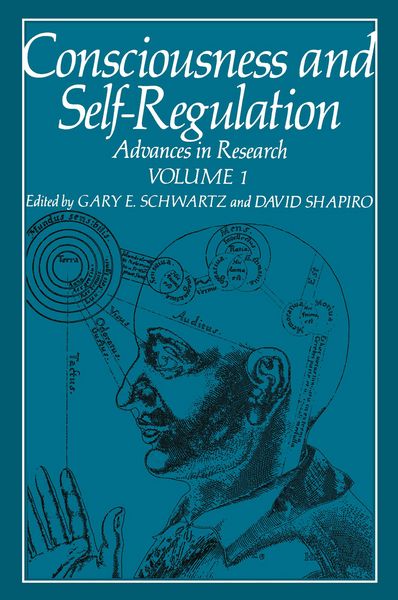
  • Produktbild: Consciousness and Self-Regulation
  • Produktbild: Consciousness and Self-Regulation

Consciousness and Self-Regulation Advances in Research Volume 1

49,99 €

inkl. gesetzl. MwSt., Versandkostenfrei


Beschreibung

The first and foremost concrete fact which every one will affirm to belong to his inner experience is the fact that consciousness of some sort goes on. I -William James, 1893 We are witnessing today a mounting interest among behavioral and biological scientists in problems long recognized as central...

Beschreibung

The first and foremost concrete fact which every one will affirm to belong to his inner experience is the fact that consciousness of some sort goes on. I -William James, 1893 We are witnessing today a mounting interest among behavioral and biological scientists in problems long recognized as central to our understanding of human nature, yet until recently considered out of the bounds of scientific psychology and physiology. Sometimes thrown into the heading of "altered states of consciousness," this growing research bears directly upon such time-honored questions as the nature of conscious experience, the mind-body relationship, and volition. If one broadly views this research as encompassing the two interrelated areas of consciousness and self-regulation, one can find many relevant contemporary examples of creative and experimentally sophisticated approaches, including research on the regulation of perception and sensory experience, attention, imagery and thinking, emotion and pain; hypnosis and meditation; biofeedback and volun tary control; hemispheric asymmetry and specialization of brain func tion; drug-induced subjective states; and biological rhythms. Because the material is spread over many different kinds of publications and disciplines, it is difficult for anyone person to keep fully abreast of the significant advances. The overall aim of the new Plenum Series in Consciousness and Self-Regulation: Advances in Research is to provide a scholarly forum for discussing integration of these diverse areas by presenting some of the best current research and theory.

Produktdetails

Einband

Taschenbuch

Erscheinungsdatum

08.03.2012

Abbildungen

XXII, 400 p. 55 illus.

Verlag Springer Us

Produktdetails

Einband

Taschenbuch

Erscheinungsdatum

08.03.2012

Abbildungen

XXII, 400 p. 55 illus.

Verlag Springer Us
Seitenzahl

400

Maße (L/B/H)

22,9/15,2/2,3 cm

Gewicht

611 g

Auflage

Softcover Reprint of the Original 1st 1976 edition

Sprache

Englisch

ISBN

978-1-4684-2570-3

Herstelleradresse

Libri GmbH
Europaallee 1
36244 Bad Hersfeld
DE

Email: gpsr@libri.de

Noch keine Bewertungen vorhanden

Verfassen Sie die erste Bewertung zu diesem Artikel

Helfen Sie anderen Kundinnen und Kunden durch Ihre Meinung.

Kundinnen und Kunden meinen

Bewertungen (0)

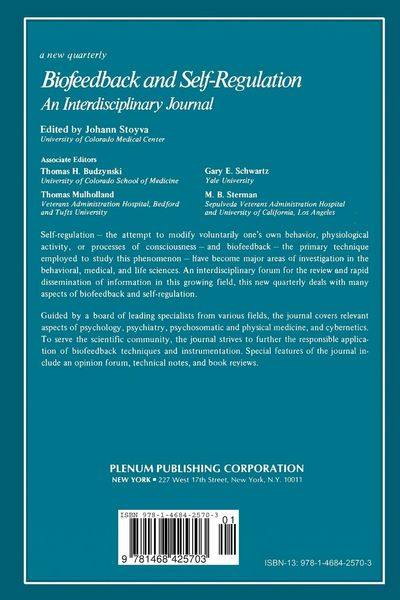
  • Produktbild: Consciousness and Self-Regulation
  • Produktbild: Consciousness and Self-Regulation
  • 1 A Model of Consciousness.- I. Levels of Information.- II. A Personal Research Strategy.- III. EEG Studies.- IV. Average Evoked Potentials.- V. Unit Studies.- VI. Brain Stimulation Studies.- VII. Theoretical Discussion of Electrophysiological Evidence.- 2. Self-Consciousness and Intentionality: A Model Based on an Experimental Analysis of the Brain Mechanisms Involved in the Jamesian Theory of Motivation and Emotion.- I. A Neurobehavioral Analysis of Brain Mechanisms in Motivation and Emotion.- II. The Role of Attention in Motivational and Emotional Reactions.- III. Effort and the Expression of Motivation and Emotion.- IV. A Control-Theory Model of Self-Regulation and Self- Consciousness.- 3. Self-Regulation of Stimulus Intensity: Augmenting/ Reducing and the Average Evoked Response.- I. Introduction.- II. Sensory Experience and Augmenting/Reducing.- III. Amplitude/Intensity Relationships in Man.- IV. Augmenting/Reducing Reliability and the Measurement of the AER.- V. Genetic Factors in Augmenting/Reducing.- VI. Tolerance for High-Intensity Stimulation.- VII. Effects of Arousal, Attention, and Sensory Overload.- VIII. Individual Differences and Intensity Judgments.- IX. Sensory Sensitivity and “Strength of the Nervous System”.- X. Self-Regulation and Sensory Homeostasis.- 4. Neodissociation Theory of Multiple Cognitive Control Systems.- I. Pierre Janet’s Theory of Dissociation.- II. Why a Neodissociation Theory?.- III. The Hypnotic Model.- IV. Neodissociation Model of Multiple Cognitive Control Structures.- V. Empirical Approaches to Multiple Control Structures and Divisions of Consciousness.- VI. The Duality of Responsiveness to Pain as Related to Neodissociation Theory.- VII. Conclusion.- 5. Hypnotic Susceptibility, EEG-Alpha, and Self-Regulation.- I.Introduction.- II. The Assessment of Hypnotic Susceptibility.- III. Stability of Hypnotic Susceptibility.- IV. Modification of Hypnotic Susceptibility.- V. Hypnotic Susceptibility and Personality.- VI. Hypnosis and the EEG.- VII. EEG and Hypnotic Susceptibility: Indirect Relationships.- VIII. EEG and Hypnotic Susceptibility: Direct Evidence.- IX. The Stability of EEG Base Rates.- X. Increasing Susceptibility by EEG Feedback.- XI. Changes in EEG during Hypnosis.- XII. Task-Specific EEG Changes.- XIII. Conclusions.- 6. Toward a Cognitive Theory of Self-Control.- I. Introduction.- II. Conclusions from Treatment.- III. A Cognitive Theory of Self-Control.- IV. Summary.- 7. Physiological and Cognitive Processes in the Regulation of Anxiety.- I. A Descriptive Model of Anxiety Process.- II. Research Studies on the Maintenance and Reduction of Anxiety.- III. Summary and Conclusions.- 8. Dreaming: Experimental Investigation of Representational and Adaptive Properties.- I. Dream Recall.- II. Representational Properties of Dreaming.- III. Functional Properties of Dreaming.- 9. Biofeedback and the Twilight States of Consciousness.- I. The Twilight State.- II. Future Considerations.- Author Index.