KI-Beratung Beta

Gutscheinbedingungen

**Gültig am 20.11.2026 ab einem Mindestbestellwert von 30€ auf Spielzeug, Schreibwaren, Filme, Geschenke & Trends, Musik, tolino eReader & Zubehör, Hörbücher und Hörbuch-Downloads, nicht preisgebundene Bücher und Kalender online auf thalia.at und in der Thalia App. Einzelne Artikel können ausgeschlossen sein. Aufgrund der Buchpreisbindung sind deutschsprachige Bücher und eBooks ausgenommen. Zusätzlich ausgenommen sind Abos & Flatrates, Games, Geschenkkarten/-boxen, Shelfies, Software, Zeitschriften sowie einzelne Artikel von tonies®. Pro Einkauf einmal einlösbar. Click & Collect nur bei Onlinevorabzahlung möglich. Keine Barauszahlung. Nicht kombinierbar mit anderen Aktionen und Gutscheinen. Gutschein wird auf max. 500€ Bestellwert angerechnet. Nicht gültig für Versandkosten und Services. Preisgebundene Artikel sind vom Mindestbestellwert ausgeschlossen.

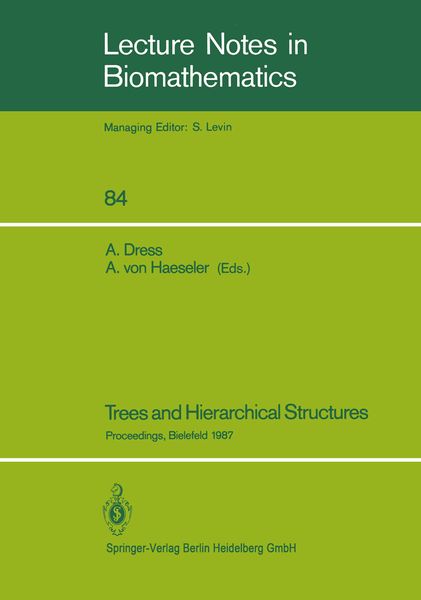
  • Produktbild: Trees and Hierarchical Structures
  • Produktbild: Trees and Hierarchical Structures
Band 84

Trees and Hierarchical Structures Proceedings of a Conference held at Bielefeld, FRG, Oct. 5–9th, 1987

51,99 €

inkl. gesetzl. MwSt., Versandkostenfrei


Beschreibung

The "raison d'etre" of hierarchical dustering theory stems from one basic phe nomenon: This is the notorious non-transitivity of similarity relations. In spite of the fact that very often two objects may be quite similar to a third without being that similar to each other, one still wants to dassify...

Beschreibung

The "raison d'etre" of hierarchical dustering theory stems from one basic phe nomenon: This is the notorious non-transitivity of similarity relations. In spite of the fact that very often two objects may be quite similar to a third without being that similar to each other, one still wants to dassify objects according to their similarity. This should be achieved by grouping them into a hierarchy of non-overlapping dusters such that any two objects in ~ne duster appear to be more related to each other than they are to objects outside this duster. In everyday life, as well as in essentially every field of scientific investigation, there is an urge to reduce complexity by recognizing and establishing reasonable das sification schemes. Unfortunately, this is counterbalanced by the experience of seemingly unavoidable deadlocks caused by the existence of sequences of objects, each comparatively similar to the next, but the last rather different from the first.

Produktdetails

Einband

Taschenbuch

Erscheinungsdatum

04.04.1990

Abbildungen

III, 140 p. 1 illus.

Herausgeber Andreas Dress + weitere

Produktdetails

Einband

Taschenbuch

Erscheinungsdatum

04.04.1990

Abbildungen

III, 140 p. 1 illus.

Herausgeber
Verlag Springer Berlin
Seitenzahl

140

Maße (L/B/H)

24,2/17/0,9 cm

Gewicht

267 g

Auflage

1990

Sprache

Englisch

ISBN

978-3-540-52453-3

Herstelleradresse

Springer-Verlag GmbH
Tiergartenstr. 17
69121 Heidelberg
DE

Email: ProductSafety@springernature.com

Noch keine Bewertungen vorhanden

Verfassen Sie die erste Bewertung zu diesem Artikel

Helfen Sie anderen Kundinnen und Kunden durch Ihre Meinung.

Kundinnen und Kunden meinen

Bewertungen (0)

  • Produktbild: Trees and Hierarchical Structures
  • Produktbild: Trees and Hierarchical Structures
  • 1. Introduction.- 2. Reconstruction of Phylogenies by Distance Data: Mathematical Framework and Statistical Analysis.- 3. Additive-Tree Representations.- 4. Finding the Minimal Change in a Given Tree.- 5. Search, Parallelism, Comparison, and Evaluation: Algorithms for Evolutionary Trees.- 6. The Phylogeny of Prochloron: Is there Numerical Evidence from SAB Values? A Response to van Valen.- 7. Evolution of the Collagen Fibril by Duplication and Diversification of a Small Primordial Exon Unit.- 8. The Poincare Paradox and The Cluster Problem.- 9. An incremental Error Correcting Evaluation Algorithm for Recursion Networks without Circuits.