Beschreibung
Produktdetails
Einband
Gebundene Ausgabe
Erscheinungsdatum
29.10.2020
Herausgeber
Desiderio Vincent J. + weitereVerlag
John Wiley & Sons IncSeitenzahl
480
Maße (L/B/H)
25,5/18,2/2,7 cm
Gewicht
1168 g
Auflage
1. Auflage
Sprache
Englisch
ISBN
978-1-118-96211-4
Covers new trace evidence techniques and expanding areas of analysis, along with key theory and applications
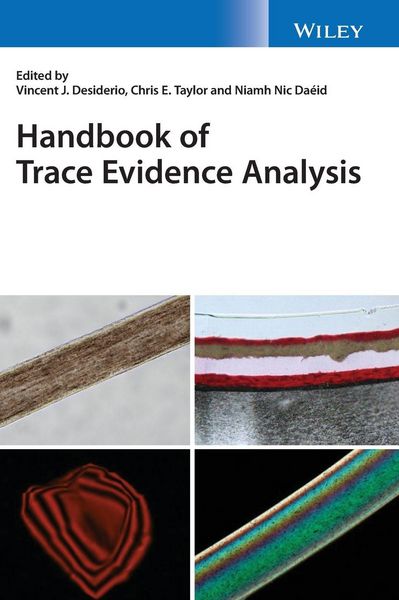
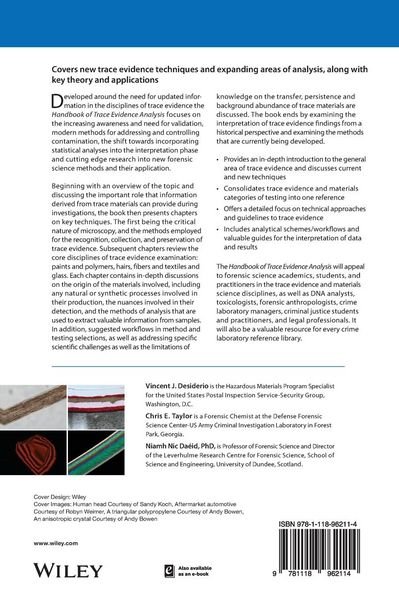
Developed around the need for updated information in the disciplines of trace evidence the Handbook of Trace Evidence Analysis focuses on the increasing awareness and need for validation, modern methods for addressing and controlling contamination, the shift towards incorporating statistical analyses into the interpretation phase and cutting edge research into new forensic science methods and their application.
Beginning with an overview of the topic and discussing the important role that information derived from trace materials can provide during investigations, the book then presents chapters on key techniques. The first being the critical nature of microscopy, and the methods employed for the recognition, collection, and preservation of trace evidence. Subsequent chapters review the core disciplines of trace evidence examination: paints and polymers, hairs, fibers and textiles and glass. Each chapter contains in-depth discussions on the origin of the materials involved, including any natural or synthetic processes involved in their production, the nuances involved in their detection, and the methods of analysis that are used to extract valuable information from samples. In addition, suggested workflows in method and testing selections, as well as addressing specific scientific challenges as well as the limitations of knowledge on the transfer, persistence and background abundance of trace materials are discussed. The book ends by examining the interpretation of trace evidence findings from a historical perspective and examining the methods that are currently being developed.
* Provides an in-depth introduction to the general area of trace evidence and discusses current and new techniques
* Consolidates trace evidence and materials categories of testing into one reference series
* Offers a detailed focus on technical approaches and guidelines to trace evidence
* Includes analytical schemes/workflows and valuable guides for the interpretation of data and results
The Handbook of Trace Evidence will appeal to forensic science academics, students, and practitioners in the trace evidence and materials science disciplines, as well as DNA analysts, toxicologists, forensic anthropologists, crime laboratory managers, criminal justice students and practitioners, and legal professionals. It would also be a valuable resource for every crime laboratory reference library.
Developed around the need for updated information in the disciplines of trace evidence the Handbook of Trace Evidence Analysis focuses on the increasing awareness and need for validation, modern methods for addressing and controlling contamination, the shift towards incorporating statistical analyses into the interpretation phase and cutting edge research into new forensic science methods and their application.
Beginning with an overview of the topic and discussing the important role that information derived from trace materials can provide during investigations, the book then presents chapters on key techniques. The first being the critical nature of microscopy, and the methods employed for the recognition, collection, and preservation of trace evidence. Subsequent chapters review the core disciplines of trace evidence examination: paints and polymers, hairs, fibers and textiles and glass. Each chapter contains in-depth discussions on the origin of the materials involved, including any natural or synthetic processes involved in their production, the nuances involved in their detection, and the methods of analysis that are used to extract valuable information from samples. In addition, suggested workflows in method and testing selections, as well as addressing specific scientific challenges as well as the limitations of knowledge on the transfer, persistence and background abundance of trace materials are discussed. The book ends by examining the interpretation of trace evidence findings from a historical perspective and examining the methods that are currently being developed.
* Provides an in-depth introduction to the general area of trace evidence and discusses current and new techniques
* Consolidates trace evidence and materials categories of testing into one reference series
* Offers a detailed focus on technical approaches and guidelines to trace evidence
* Includes analytical schemes/workflows and valuable guides for the interpretation of data and results
The Handbook of Trace Evidence will appeal to forensic science academics, students, and practitioners in the trace evidence and materials science disciplines, as well as DNA analysts, toxicologists, forensic anthropologists, crime laboratory managers, criminal justice students and practitioners, and legal professionals. It would also be a valuable resource for every crime laboratory reference library.
Noch keine Bewertungen vorhanden
Verfassen Sie die erste Bewertung zu diesem Artikel
Helfen Sie anderen Kundinnen und Kunden durch Ihre Meinung.
Kurze Frage zu unserer Seite
Vielen Dank für Ihr Feedback
Wir nutzen Ihr Feedback, um unsere Produktseiten zu verbessern. Bitte haben Sie Verständnis, dass wir Ihnen keine Rückmeldung geben können. Falls Sie Kontakt mit uns aufnehmen möchten, können Sie sich aber gerne an unseren Kund*innenservice wenden.
zum Kundenservice