Gutscheinbedingungen

**Gültig bis 06.07.2026 auf fremdsprachige Bücher online auf thalia.at, in der Thalia App ab einem Mindestbestellwert von 30€ und in allen Thalia Buchhandlungen in Österreich. In den Buchhandlungen nur gültig auf lagernde Ware. Einzelne Artikel können ausgeschlossen sein. Ausgenommen sind preisgebundene Artikel & eBooks. Pro Einkauf einmal einlösbar. Nur gültig gegen Vorlage oder im Onlineshop hinterlegter Bonuscard. Infos zur Einlösung in der Buchhandlung sind auf der Bonuscard-Vorteilspreisseite zu finden. Click & Collect nur bei Onlinevorabzahlung möglich. Keine Einlösung bei Scan & Go-Bezahlung. Keine Barauszahlung. Nicht kombinierbar mit anderen Aktionen und Gutscheinen. Gutschein wird auf max. 500€ Bestellwert angerechnet. Nicht gültig für Versandkosten und Services.

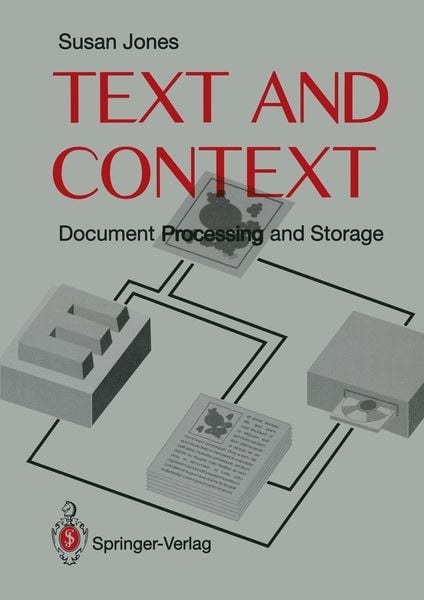
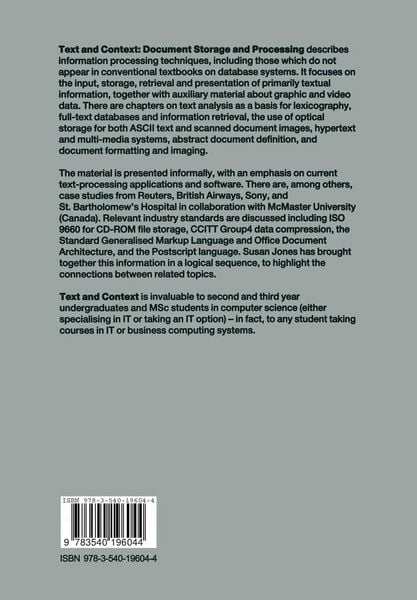
  • Produktbild: Text and Context
  • Produktbild: Text and Context

Text and Context Document Storage and Processing

49,99 €

inkl. gesetzl. MwSt., Versandkostenfrei


Beschreibung

Produktdetails

Einband

Taschenbuch

Erscheinungsdatum

29.05.1991

Verlag

Springer Berlin

Seitenzahl

298

Maße (L/B/H)

24,2/17/1,8 cm

Gewicht

544 g

Auflage

Softcover reprint of the original 1st ed. 1991

Sprache

Englisch

ISBN

978-3-540-19604-4

Beschreibung

Produktdetails

Einband

Taschenbuch

Erscheinungsdatum

29.05.1991

Verlag

Springer Berlin

Seitenzahl

298

Maße (L/B/H)

24,2/17/1,8 cm

Gewicht

544 g

Auflage

Softcover reprint of the original 1st ed. 1991

Sprache

Englisch

ISBN

978-3-540-19604-4

Herstelleradresse

Springer-Verlag KG
Sachsenplatz 4-6
1201 Wien
AT

Email: GPSR Kontakt

Noch keine Bewertungen vorhanden

Verfassen Sie die erste Bewertung zu diesem Artikel

Helfen Sie anderen Kundinnen und Kunden durch Ihre Meinung.

Kundinnen und Kunden meinen

Bewertungen (0)

  • Produktbild: Text and Context
  • Produktbild: Text and Context
  • One Introduction and Overview.- Data Capture.- Storage.- Searching.- Presentation.- Applications.- Two Fundamentals of Text Processing.- Natural Language as Data.- Representing Text.- Computers in Lexicography.- The Cobuild Project.- Obtaining the Corpus.- Basic Text Analysis.- Interactive and Dynamic Use of a Corpus.- Building the Dictionary Database.- Generating a Dictionary Text.- Summary.- Investigations.- References.- Three Information Retrieval I.- Definitions.- Information Retrieval Services.- Query Languages.- Database Design for a Co-ordinate Indexing System.- Word Occurrence Vectors and Document Signatures.- Assessment of IR Systems.- Improving Search Performance.- Thesauri.- Faceting.- Stop-lists.- Dealing with Variant Spellings.- Conflation, Suffix-stripping, Stemming, Lemmatisation.- Proximity Searching.- Ranking Retrieved Documents in Order of Relevance.- Exploiting Connections Within the Database.- Summary.- Investigations.- References.- Four Information Retrieval II.- The Move Towards Full-text Systems.- Reuters Newsbank.- Selection and Indexing.- Validation and Updating.- Searching.- The Status Text Retrieval System.- The ICL CAFS Extension.- Oracle SQL*Textretrieval.- Extensions to the Relational Model.- Extensions to SQL.- Handling Queries.- Text Compression Techniques.- Compression by Substitution.- Run-length Encoding.- Two-dimensional Encoding.- Summary.- Investigations.- References.- Five Introduction to Optical Storage.- The Physical Level.- Investigations.- References.- Six CD-ROM.- Physical Data Representation Methods.- Standards for CD-ROM Logical Structure.- Volumes.- Directories and Path Tables.- Files.- The Standard in Practice.- Example Applications.- Whitaker’s Bookbank.- The Possible Impact of CD-ROM on Libraries.- British Airways Technical Publications.- Background.- The Feasibility Study.- Structure of the Manuals.- System Operation.- Extensions.- Summary.- Investigations.- References.- Seven Worm Disc and Document Image Processing.- Overview of Worm Disc Characteristics.- Logical Data Organisation — Requirements and Strategies.- Worm Disc Applications.- An Optical Storage Archiving and Retrieval System.- Document Preparation.- Scanning.- Compression.- Verification/Processing.- Indexing.- Storage.- Retrieval.- Printing.- Conclusions.- Summary.- Investigations.- References.- Eight Video Disc and Computer-Based Training.- Physical Characteristics.- Video Disc Control Functions.- Video Disc Applications.- Educational Software Overview.- CBT: Authoring Systems.- Example System 1: MacAid.- Frames.- Programming Commands.- Use of Video Disc in MacAid.- Use of MacAid for Video Databases.- Example System 2: Interactive Knowledge System.- IAS: Page Structure Definition.- Video/Audio Production.- Page Editing.- Courseware Presentation.- Summary.- Investigations.- References.- Nine Hypertext Principles.- What is it?.- Hypertext Systems.- Data Models.- Frame-based Systems.- Scrolling Systems.- Textual Relationships and Their Representation.- Hierarchical.- Sequential.- Referential.- Hypertext System Design Issues.- Textual Units or Nodes.- Textual Relationships or Links.- Searching and Browsing.- Authoring Hypertext.- Authoring with HyperCard.- Authoring with Guide.- Preprocessing and Verification.- Large Scale Document Management.- Hypertext in a Broader Context.- Summary.- Investigations.- References.- Ten Describing the Structure of Documents.- The Need for Standards.- General Principles of Document Structuring.- The Standard Generalized Markup Language.- What is Mark-up?.- Defining Documents with Replacement Rules.- Other SGML Language Features.- SGML in Use: Creating and Formatting Documents.- The Oxford English Dictionary.- Her Majesty’s Stationery Office: Statutory Instruments.- Office Document Architecture.- Contrasts with SGML.- Summary of the ODA Document Processing Model.- Defining a Document: Generic and Specific Structures.- The Document Layout Process.- Examples of Object Attributes.- Comments on the ODA Processing Model.- Summary.- Investigations.- References.- Eleven Formatting and Printing Documents.- The Development of Desk-top Publishing.- Models and Metaphors.- Functions of Formatting Software.- Overall Document/Page Design.- Representation of Logical Structures.- Selection of Layout Structures.- Text Filling.- Document Style/Use of Auxiliary Files.- Special Document Elements.- Utilities.- Behind the Scenes.- Troff/Nroff.- Macros, Conditionals, and Traps.- Environments.- Diversions.- TeX and LaTeX.- TeX Formatting.- Exploiting TeX Macro Facilities.- Summary.- Investigations.- References.- Twelve Postscript.- The Postscript Imaging Model.- Stacks.- Fonts.- An Example Program.- Postscript in Practice.- Summary.- Investigations.- References.