Gutscheinbedingungen

**Gültig bis 06.07.2026 auf fremdsprachige Bücher online auf thalia.at, in der Thalia App ab einem Mindestbestellwert von 30€ und in allen Thalia Buchhandlungen in Österreich. In den Buchhandlungen nur gültig auf lagernde Ware. Einzelne Artikel können ausgeschlossen sein. Ausgenommen sind preisgebundene Artikel & eBooks. Pro Einkauf einmal einlösbar. Nur gültig gegen Vorlage oder im Onlineshop hinterlegter Bonuscard. Infos zur Einlösung in der Buchhandlung sind auf der Bonuscard-Vorteilspreisseite zu finden. Click & Collect nur bei Onlinevorabzahlung möglich. Keine Einlösung bei Scan & Go-Bezahlung. Keine Barauszahlung. Nicht kombinierbar mit anderen Aktionen und Gutscheinen. Gutschein wird auf max. 500€ Bestellwert angerechnet. Nicht gültig für Versandkosten und Services.

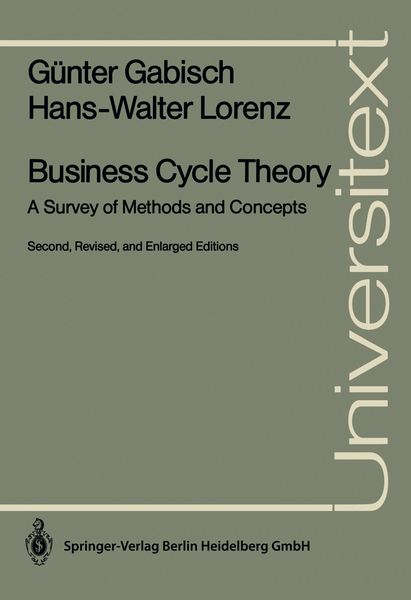
Produktbild: Business Cycle Theory

Business Cycle Theory A Survey of Methods and Concepts

Aus der Reihe Universitext

49,99 €

inkl. gesetzl. MwSt., Versandkostenfrei


Beschreibung

Produktdetails

Einband

Taschenbuch

Erscheinungsdatum

14.04.1989

Abbildungen

8 schwarzweisse Abbildungen, 9 Tabellen,

Verlag

Springer Berlin

Seitenzahl

250

Maße (L/B/H)

24,4/17/1,5 cm

Gewicht

462 g

Auflage

Second Edition 1989

Sprache

Englisch

ISBN

978-3-540-51059-8

Beschreibung

Produktdetails

Einband

Taschenbuch

Erscheinungsdatum

14.04.1989

Abbildungen

8 schwarzweisse Abbildungen, 9 Tabellen,

Verlag

Springer Berlin

Seitenzahl

250

Maße (L/B/H)

24,4/17/1,5 cm

Gewicht

462 g

Auflage

Second Edition 1989

Sprache

Englisch

ISBN

978-3-540-51059-8

Herstelleradresse

Springer-Verlag KG
Sachsenplatz 4-6
1201 Wien
AT

Email: GPSR Kontakt

Noch keine Bewertungen vorhanden

Verfassen Sie die erste Bewertung zu diesem Artikel

Helfen Sie anderen Kundinnen und Kunden durch Ihre Meinung.

Kundinnen und Kunden meinen

Bewertungen (0)

  • Produktbild: Business Cycle Theory
  • Preface.- 1. Fluctuations in Major Economic Variables.- 1.1. Periodic Patterns and Stylized Facts.- 1.2. The Measurement of the Business Cycle.- 1.2.1. Economic Indicators.- 1.2.1.1. Harvard Barometer.- 1.2.1.2. NBER Indicators.- 1.2.1.3. Indicators in Germany.- 1.2.1.4. Diagnosis and Prognosis by Means of Indicators.- 1.2.2. Capacity Utilization.- 1.2.2.1. Concepts Based on Single Factors of Production.- 1.2.2.2. Concepts Based on Production Functions.- 1.2.2.3. Wharton School Index and Surveys.- 2. Shock-Dependent Business Cycle Theories.- 2.1. Discrete-Time Shock-Dependent Models.- 2.1.1. Linear Models of the Cycle.- 2.1.1.1. The Basic Samuelson Model.- 2.1.1.2. Hicks’ Linear Accelerator.- 2.1.1.3. The Influence of Inventories.- 2.1.1.4. Monetary Aspects of the Cycle.- 2.1.2. Non-Linear Multiplier-Accelerator Models.- 2.1.2.1. Ceiling and Floor in the Hicks Model.- 2.1.2.2. The Influence of Ratchet Effects.- 2.2. Continuous-Time Shock-Dependent Models.- 2.3. The Kalecki Model and Mixed Difference-Differential Equations.- 2.4. The Relevance of Shock-Dependent Business Cycle Theories.- 3. Business Cycle Theory and Exogenous Shocks.- 3.1. The Political Business Cycle.- 3.1.1. Governmental Behavior as the Cause of Business Cycles.- 3.1.2. Implications of the Political Business Cycle.- 3.2. The Theory of Stochastic Business Cycles.- 3.2.1. Business Cycle Models with Stochastic Exogenous Influences.- 3.2.2. A Stochastic Business Cycle Model.- 3.3. The Rational Expectations Approach to Business Cycles.- 3.3.1. Expectations and Rationality in Economic Theory.- 3.3.2. The New Classical Macroeconomics.- 3.3.3. Rational Expectations Business Cycle Models.- 4. Shock-Independent Business Cycle Theorie.- 4.1. A Linear Shock-Independent Growth Cycle Model.- 4.2. Goodwin’s Quasi-Non-Linear Accelerator.- 4.3. Non-Linear Theories of the Cycle.- 4.3.1. Kaldor’s Non-Linear Investment and Savings Functions.- 4.3.2. The Poincaré-Bendixson Theorem and the Existence of Limit Cycles.- 4.3.2.1. Chang/Smyth’s Reformulation of the Kaldor Model.- 4.3.2.2. The Non-Linear Phillips Curve and the Cycle.- 4.3.2.3. Non-Walrasian Macroeconomics and the Business Cycle.- 4.3.3. Predator-Prey Interpretations of the Business Cycle.- 4.3.4. The Liénard-van der Pol Equation.- 4.3.4.1. The Uniqueness of Limit Cycles.- 4.3.4.2. The Kaldor Model as a Liénard Equation.- 4.3.5. The Hopf Bifurcation in Business Cycle Theory.- 4.3.5.1. The Hopf Bifurcation in the Continuous-Time Case.- 4.3.5.2. The Hopf Bifurcation in the Discrete-Time Case.- 5. Complex Motion in Business Cycle Models.- 5.1. Non-Linearities and Chaotic Movements.- 5.1.1. Chaos in Discrete-Time Models.- 5.1.2. Chaos and Business Cycles.- 5.1.3. Chaos in Higher-Dimensional Systems.- 5.1.4. Numerical Techniques and the Empirical Evidence of Chaos.- 5.2. Catastrophe Theory and Business Cycle Theory.- 5.2.1. Basic Ideas of Catastrophe Theory.- 5.2.2. The Kaldor Model in the Light of Catastrophe Theory.- 5.3. Structural Instability and Business Cycle Theory - Conclusions.- References.- Name Index.