KI-Beratung Beta

  • Produktbild: Corpus Analysis for Descriptive and Pedagogical Purposes
  • Produktbild: Corpus Analysis for Descriptive and Pedagogical Purposes
Band 200

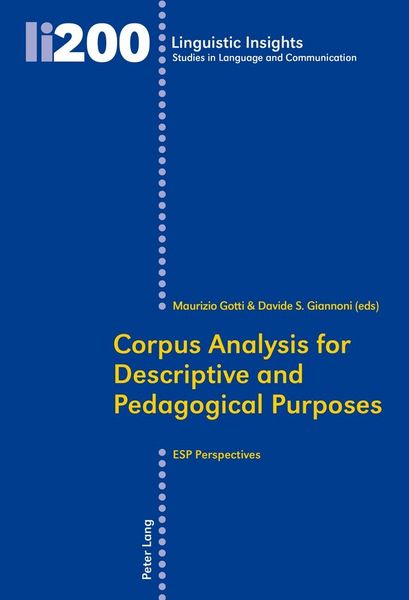
Corpus Analysis for Descriptive and Pedagogical Purposes ESP Perspectives

Aus der Reihe Linguistic Insights

130,85 €

inkl. gesetzl. MwSt., Versandkostenfrei


Beschreibung

There is hardly any aspect of verbal communication that has not been investigated using the analytical tools developed by corpus linguists. This is especially true in the case of English, which commands a vast international research community, and corpora are becoming increasingly specialised, as they...

Beschreibung

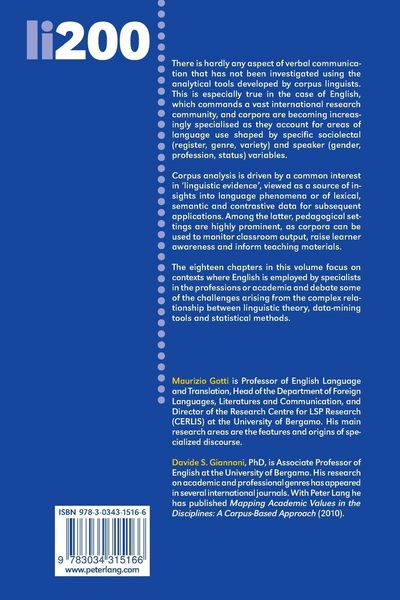
There is hardly any aspect of verbal communication that has not been investigated using the analytical tools developed by corpus linguists. This is especially true in the case of English, which commands a vast international research community, and corpora are becoming increasingly specialised, as they account for areas of language use shaped by specific sociolectal (register, genre, variety) and speaker (gender, profession, status) variables. Corpus analysis is driven by a common interest in ‘linguistic evidence’, viewed as a source of insights into language phenomena or of lexical, semantic and contrastive data for subsequent applications. Among the latter, pedagogical settings are highly prominent, as corpora can be used to monitor classroom output, raise learner awareness and inform teaching materials. The eighteen chapters in this volume focus on contexts where English is employed by specialists in the professions or academia and debate some of the challenges arising from the complex relationship between linguistic theory, data-mining tools and statistical methods.

Portrait

Maurizio Gotti is Professor of English Language and Translation, Head of the Department of Foreign Languages, Literatures and Communication, and Director of the Research Centre for LSP Research (CERLIS) at the University of Bergamo. His main research areas are the features and origins of specialized discourse. Davide S. Giannoni, PhD, is Associate Professor of English Language and Linguistics at the University of Bergamo. His research on academic and professional genres has appeared in several international journals. With Peter Lang he has published Mapping Academic Values in the Disciplines: A Corpus-Based Approach (2010).

Produktdetails

Einband

Taschenbuch

Erscheinungsdatum

18.03.2014

Herausgeber Maurizio Gotti + weitere
Verlag Peter Lang Group AG, International Academic Publishers

Produktdetails

Einband

Taschenbuch

Erscheinungsdatum

18.03.2014

Herausgeber
Verlag Peter Lang Group AG, International Academic Publishers
Seitenzahl

432

Maße (L/B/H)

22,5/15/2,5 cm

Gewicht

640 g

Auflage

1

Sprache

Englisch

ISBN

978-3-0343-1516-6

EU-Ansprechpartner

Kolibri 360 GmbH
Ettore-Bugatti-Straße 6-14
51149 Köln
DE
produktsicherheit@kolibri360.de

Herstelleradresse

Peter Lang
Avenue du Théâtre 7
1005 Lausanne
CH
orders@peterlang.com

Noch keine Bewertungen vorhanden

Verfassen Sie die erste Bewertung zu diesem Artikel

Helfen Sie anderen Kundinnen und Kunden durch Ihre Meinung.

Kundinnen und Kunden meinen

Bewertungen (0)

  • Produktbild: Corpus Analysis for Descriptive and Pedagogical Purposes
  • Produktbild: Corpus Analysis for Descriptive and Pedagogical Purposes

  • Contents: Lynne Flowerdew: Which Unit for Linguistic Analysis of ESP Corpora of Written Text? – Marina Bondi: Integrating Corpus and Genre Approaches: Phraseology and Voice across EAP Genres – Winnie Cheng: Using Concgrams to Investigate Research Article Sections – Hilary Nesi: Corpus Query Techniques for Investigating Citation in Student Assignments – Carmen Perez-Llantada: Researching Genres with Multilingual Corpora: A Conceptual Enquiry – Shelley Staples/Douglas Biber: The Expression of Stance in Nurse-Patient Interactions: An ESP Perspective – Alan Partington: The Marking of
    Importance
    in ‘Enlightentainment’ Talks – Giuliana Garzone: Investigating Blawgs through Corpus Linguistics: Issues of Generic Integrity – Begoña Crespo: Women’s Authorial Voice: Discursive Practices in Scientific Prefaces – Isabel Moskowich/Leida Maria Monaco: Abstraction as a Means of Expressing Reality: Women Writing Science in Late Modern English – Roberta Facchinetti: Newsroom Jargon at the Crossroads of Corpus Linguistics and Lexicography – Rita Salvi: Exploring Political and Banking Language for Institutional Purposes – Jane H. Johnson: Family in the UK - Risks, Threats and Dangers: A Modern Diachronic Corpus-assisted Study across Two Genres – Averil Coxhead: Corpus Linguistics and Vocabulary Teaching: Perspectives from English for Specific Purposes – Cassi L. Liardét: A ‘Speedful Development’: Academic Literacy in Chinese Learners of English as a Foreign Language – Josef Schmied: Variation in Academic Writing: Complexity, Pronouns, Modals and Linking in South African MA Theses – Turo Hiltunen/Martti Mäkinen: Formulaic Language in Economics Papers: Comparing Novice and Published Writing – Gillian Mansfield: Hands On: Developing Language Awareness through Corpus Investigation.