
KI-Beratung Beta

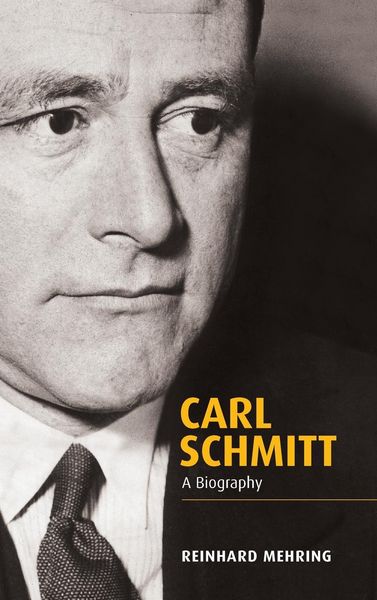
  • Produktbild: Carl Schmitt
  • Produktbild: Carl Schmitt

Carl Schmitt A Biography

93,99 €

inkl. gesetzl. MwSt., Versandkostenfrei


Beschreibung

Carl Schmitt is one of the most widely read and influential German thinkers of the twentieth century. His fundamental works on friend and enemy, legality and legitimacy, dictatorship, political theology and the concept of the political are read today with great interest by everyone from conservative...

Beschreibung

Carl Schmitt is one of the most widely read and influential German thinkers of the twentieth century. His fundamental works on friend and enemy, legality and legitimacy, dictatorship, political theology and the concept of the political are read today with great interest by everyone from conservative Catholic theologians to radical political thinkers on the left. In his private life, however, Schmitt was haunted by the demons of his wild anti-Semitism, his self-destructive and compulsive sexuality and his deep-seated resentment against the complacency of bourgeois life. As a young man from a modest background, full of social envy, he succeeded in making his way to the top of the academic discipline of law in Germany through his exceptional intellectual prowess. And yet he never felt at home in the academic establishment and among those of high social standing. In his works, Schmitt unmasked the liberal Rechtsstaat as a constitutional façade and reflected on the legitimacy of dictatorship. When the Nazis seized power Schmitt was susceptible to their ideology. He broke with his Jewish friends, joined the Nazi Party in May 1933 and lent a helping hand to Hitler, thereby becoming deeply entangled with the regime. Schmitt was irrevocably compromised by his role as the 'crown jurist' of the Third Reich. But by 1936 he had already lost his influential position. After the war, he led a secluded life in his home town in the Sauerland and became a key background figure in the intellectual scene of postwar Germany. Reinhard Mehring's outstanding biography is the most comprehensive work available on the life and work of Carl Schmitt. Based on thorough research and using new sources that were previously unavailable, Mehring portrays Schmitt as a Shakespearean figure at the centre of the German catastrophe.

Rezension

"Mehring's study...lay bare the links between Schmitt's litigious life and his complicated ideas."
Library Journal
"Reinhard Mehring offers the English speaking world the first comprehensive intellectual biography of the highly controversial legal and political theorist, Carl Schmitt. Based on extensive archival research and a vast amount of unpublished material, Mehring identifies the psychological and emotional motivations that drove the intellectual endeavors of the notorious philosopher of "the political" and "the state of exception." Mehring demonstrates conclusively how Schmitt's struggles with, among other issues, his sexual desire and his obsession with the Jews, generated some of the most important, influential and dangerous political writings of the twentieth century."
John P. McCormick, University of Chicago
"In this fascinating biography, Mehring has used Schmitt's only recently available diaries and calendar entries to lay bare the obsessions of this brilliant thinker -- often referred to as the Hobbes of the 20th century. Especially revealing are his struggles to shatter "the Jew in him," which led him to aspire to become Hitler's "pope" with all that that implied. Politically naïve about Nazism, he was severely attacked by the SS in 1936 and marginalized for, among other reasons, his pre-1933 close association with Jews and his anti-Nazism."
George Schwab, President, National Committee on American Foreign Policy

Produktdetails

Einband

Gebundene Ausgabe

Erscheinungsdatum

01.11.2014

Verlag John Wiley & Sons
Seitenzahl

700

Produktdetails

Einband

Gebundene Ausgabe

Erscheinungsdatum

01.11.2014

Verlag John Wiley & Sons
Seitenzahl

700

Maße (L/B/H)

23,3/15,4/6,3 cm

Gewicht

1271 g

Auflage

1. Auflage

Sprache

Englisch

ISBN

978-0-7456-5224-5

Herstelleradresse

Libri GmbH
Europaallee 1
36244 Bad Hersfeld
DE

Email: gpsr@libri.de

Noch keine Bewertungen vorhanden

Verfassen Sie die erste Bewertung zu diesem Artikel

Helfen Sie anderen Kundinnen und Kunden durch Ihre Meinung.

Kundinnen und Kunden meinen

Bewertungen (0)

  • Produktbild: Carl Schmitt
  • Produktbild: Carl Schmitt
  • Abbreviations
     
    Translator's Preface
     
    A White Raven: The Strange Life of the German State Theorist Carl Schmitt
     
    Part One
    That 'false and arrogant idea "I am"'
    Schmitt's Rise in the Wilhelminian Era
    1. An 'Obscure Young Man from a Modest Background'
    2. The Law of Practice
    3. Apotheosis of the Poet, Rant against Literary Figures:
    the 'Untimely Poet' and the 'Received Wisdom of the Educated'
    4. On the Eve of the Great War:
    State, Church and Individual as Points of Reference
    5. Düsseldorf: Living in a State of Exception
    6. World War and Defeatism: Carl Schmitt in Munich
    7. Strasbourg, the State of Siege and a Decision in Favour of Catholicism
    8. Political Romanticists 1815/1919
     
    Part 2
    Beyond Bourgeois Existence
    Schmitt's Life and Work during the Weimar Republic
    1. A Permanent Position?
    The Handelshochschule in Munich
    2. A 'Faithful Gypsy' in Greifswald
    3. Arrival in Bonn? Schmitt's Turn towards the Catholic Church
    4. Schmitt as a Teacher in Bonn
    5. From Status Quo to Democratic 'Myth'
    6. The Yield of the Bonn Years:
    7. From 'Ice Floe to Ice Floe':
    Signals in the Berlin Maelstrom
    8. Reconstructing the 'Strong' State
    9. Within the Journalistic Circles of Weimar's Last Days
    10. Carl Schmitt as an Actor During the Rule by Presidential Decree
     
    Part Three
    In The Belly of the Leviathan:
    Schmitt's Involvement in National Socialism
    1. After 30 January 1933
    2. Schmitt's Resistible Rise to the Position of 'Crown Jurist'
    3. The 'Year of Construction'?
    Beginning and End of the Juridico-Institutional Provision of Meaning
    4. Anti-Semitic Provision of Meaning
    5. A New Turn with Hobbes? Meaning and Failure of Schmitt's Commitment to National Socialism
    6. The Right to Power?
    Großraum Order and Empire Formation
    7. The Captain held Hostage?
    Carl Schmitt's Farewell to the 'Reich'
    8. Last Writings under National Socialism
     
    Part Four
    'One man remains'
    Schmitt's Slow Retreat after 1945
    1. Detention and 'Asylum'
    2. From Benito Cereno to Hamlet:
    The 'Comeback' of the Intellectual?
    3. Private Seminars in Plettenberg:
    Schmitt's Renewed Influence on Pupils in the Federal Republic
    4. The Partisan in Conversation
    5. Past Eighty: A Look Back to Old Questions
     
    Appendix
     
    Afterword
     
    Chronology
     
    Bibliography
     
    Endnotes
    Acknowledgments