Gutscheinbedingungen

**Gültig am 28.06.2026 auf Spielzeug, Schreibwaren, Filme, Geschenke & Trends, Musik, tolino eReader & Zubehör, Hörbücher und Hörbuch-Downloads (außer Abo), nicht preisgebundene Bücher und Kalender online auf thalia.at und in der Thalia App. Einzelne Artikel können ausgeschlossen sein. Aufgrund der Buchpreisbindung sind deutschsprachige Bücher und eBooks ausgenommen. Zusätzlich ausgenommen sind preisgebundene Artikel, Abos & Flatrates, eBooks, Games, Geschenkkarten/-boxen, Shelfies, Software, Zeitschriften sowie einzelne Artikel von tonies®. Pro Einkauf einmal einlösbar. Click & Collect nur bei Onlinevorabzahlung möglich. Keine Barauszahlung. Nicht kombinierbar mit anderen Aktionen und Gutscheinen. Gutschein wird auf max. 500€ Bestellwert angerechnet. Nicht gültig für Versandkosten und Services.

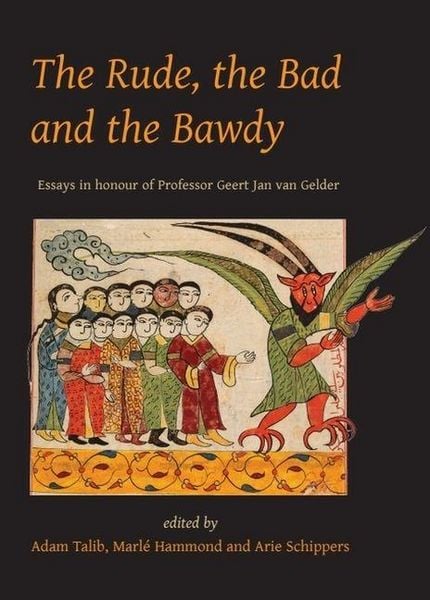
Produktbild: The Rude, the Bad and the Bawdy

The Rude, the Bad and the Bawdy

159,99 €

inkl. gesetzl. MwSt., Versandkostenfrei


Beschreibung

Produktdetails

Einband

Gebundene Ausgabe

Erscheinungsdatum

31.10.2014

Herausgeber

Adam Talib + weitere

Verlag

Edinburgh University Press

Seitenzahl

336

Maße (L/B/H)

24,1/17/3 cm

Gewicht

998 g

Sprache

Englisch

ISBN

978-1-909724-33-4

Beschreibung

Portrait

Marlé Hammond is Senior Lecturer in Arabic Popular Literature and Culture at SOAS University of London where she teaches classes on Arabic Literature and Middle Eastern and North African cinema. She is the author of The Tale of al-Barraq Son of Rahwan and Layla the Chaste: A Bilingual Edition and Study (Oxford University Press, 2020) and the award-winning monograph Beyond Elegy: Classical Arabic Women's Poetry in Context (Oxford University Press, 2010). She also edited Arabic Poems (Everyman's Library Pocket Poets, 2014). Having studied film modules at Columbia University in New York and The American University in Cairo, she started teaching about Arabic-language cinema in 2006 and began integrating it into her research in 2007, when she was awarded a three-year British Academy Postdoctoral Fellowship at Oxford University to explore representations of ancient female poets in modern Arabic literature and film. This led to her publication of studies of two films: Togo Mizrahi's Sallama (1945) and Bahiga Hafez's Layla, Daughter of the Desert (1937). She has also authored a book chapter on the role of the kiss in Egyptian film language of the 1940s. Her work at the archival collection of (primarily Egyptian) film scripts at the New York State museum in her home town of Albany, has enabled her to 'reconstruct' bowdlerized films, such as Yusuf Wahbi's Love and Revenge (1945), the subject of Chapter 1.3, and have informed the regional essays at certain junctures. Whilst this 'expertise' has been focused on Egypt, over a decade of teaching of teaching on the subject of Arabic-language cinema more generally has resulted in her researching the cinemas of North Africa and the Eastern Arab world rather extensively.

Produktdetails

Einband

Gebundene Ausgabe

Erscheinungsdatum

31.10.2014

Herausgeber

Verlag

Edinburgh University Press

Seitenzahl

336

Maße (L/B/H)

24,1/17/3 cm

Gewicht

998 g

Sprache

Englisch

ISBN

978-1-909724-33-4

Herstelleradresse

Libri GmbH
Europaallee 1
36244 Bad Hersfeld
DE

Email: gpsr@libri.de

Kundinnen und Kunden meinen

0 Bewertungen

Informationen zu Bewertungen

Zur Abgabe einer Bewertung ist eine Anmeldung im Konto notwendig. Die Authentizität der Bewertungen wird von uns nicht überprüft. Wir behalten uns vor, Bewertungstexte, die unseren Richtlinien widersprechen, entsprechend zu kürzen oder zu löschen.

Die Bewertungen sind nach Format, Anzahl Sterne und Datum sortiert.

Verfassen Sie die erste Bewertung zu diesem Artikel

Helfen Sie anderen Kund*innen durch Ihre Meinung

Kundinnen und Kunden meinen

0 Bewertungen filtern

  • Produktbild: The Rude, the Bad and the Bawdy
  • Tabula Gratulatoria Geert Jan van Gelder: a biographical sketch Introduction 1. Wen-chin Ouyang, 'Mujun, Junun, Funun' 2. Jaakko Hameen-Anttila, 'What is Obscene? Obscenity in Classical Arabic Literature' 3. Pieter Smoor, 'A Suspicion of Excessive Frankness' 4. Gregor Schoeler, Abu Nuwas' poem to the Zoroastrian boy Bihruz: An Arabic 'sawgand-nama' with a Persian 'kharja' 5.. Arie Schippers, 'The Mujun Genre by Abu Nuwas and by Ibn Quzman: a Comparison' 6. Nefeli Papoutsakis, 'The ayriyat of Abu Hukayma (d. 240/854): A preliminary study' 7. Monica Balda-Tillier, "Udhri Love and Mujun: Opposites and Parallels' 8. Emily Selove, 'Mujun is a Crazy Game' 9. Thomas Bauer, 'Dignity at Stake: Mujun epigrams by Ibn Nubata (686-768/1287-1366) and his contemporaries' 10. Ewald Wagner, 'Lyrics on a Fart' 11. Denis McAuley, 'Two fart jokes in Ibn 'Arabi's Muhadarat al-abrar' 12. Richard van Leeuwen, 'Love or Lust: Sexual Relationships between Humans and Jinns in the Thousand and One Nights and The Djinn in the Nightingale's Eye 13. Roger Allen, 'The Obscenity of Sexual Torture' 14. Frederic Lagrange, 'Modern Arabic Literature and the Disappearance of Mujun: Same-Sex Rape as a Case Study' 15. Marle Hammond, 'The Foul-Mouthed Fahla: Obscenity and Amplification in Early Women's Invective' 16. Clive Holes, 'A Saudi "housewife" goes to war: or "the evil fatwas"' 17. Adam Talib, 'Caricature and Obscenity in Mujun Poetry and African-American Women's Hip Hop' 18. Jan Schmidt, 'Love and Sex among the Ottomans (1500-1800)' 19. Geert Jan van Gelder: List of Publications Notes on the Contributors Index