• Produktbild: Developing Mathematical Thinking
  • Produktbild: Developing Mathematical Thinking

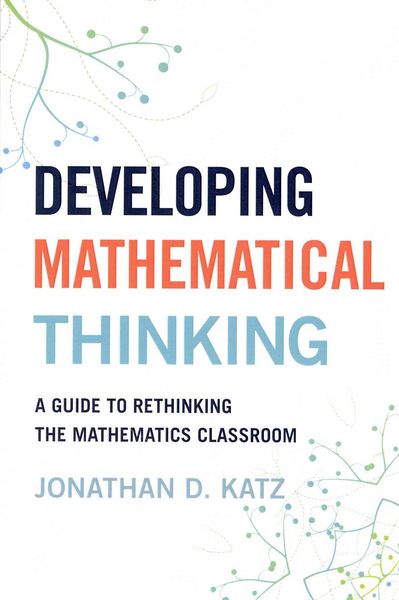
Developing Mathematical Thinking A Guide to Rethinking the Mathematics Classroom

61,99 €

inkl. gesetzl. MwSt., Versandkostenfrei


Beschreibung

Produktdetails

Einband

Taschenbuch

Erscheinungsdatum

07.07.2014

Verlag

Rowman & Littlefield

Seitenzahl

144

Maße (L/B/H)

22,9/15,2/0,8 cm

Gewicht

227 g

Sprache

Englisch

ISBN

978-1-4758-1057-8

Beschreibung

Produktdetails

Einband

Taschenbuch

Erscheinungsdatum

07.07.2014

Verlag

Rowman & Littlefield

Seitenzahl

144

Maße (L/B/H)

22,9/15,2/0,8 cm

Gewicht

227 g

Sprache

Englisch

ISBN

978-1-4758-1057-8

Herstelleradresse

Libri GmbH
Europaallee 1
36244 Bad Hersfeld
DE

Email: gpsr@libri.de

Noch keine Bewertungen vorhanden

Verfassen Sie die erste Bewertung zu diesem Artikel

Helfen Sie anderen Kundinnen und Kunden durch Ihre Meinung.

Kundinnen und Kunden meinen

Bewertungen (0)

Weitere Artikel finden Sie in

Die Leseprobe wird geladen.
  • Produktbild: Developing Mathematical Thinking
  • Produktbild: Developing Mathematical Thinking
  • Preface
    Introduction
    What Will You Find in This Book

    Chapter 1: An Explanation of the ISA Approach to Teaching and Learning Mathematics
    Introduction
    A Vision of Mathematics in an ISA Classroom
    Guide To Creating a Vision and Four-Year Plan
    ISA Mathematics Rubric
    Indicators of Teacher Instructional Practices That Elicit Student Mathematical Thinking
    Indicators of Student Demonstration of Mathematical Thinking

    Chapter 2: A Guide to Teaching and Learning Mathematics Using the Five Dimensions of the ISA Rubric
    Introduction
    Dimension 1: Problem Solving
    Problem Solving Definition and Overview
    Teaching Idea #1: Choosing the Appropriate Problem
    Teaching Idea #2A: Use Problems with Multiple Strategies
    Teaching Idea #2B: Selecting an Appropriate Strategy
    Teaching Idea #3: Value Process and Answer
    Teaching Idea #4: Answer Student Questions to Foster Understanding
    Teaching Idea #5: Error as a Tool for Inquiry
    Teaching Idea #6: Students Create Their Own Problems
    Dimension II: Reasoning and Proof
    Reasoning and Proof Definitions and Overview
    Teaching Idea #1: Conjecturing
    Teaching Idea #2: Evidence and Proof
    Teaching Idea #3: Metacognition
    Dimension III: Communication
    Communication Definition and Overview
    Teaching Idea #1: Writing in Journals
    Teaching Idea #2: Writing in Problems and Projects
    Teaching Idea #3: Oral Communication
    Dimension IV: Connections
    Connections Definition and OverviewX
    Teaching Idea #1: There Are Common Structures That Bind Together the Multiple Ideas of Mathematics
    Teaching Idea #2: The History of Mathematics Helps Students Make Sense of and Appreciate Mathematics
    Teaching Idea #3: Using Contextual Problems That Are Meaningful to Students
    Dimension V: Representation
    Representation Definition and Overview
    Teaching Idea #1A: Learning to Abstract - Moving from Arithmetic to Algebra
    Teaching Idea #1B: Learning to Abstract - Use Examples of Physical Structures
    Teaching Idea #2: Making Sense of Confusion to Solve Problems
    Teaching Idea #3: Interpreting and Explaining
    Teaching Idea #4A: Mathematical Modeling - Modeling Mathematical Ideas and Real World Situations
    Teaching Idea #4B: Mathematical Modeling - Projects of the World That Use Rich Mathematics

    Chapter 3: Problems, Investigations, Lessons, Projects, and Performance Tasks
    Introduction
    Example 1: Display Dilemma Problem - Using Multiple Strategies / Looking for Patterns
    Example 2: Shakira's Number - Valuing Process
    Example 3: Crossing the River - Valuing Process
    Example 4: Checker Board Problem - Simplifying the Problem
    Example 5: When Can I Divide? - Using Errors as a Tool of Inquiry
    Example 6: Creating a Mathematical Situation: Three Examples - Students Create Their Own Problems
    Example 7: The Game of 27 - Reasoning and Conjecturing
    Example 8: The String Problem - Conjecturing
    Example 9: Congruence and Similarity - Conjecturing and Proof
    Example 10: The Race - Metacognition on Multiple Strategies
    Example 11: Murder Mystery - Evidence and Proof
    Example 12: The Locker Problem - Metacognition
    Example 13: Gaming the Dice - Writing in Problems
    Example 14: Does Penelope Crash Into Mars? - Problems Are Meaningful to Students
    Example 15: Consecutive Sums Problem - Patterns and Conjecturing
    Example 16: Activity to Lead to Definition and Multiple Representations of a Function - Structures in Mathematics
    Example 17: The Pythagorean Triplets - The History of Mathematics
    Example 18: Laws of Exponents - Moving From Arithmetic to Algebra
    Example 19: Working with Variables - Learning to Abstract: Moving from Arithmetic to Algebra
    Example 20: Models of the Seagram Building - Use of Physical Structures
    Example 21: How Tall Is Your School Building? - Use of Physical Structures
    Example 22: Model Suspension Bridge Project - Modeling Real World Situations
    Example 23: Shoe Size Problem - Modeling Real World Situations
    Example 24: The Peg Game - Using Games to Understand Mathematics
    Example 25: Concentration of Medication in a Patient's Blood Over Time - Modeling Using Real World Data
    Example 26: Marcella's Bagels - Working Backwards
    Example 27: What is normal? - Modeling Mathematical Ideas and Real World Situations
    Example 28: Can You Build the Most Efficient Container? - Mathematical Modeling
    Example 29: Salary Choice - Mathematical Modeling
    Example 30: Border Problem - Learning to Abstract: Moving from Arithmetic to Algebra
    Example 31: The Magical Exterior Angles - Encouraging the Use of Evidence and Proof in Daily Problem Solving
    Example 32: Creating a Fair Game - Projects of the World That Use Rich Mathematics

    Chapter 4: Various Guides for Teachers
    Introduction
    School Mathematics: A Self-Assessment
    What Does An Inquiry Process Look Like In Mathematics?
    How to Write an Inquiry Lesson
    Questions to Think About When Planning an Inquiry-Based Common Core Aligned Unit
    List of Questions to Think About When Writing a Mathematical Performance Task
    Guide to Writing an Inquiry Lesson
    Inquiry-Based Lesson Planning Template
    Big Ideas in Algebra
    Big Ideas in Geometry
    Big Ideas in Probability and Statistics
    Questions for Students to Ask Themselves When Solving a Problem
    An Inquiry Approach to Look at Student Work
    An Inquiry Approach to Look at a Teacher-Created Task, Activity, or Lesson
    Teacher's Perceptions Continuum
    Student's Perceptions Continuum
    School Mathematics: A Self-Assessment
    References