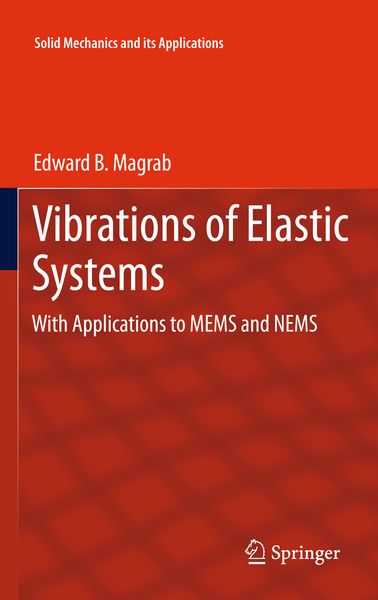
Produktbild: Vibrations of Elastic Systems
Band 184

Vibrations of Elastic Systems With Applications to MEMS and NEMS

189,99 €

inkl. gesetzl. MwSt., Versandkostenfrei


Beschreibung

Produktdetails

Einband

Taschenbuch

Erscheinungsdatum

22.02.2014

Verlag

Springer Netherland

Seitenzahl

492

Maße (L/B/H)

23,5/15,5/2,8 cm

Gewicht

762 g

Auflage

2012

Sprache

Englisch

ISBN

978-94-007-9525-9

Beschreibung

Produktdetails

Einband

Taschenbuch

Erscheinungsdatum

22.02.2014

Verlag

Springer Netherland

Seitenzahl

492

Maße (L/B/H)

23,5/15,5/2,8 cm

Gewicht

762 g

Auflage

2012

Sprache

Englisch

ISBN

978-94-007-9525-9

Herstelleradresse

Springer Netherland
Heidelberger Platz 3
14197 Berlin
Deutschland
Email: sdc-bookservice@springer.com
Fax: +49 6221 3454229

Noch keine Bewertungen vorhanden

Verfassen Sie die erste Bewertung zu diesem Artikel

Helfen Sie anderen Kundinnen und Kunden durch Ihre Meinung.

Kundinnen und Kunden meinen

Bewertungen (0)

  • Produktbild: Vibrations of Elastic Systems
  • 1 Introduction.-  1.1 A Brief Historical Perspective.-  1.2 Importance of Vibrations.-  1.3 Analysis of Vibrating Systems.-  1.4 About the Book.-  2 Spring-Mass Systems.-  2.1 Introduction.-  2.2 Some Preliminaries.-  2.2.1 A Brief Review of Single Degree-of-Freedom Systems.-  2.2.2 General Solution: Harmonically Varying Forcing.-  2.2.3 Power Dissipated by a Viscous Damper.-  2.2.4 Structural Damping.-  2.3 Squeeze Film Air Damping.-  2.3.1 Introduction.-  2.3.2 Rectangular Plates.-  2.3.3 Circular Plates.-  2.3.4 Base Excitation with Squeeze Film Damping.-  2.3.5 Time-Varying Force Excitation of the Mass.-  2.4 Viscous Fluid Damping.-  2.4.1 Introduction.-  2.4.2 Single Degree-of-Freedom System in a Viscous Fluid.-  2.5 Electrostatic and van der Waals Attraction.-  2.5.1 Introduction.-  2.5.2 Single Degree-of-Freedom with Electrostatic Attraction.-  2.5.3 van der Waals Attraction and Atomic Force Microscopy.-  2.6 Energy Harvesters.-  2.6.1 Introduction.-  2.6.2 Piezoelectric Generator.-  2.6.3 Maximum Average Power of a Piezoelectric Generator.-  2.6.4 Permanent Magnet Generator.-  2.6.5 Maximum Average Power of a Permanent Magnet Generator.-  2.7 Two Degree-of-Freedom Systems.-  2.7.1 Introduction.-  2.7.2 Harmonic Excitation: Natural Frequencies and Frequency Response Functions.-  2.7.3 Enhanced Energy Harvester.-  2.7.4 MEMS Filters.-  2.7.5 Time-Domain Response.-  2.7.6 Design of an Atomic Force Microscope Motion Scanner.-  Appendix 2.1 Forces on a Submerged Vibrating Cylinder.-  3 Thin Beams: Part I .-  3.1 Introduction.-  3.2 Derivation of Governing Equation and Boundary Conditions.-  3.2.1 Contributions to the Total Energy.-  3.2.2 Governing Equation.-  3.2.3 Boundary Conditions.-  3.2.4 Non Dimensional Form of the Governing Equation and Boundary Conditions.-  3.3 Natural Frequencies and Mode Shapes of Beams with Constant Cross Section and with Attachments.-  3.3.1 Introduction.-  3.3.2 Solution for Very General Boundary Conditions .-  3.3.3 General Solution in the Absence of an Axial Force and an Elastic Foundation.-  3.3.4 Numerical Results.-  3.3.5 Cantilever Beam as a Biosensor.-  3.4 Single Degree-of-Freedom Approximation of Beams with a Concentrated Mass.-  3.5 Beams with In-Span Spring-Mass Systems .-  3.5.1 Single Degree-of-Freedom System.-  3.5.2 Two Degree-of-Freedom System with Translation and Rotation.-  3.6 Effects of an Axial Force and an Elastic Foundation on the Natural Frequency.-  3.7 Beams with a Rigid Extended Mass.-  3.7.1 Introduction.-  3.7.2 Cantilever Beam with a Rigid Extended Mass.-  3.7.3 Beam with an In-span Rigid Extended Mass.-  3.8 Beams with Variable Cross Section.-  3.8.1 Introduction.-  3.8.2 Continuously Changing Cross Section.-  3.8.3 Linear Taper.-  3.8.4 Exponential Taper.-  3.8.5 Approximate Solution to Tapered Beams: Rayleigh-Ritz Method.-  3.8.6 Triangular Taper: Application to Atomic Force Microscopy.-  3.8.7 Constant Cross Section with a Step Change in Properties.-  3.8.8 Stepped Beam with an In-Span Rigid Support.-  3.9 Elastically Connected Beams.-  3.9.1 Introduction.-  3.9.2 Beams Connected by a Continuous Elastic Spring.-  3.9.3 Beams with Concentrated Masses Connected by an Elastic Spring.-  3.10 Forced Excitation.-  3.10.1 Boundary Conditions and the Generation of Orthogonal Functions.-  3.10.2 General Solution.-  3.10.3 Impulse Response.-  3.10.4 Time-Dependent Boundary Excitation.-  3.10.5 Forced Harmonic Oscillations.-  3.10.6 Harmonic Boundary Excitation.-  4 Thin Beams: Part II .-  4.1 Introduction.-  4.2 Damping.-  4.2.1 Generation of Governing Equation.-  4.2.2 General Solution.-  4.2.3 Illustration of the Effects of Various Types of Damping: Cantilever Beam.-  4.3 In-plane Forces and Electrostatic Attraction.-  4.3.1 Introduction.-  4.3.2 Beam Subjected to a Constant Axial Force.-  4.3.3 Beam Subject to In-plane Forces and Electrostatic Attraction.-  4.4 Piezoelectric Energy Harvesters.-  4.4.1 Governing Equations and Boundary Conditions.-  4.4.2 Power from the Harmonic Oscillations of a Base-Excited Cantilever Beam.-  Appendix 4.1 Hydrodynamic Correction Function.-  5 Timoshenko Beams.-  5.1 Introduction.-  5.2 Derivation of the Governing Equations and Boundary Conditions.-  5.2.1 Introduction.-  5.2.2 Contributions to the Total Energy.-  5.2.3 Governing Equations.-  5.2.4 Boundary Conditions.-   5.2.5 Non Dimensional Form of the Governing Equations and Boundary Conditions.-  5.2.6 Reduction of Timoshenko Equations to That of Euler-Bernoulli.-  5.3 Natural Frequencies and Mode Shapes of Beams with Constant Cross Section, Elastic Foundation, Axial Force and In-span Attachments.-  5.3.1 Introduction.-  5.3.2 Solution for Very General Boundary Conditions.-  5.3.3 Special Cases.-  5.3.4 Numerical Results.-  5.4 Natural Frequencies of Beams with Variable Cross Section.-  5.4.1 Beams with a Continuous Taper: Rayleigh-Ritz Method.-  5.4.2 Constant Cross Section with a Step Change in Properties.-  5.4.3 Numerical Results.-  5.5 Beams Connected by a Continuous Elastic Spring.-  5.6 Forced Excitation.-  5.6.1 Boundary Conditions and the Generation of Orthogonal Functions.-  5.6.2 General Solution.-  5.6.3 Impulse Response.-  Appendix 5.1 Definitions of the Solution Functions fl and gl and Their Derivatives .-   Appendix 5.2 Definitions of the Solution Functions fli and gli and Their Derivatives.-   6 Thin Plates.-  6.1 Introduction.-  6.2 Derivation of Governing Equation and Boundary Conditions: Rectangular Plates.-  6.2.1 Introduction.-  6.2.2 Contributions to the Total Energy.-  6.2.3 Governing Equation.-  6.2.4 Boundary Conditions.-  6.2.5 Non Dimensional Form of the Governing Equation and Boundary Conditions.-  6.3 Governing Equations and Boundary Conditions: Circular Plates.-  6.4 Natural Frequencies and Mode Shapes of Circular Plates for Very General Boundary Conditions.-  6.4.1 Introduction.-  6.4.2 Natural Frequencies and Mode Shapes of Annular and Solid Circular Plates.-  6.4.3 Numerical Results.-  6.5 Natural Frequencies and Mode Shapes of Rectangular and Square Plates: Rayleigh-Ritz Method.-  6.5.1 Introduction.-  6.5.2 Natural Frequencies and Mode Shapes of Rectangular and Square Plates.-  6.5.3 Numerical Results.-  6.5.4 Comparison with Thin Beams.-  6.6 Forced Excitation of Circular Plates.-  6.6.1 General Solution to the Forced Excitation of Circular Plates.-  6.6.2 Impulse Response of a Solid Circular Plate.-  6.7 Circular Plate with Concentrated Mass Revisited.-  6.8 Extensional Vibrations of Plates.-  6.8.1 Introduction.-  6.8.2 Contributions to the Total Energy.-  6.8.3 Governing Equations and Boundary Conditions.-  6.8.4 Natural Frequencies and Mode Shapes of a Circular Plate.-  6.8.5 Numerical Results.-  Appendix 6.1 Elements of Matrices in Eq. (6.100).-  7 Cylindrical Shells and Carbon Nanotube Approximations .-  7.1 Introduction.-  7.2 Derivation of Governing Equations and Boundary Conditions: Flügge’s Theory.-  7.2.1 Introduction.-  7.2.2 Contributions to the Total Energy.-  7.2.3 Governing Equations.-  7.2.4 Boundary Conditions.-  7.2.5 Boundary Conditions and the Generation of Orthogonal Functions.-   7.3 Derivation of Governing Equations and Boundary Conditions: Donnell’s Theory.-  7.3.1 Introduction.-  7.3.2 Contributions to the Total Energy.-  7.3.3 Governing Equations 7.3.4 Boundary Conditions.-  7.4 Natural Frequencies of Clamped and Cantilever Shells: Single-Wall Carbon Nanotube Approximations.-  7.4.1 Rayleigh-Ritz Solution.-  7.4.2 Numerical Results.-  7.5 Natural Frequencies of Hinged Shells: Double-Wall Carbon Nanotube Approximation.-  Appendix A Strain Energy in Linear Elastic Bodies .-  Appendix B Variational Calculus: Generation of Governing Equations, Boundary Conditions, and Orthogonal Functions.-  B.1 Variational Calculus.-  B.1.1 System with One Dependent Variable.-  B.1.2 A Special Case for Systems with One Dependent Variable.-  B.1.3 Systems with N Dependent Variables.-  B.1.4 A Special Case for Systems with N Dependent Variables.-  B.2 Orthogonal Functions.-  B.2.1 Systems with One Dependent Variable.-  B.2.2 Systems with N Dependent Variables.-  B.3 Application of Results to Specific Elastic Systems.-  Appendix C Laplace Transforms and the Solutions to Ordinary Differential Equations.-   C.1 Definition of the Laplace Transform .-  C.2 Solution to Second-Order Equation.-  C.3 Solution to Fourth-Order Equation.-   C.4 Table of Laplace Transform Pairs.