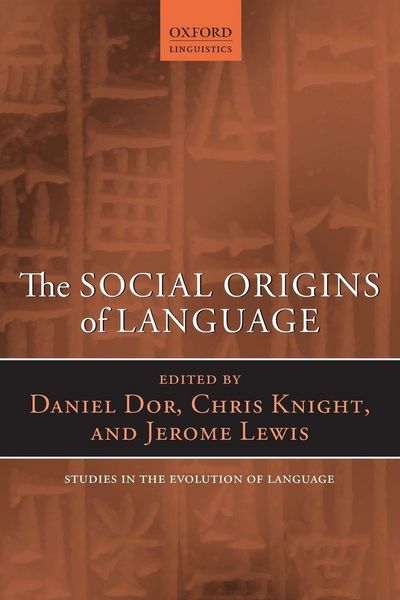

• Produktbild: SOCIAL ORIGINS OF LANGUAGE SEL
  • Produktbild: SOCIAL ORIGINS OF LANGUAGE SEL

SOCIAL ORIGINS OF LANGUAGE SEL NCS P

101,99 €

inkl. gesetzl. MwSt., Versandkostenfrei


Beschreibung

Produktdetails

Einband

Taschenbuch

Erscheinungsdatum

26.06.2014

Herausgeber

Dor Daniel + weitere

Verlag

Oxford University Press

Seitenzahl

452

Maße (L/B/H)

23,4/15,6/2,4 cm

Gewicht

682 g

Sprache

Englisch

ISBN

978-0-19-966533-4

Beschreibung

Produktdetails

Einband

Taschenbuch

Erscheinungsdatum

26.06.2014

Herausgeber

Verlag

Oxford University Press

Seitenzahl

452

Maße (L/B/H)

23,4/15,6/2,4 cm

Gewicht

682 g

Sprache

Englisch

ISBN

978-0-19-966533-4

Herstelleradresse

Libri GmbH
Europaallee 1
36244 Bad Hersfeld
DE

Email: gpsr@libri.de

Noch keine Bewertungen vorhanden

Verfassen Sie die erste Bewertung zu diesem Artikel

Helfen Sie anderen Kundinnen und Kunden durch Ihre Meinung.

Kundinnen und Kunden meinen

Bewertungen (0)

  • Produktbild: SOCIAL ORIGINS OF LANGUAGE SEL
  • Produktbild: SOCIAL ORIGINS OF LANGUAGE SEL

    • 1: Daniel Dor, Chris Knight, and Jerome Lewis: Introduction: A social perspective on how language began


    • PART 1 Theoretical Foundations


    • 2: Daniel Dor and Eva Jablonka: Why we need to move from gene-culture co-evolution to culturally-driven co-evolution


    • 3: Chris Sinha: Niche construction and semiosis: Biocultural and social dynamics


    • 4: Camilla Power: Signal evolution and the social brain


    • 5: Sverker Johansson: How can a social theory of language evolution be grounded in evidence?


    • PART 2 Language as a Collective Object


    • 6: Adam Kendon: The 'poly-modalic' nature of utterances and its relevance for inquiring into language origins


    • 7: Jerome Lewis: BaYaka Pygmy multi-modal and mimetic communication traditions


    • 8: Nick J. Enfield and Jack Sidnell: Language presupposes an enchronic infrastructure for social interaction


    • 9: Daniel Dor: The instruction of imagination: Language and its evolution as a communication technology


    • PART 3 Apes and People, Past and Present


    • 10: Simone Pika: Chimpanzee grooming gestures and sounds: What might they tell us about how language evolved?


    • 11: Zanna Clay and Klaus Zuberbÿhler: Vocal communication and social awareness in chimpanzees and bonobos


    • 12: Charles Whitehead: Why humans and not apes: The social preconditions for the emergence of language


    • 13: Emily Wyman: Language and collective fiction: From children's pretence to social institutions


    • 14: Dan Dediu and Stephen C. Levinson: The time frame of the emergence of modern language and its implications


    • 15: Camilla Power: The evolution of ritual as a process of sexual selection


    • 16: Ian Watts: The red thread: Pigment use and the evolution of collective ritual


    • 17: Chris Knight: Language and symbolic culture: An outcome of hunter-gatherer reverse dominance


    • PART 4 The Social Origins of Language


    • 18: Jordan Zlatev: The co-evolution of human intersubjectivity, morality, and language


    • 19: Ehud Lamm: Forever united: The co-evolution of language and normativity


    • 20: Jean-Louis Dessalles: Why talk?


    • 21: Chris Knight and Jerome Lewis: Vocal deception, laughter, and the linguistic significance of reverse dominance


    • PART 5 The Journey Thereafter


    • 22: Simona Ginsburg and Eva Jablonka: Memory, imagination, and the evolution of modern language


    • 23: Nick J. Enfield: Transmission biases in the cultural evolution of language: Towards an explanatory framework


    • 24: Luc Steels: Breaking down false barriers to understanding