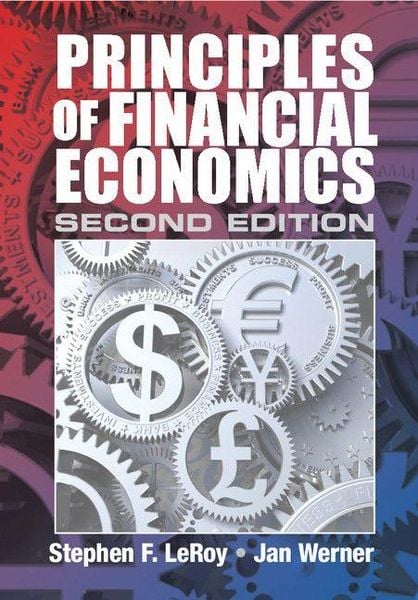

Principles of Financial Economics
-
- Hardcover
- Taschenbuch ausgewählt
- eBook
-
Sprache:Englisch
91,99 €
inkl. gesetzl. MwSt.,
Beschreibung
Produktdetails
Einband
Taschenbuch
Erscheinungsdatum
26.02.2016
Abbildungen
19 b/w illus., Zeichnungen, nicht spezifiziert
Verlag
Cambridge AcademicSeitenzahl
370
Maße (L/B/H)
25,4/17,8/2,1 cm
Gewicht
695 g
Auflage
2., überarbeitete Auflage
Sprache
Englisch
ISBN
978-1-107-67302-1
This second edition provides a rigorous yet accessible graduate-level introduction to financial economics. Since students often find the link between financial economics and equilibrium theory hard to grasp, less attention is given to purely financial topics, such as valuation of derivatives, and more emphasis is placed on making the connection with equilibrium theory explicit and clear. This book also provides a detailed study of two-date models because almost all of the key ideas in financial economics can be developed in the two-date setting. Substantial discussions and examples are included to make the ideas readily understandable. Several chapters in this new edition have been reordered and revised to deal with portfolio restrictions sequentially and more clearly, and an extended discussion on portfolio choice and optimal allocation of risk is available. The most important additions are new chapters on infinite-time security markets, exploring, among other topics, the possibility of price bubbles.
Noch keine Bewertungen vorhanden
Verfassen Sie die erste Bewertung zu diesem Artikel
Helfen Sie anderen Kundinnen und Kunden durch Ihre Meinung.
Kurze Frage zu unserer Seite
Vielen Dank für Ihr Feedback
Wir nutzen Ihr Feedback, um unsere Produktseiten zu verbessern. Bitte haben Sie Verständnis, dass wir Ihnen keine Rückmeldung geben können. Falls Sie Kontakt mit uns aufnehmen möchten, können Sie sich aber gerne an unseren Kund*innenservice wenden.
zum Kundenservice