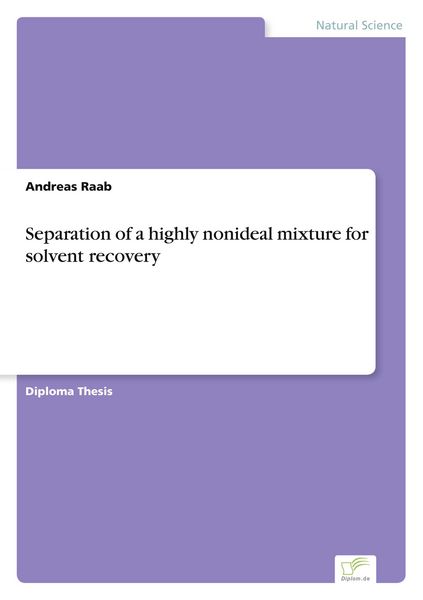
Separation of a highly nonideal mixture for solvent recovery
-
- Englisch ausgewählt
59,70 €
inkl. gesetzl. MwSt.,
Beschreibung
Produktdetails
Einband
Taschenbuch
Erscheinungsdatum
15.01.2003
Verlag
GRINSeitenzahl
84
Maße (L/B/H)
21/14,8/0,7 cm
Gewicht
135 g
Auflage
3. Auflage
Sprache
Englisch
ISBN
978-3-8386-6309-8
Inhaltsangabe:Abstract: The separation of complex nonideal mixtures is a common problem in the process industries. The solvent recovery is an important task for chemical engineers to minimize burden upon the environment due to exhaustive use of solvents. The recovery of the individual components is complicated by the highly nonideal features of these mixtures. The separation of such highly nonideal mixtures can be limited by the presence of azeotropes, which can create distillation boundaries. These distillation boundaries are forming distillation regions which are difficult to overcome with the standard rectification. Distillation systems for these highly nonideal azeotropic mixtures are particularly difficult to design and to operate in an efficient way. In printing companies often four component mixtures of ethanol, ethyl acetate, isopropyl acetate, and water arise as waste. A separation scheme of multicomponent azeotropic distillation is developed and successfully used for a highly nonideal quaternary mixture. The composition of the mixture in mass percent is ethanol 30%, water 20%, ethyl acetate 25% and isopropyl acetate with 20%. The rest of the mixture (5%) consists of n-propane, isopropane, cyclohexane, and etoxypropane. For the further investigation just the quaternary mixture is examined. Generally, every component should be recovered as pure as possible from the mixture. In the mixture namely five binary and two ternary azeotropes are formed by the components. Based on the synthesis procedure proposed by Rev et al. and Mizsey et al. a new separation technology is developed followed up the vapor-liquid-liquid equilibrium behavior of the mixture. They have recommended a general framework for designing feasible schemes of multicomponent azeotropic distillation. This procedure recommends to study in detail the vapor-liquid-liquid equilibrium data to explore immiscibility regions, azeotropic points, and separatrices for ternary and quaternary regions. On the behalf of the VLLE data the set of feasible separation structures is explored. This procedure is followed and a new separation structure is developed and tested experimentally. First, the quaternary mixture is separated into two ternary mixtures by distillation. The two ternary mixtures containing ethyl acetate, ethanol, water and isopropyl acetate, ethanol, water, respectively. Due to the analogous behavior of the two ternary mixtures similar separation cycles can be designed. The two [...]
Noch keine Bewertungen vorhanden
Verfassen Sie die erste Bewertung zu diesem Artikel
Helfen Sie anderen Kundinnen und Kunden durch Ihre Meinung.
Kurze Frage zu unserer Seite
Vielen Dank für Ihr Feedback
Wir nutzen Ihr Feedback, um unsere Produktseiten zu verbessern. Bitte haben Sie Verständnis, dass wir Ihnen keine Rückmeldung geben können. Falls Sie Kontakt mit uns aufnehmen möchten, können Sie sich aber gerne an unseren Kund*innenservice wenden.
zum Kundenservice