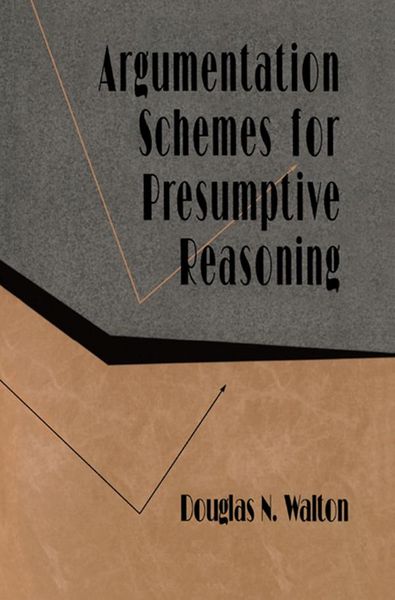
Argumentation Schemes for Presumptive Reasoning
-
- Taschenbuch
- eBook ausgewählt
-
Form:Einzelkauf Download
-
Sprache:Englisch
-
eBook Format:PDF
- ePUB 3 60,70 €
- PDF 60,20 € ausgewählt
60,20 €
inkl. gesetzl. MwSt.Beschreibung
Produktdetails
Format
Kopierschutz
Ja
Family Sharing
Nein
Text-to-Speech
Nein
Erscheinungsdatum
05.11.2013
Verlag
Taylor & Francis eBooksSeitenzahl
232 (Printausgabe)
Dateigröße
3276 KB
Sprache
Englisch
EAN
9781136687068
Recent concerns with the evaluation of argumentation in informal logic and speech communication center around nondemonstrative arguments that lead to tentative or defeasible conclusions based on a balance of considerations. Such arguments do not appear to have structures of the kind traditionally identified with deductive and inductive reasoning, but are extremely common and are often called "plausible" or "presumptive," meaning that they are only provisionally acceptable even when they are correct. How is one to judge, by some clearly defined standard, whether such arguments are correct or not in a given instance? The answer lies in what are called argumentation schemes -- forms of argument (structures of inference) that enable one to identify and evaluate common types of argumentation in everyday discourse.
This book identifies 25 argumentation schemes for presumptive reasoning and matches a set of critical questions to each. These two elements -- the scheme and the questions -- are then used to evaluate a given argument in a particular case in relation to a context of dialogue in which the argument occurred.
In recent writings on argumentation, there is a good deal of stress placed on how important argumentation schemes are in any attempt to evaluate common arguments in everyday reasoning as correct or fallacious, acceptable or questionable. However, the problem is that the literature thus far has not produced a precise and user-friendly enough analysis of the structures of the argumentation schemes themselves, nor have any of the documented accounts been as helpful, accessible, or systematic as they could be, especially in relation to presumptive reasoning. This book solves the problem by presenting the most common presumptive schemes in an orderly and clear way that makes them explicit and useful as precisely defined structures. As such, it will be an indispensable tool for researchers, students, and teachers in the areas of critical thinking, argumentation, speech communication, informal logic, and discourse analysis.
Noch keine Bewertungen vorhanden
Verfassen Sie die erste Bewertung zu diesem Artikel
Helfen Sie anderen Kundinnen und Kunden durch Ihre Meinung.
Kurze Frage zu unserer Seite
Vielen Dank für Ihr Feedback
Wir nutzen Ihr Feedback, um unsere Produktseiten zu verbessern. Bitte haben Sie Verständnis, dass wir Ihnen keine Rückmeldung geben können. Falls Sie Kontakt mit uns aufnehmen möchten, können Sie sich aber gerne an unseren Kund*innenservice wenden.
zum Kundenservice