KI-Beratung Beta

Gutscheinbedingungen

**Gültig bis 11.11.2026 auf Spielzeug, Schreibwaren, Filme, Geschenke & Trends, Musik, tolino eReader & Zubehör, Hörbücher und Hörbuch-Downloads, nicht preisgebundene Bücher und Kalender online auf thalia.at und in der Thalia App. Einzelne Artikel können ausgeschlossen sein. Aufgrund der Buchpreisbindung sind deutschsprachige Bücher und eBooks ausgenommen. Zusätzlich ausgenommen sind Abos & Flatrates, Games, Geschenkkarten/-boxen, Shelfies, Software, Zeitschriften sowie einzelne Artikel von tonies®. Pro Einkauf einmal einlösbar. Click & Collect nur bei Onlinevorabzahlung möglich. Keine Barauszahlung. Nicht kombinierbar mit anderen Aktionen und Gutscheinen. Gutschein wird auf max. 500€ Bestellwert angerechnet. Nicht gültig für Versandkosten und Services.

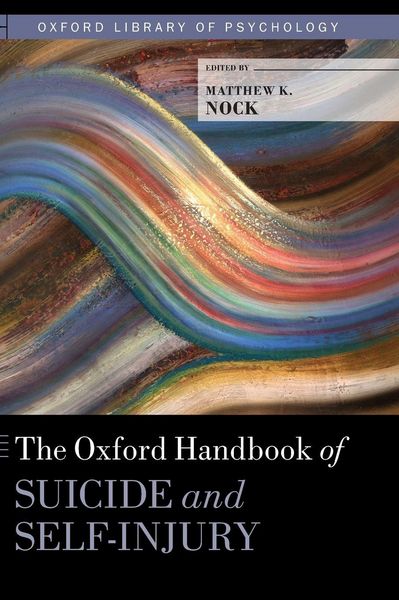
  • Produktbild: Oxford Handbook of Suicide and Self-Injury
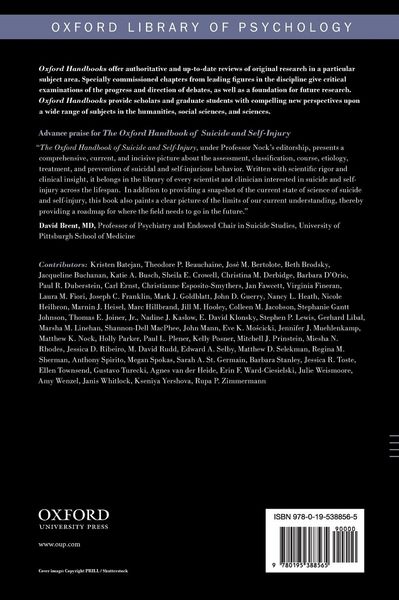
  • Produktbild: Oxford Handbook of Suicide and Self-Injury

Oxford Handbook of Suicide and Self-Injury

Aus der Reihe OLOP

263,99 €

inkl. gesetzl. MwSt., Versandkostenfrei


Beschreibung

Suicide is a perplexing human behavior that remains among the leading causes of death worldwide, responsible for more deaths each year than all wars, genocide, and homicide combined. Although suicide and other forms of self-injury have baffled scholars and clinicians for thousands of years, the past...

Beschreibung

Suicide is a perplexing human behavior that remains among the leading causes of death worldwide, responsible for more deaths each year than all wars, genocide, and homicide combined. Although suicide and other forms of self-injury have baffled scholars and clinicians for thousands of years, the past few decades have brought significant leaps in our understanding of these behaviors.
This volume provides a comprehensive summary of the most important and exciting advances in our understanding of suicide and self-injury and our ability to predict and prevent it. Comprised of a formidable who's who in the field, the handbook covers the full spectrum of topics in suicide and self-injury across the lifespan, including the classification of different self-injurious behaviors, epidemiology, assessment techniques, and intervention. Chapters probe relevant issues in our society
surrounding suicide, including assisted suicide and euthanasia, suicide terrorism, overlap between suicidal behavior and interpersonal violence, ethical considerations for suicide researchers, and current knowledge on survivors of suicide.
The most comprehensive handbook on suicide and self-injury to date, this volume is a must-read text for graduate students, fellows, academic and research psychologists, and other researchers working in the brain and behavioral sciences.

Rezension

There is no doubt that this book will likely appeal to a wide range of mental health researchers and practitioners, including psychologists, social workers, policy makers, and psychiatrists. Students in psychology and psychiatry will find this resource helpful in their coursework as they developed their skills as a clinician. Seasoned therapists, physicians, and researchers will aslo benefit from a deepened understanding of the important concepts covered in this book. PsycCritiques

Produktdetails

Einband

Gebundene Ausgabe

Erscheinungsdatum

01.06.2014

Herausgeber Nock Matthew K.
Verlag Oxford University Press

Produktdetails

Einband

Gebundene Ausgabe

Erscheinungsdatum

01.06.2014

Herausgeber Nock Matthew K.
Verlag Oxford University Press
Seitenzahl

534

Maße (L/B/H)

26/18,3/3,3 cm

Gewicht

1188 g

Sprache

Englisch

ISBN

978-0-19-538856-5

Herstelleradresse

Libri GmbH
Europaallee 1
36244 Bad Hersfeld
DE

Email: gpsr@libri.de

Noch keine Bewertungen vorhanden

Verfassen Sie die erste Bewertung zu diesem Artikel

Helfen Sie anderen Kundinnen und Kunden durch Ihre Meinung.

Kundinnen und Kunden meinen

Bewertungen (0)

  • Produktbild: Oxford Handbook of Suicide and Self-Injury
  • Produktbild: Oxford Handbook of Suicide and Self-Injury

    • 1. Introduction to the Handbook


    • Matthew K. Nock


    • Part One: Classification of Self-Injurious Behaviors


    • 2. The Classification of Suicidal Behavior


    • Kelly Posner, Beth Brodsky, Kseniya Yershova, Jacqueline Buchanan, and John Mann


    • 3. Distinguishing between Suicidal and Non-Suicidal Self-Injury


    • Jennifer J. Muehlenkamp


    • 4. Should We Expand the Conceptualization of Self-Injurious Behavior? Rationale, Review, and Recommendations


    • Jill M. Hooley and Sarah St. Germain


    • Part Two: Phenomenology and Epidemiology


    • 5. Suicidal Behaviors among Children and Adolescents


    • Christianne Esposito-Smythers, Julie Weismoore, Rupa P. Zimmermann, and Anthony Spirito


    • 6. Suicidal Behaviors Among Adults


    • Eve K. Moscicki


    • 7. Person-Centered Prevention of Suicide Among Older Adults


    • Paul R. Duberstein and Marnin J. Heisel


    • 8. Non-suicidal Self-injury across the Lifespan


    • Janis Whitlock and Matthew Selekman


    • Part Three: Approaches to Understanding Self-Injurious Behaviors


    • 9. Genetic and Neurobiological Approaches to Understanding Suicidal Behaviors


    • Laura M. Fiori, Carl Ernst, and Gustavo Turecki


    • 10. Developmental Approaches to Understanding Suicidal and Self-Injurious Behaviors


    • Sheila E. Crowell, Christina M. Derbidge, and Theodore P. Beauchaine


    • 11. Social and Ecological Approaches to Suicidal Behaviors and Nonsuicidal Self-Injury (NSSI)


    • Nicole Heilbron, Joseph C. Franklin, John D. Guerry, and Mitchell J. Prinstein


    • 12. Cognitive and Information Processing Approaches to Understanding Suicidal Behaviors


    • Amy Wenzel and Megan Spokas


    • 13. Psychodynamics of Suicide


    • Mark J. Goldblatt


    • 14. Racial/Ethnic, Spiritual/Religious, and Sexual Orientation Influences on Suicidal Behaviors


    • Regina M. Sherman, Barbara D'Orio, Miesha N. Rhodes, Stephanie Gantt, and Nadine J. Kaslow


    • 15. Comprehensive Theories of Suicidal Behaviors


    • Edward A. Selby, Thomas E. Joiner Jr., and Jessica D. Ribeiro


    • 16. Comprehensive Theoretical Models of NSSI


    • Colleen M. Jacobson and Kristen Batejan


    • Part Four: Assessment


    • 17. Core Competencies, Warning Signs, and a Framework for Suicide Risk Assessment in Clinical Practice


    • M. David Rudd


    • 18. Assessment of Non-Suicidal Self-Injury


    • E. David Klonsky and Stephen P. Lewis


    • Part Five: Prevention and Intervention


    • 19. Prevention of Suicidal Behaviors


    • JosÃ(c) M. Bertolote


    • 20. Psychological Treatment of Suicidal Behaviors


    • Erin F. Ward-Ciesielski and Marsha M. Linehan


    • 21. The Pharmacologic Treatment of Suicidal Patients


    • Jan Fawcett and Katie A. Busch


    • 22. Prevention of Non-Suicidal Self-Injury


    • Nancy L. Heath, Jessica R. Toste, and Shannon-Dell MacPhee


    • 23. Psychological Treatments for Non-Suicidal Self-Injury


    • Barbara Stanley, Virginia Fineran, and Beth Brodsky


    • 24. Pharmacologic Treatment of NSSI


    • Paul L. Plener and Gerhard Libal


    • Part Six: Special Issues


    • 25. Overlap between Suicidal Behavior and Interpersonal Violence


    • Marc Hillbrand


    • 26. Suicide Terrorism


    • Ellen Townsend


    • 27. Physician-Assisted Suicide and Euthanasia


    • Agnes van der Heide


    • 28. Survivors of Suicide


    • Holly Parker


    • 29. Conclusion to the Handbook


    • Matthew K. Nock