Gutscheinbedingungen

**Gültig bis 25.06.2026 auf fremdsprachige Bücher online auf thalia.at und in der Thalia App. Einzelne Artikel können ausgeschlossen sein. Ausgenommen sind preisgebundene Artikel & eBooks. Pro Einkauf einmal einlösbar. Click & Collect nur bei Onlinevorabzahlung möglich. Keine Barauszahlung. Nicht kombinierbar mit anderen Aktionen und Gutscheinen. Gutschein wird auf max. 500€ Bestellwert angerechnet. Nicht gültig für Geschenkkarten, Versandkosten und Services.

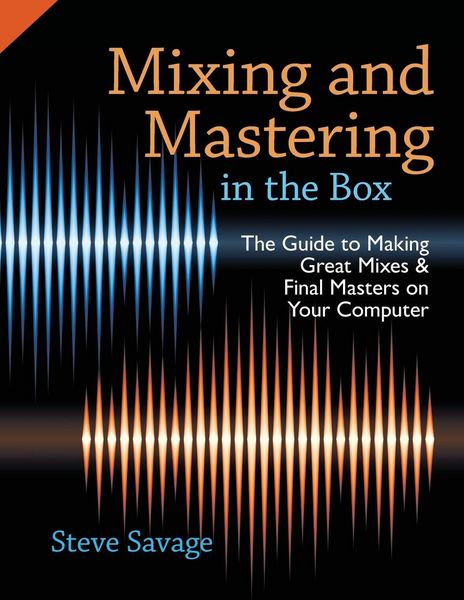
  • Produktbild: Mixing and Mastering in the Box
  • Produktbild: Mixing and Mastering in the Box

Mixing and Mastering in the Box The Guide to Making Great Mixes and Final Masters on Your Computer

79,99 €

inkl. gesetzl. MwSt., Versandkostenfrei


Beschreibung

Produktdetails

Einband

Taschenbuch

Erscheinungsdatum

01.09.2014

Abbildungen

115 illustrations

Verlag

Oxford Academic

Seitenzahl

316

Maße (L/B/H)

28/21,6/1,8 cm

Gewicht

680 g

Sprache

Englisch

ISBN

978-0-19-992932-0

Beschreibung

Produktdetails

Einband

Taschenbuch

Erscheinungsdatum

01.09.2014

Abbildungen

115 illustrations

Verlag

Oxford Academic

Seitenzahl

316

Maße (L/B/H)

28/21,6/1,8 cm

Gewicht

680 g

Sprache

Englisch

ISBN

978-0-19-992932-0

Herstelleradresse

Libri GmbH
Europaallee 1
36244 Bad Hersfeld
DE

Email: gpsr@libri.de

Kundinnen und Kunden meinen

0 Bewertungen

Informationen zu Bewertungen

Zur Abgabe einer Bewertung ist eine Anmeldung im Konto notwendig. Die Authentizität der Bewertungen wird von uns nicht überprüft. Wir behalten uns vor, Bewertungstexte, die unseren Richtlinien widersprechen, entsprechend zu kürzen oder zu löschen.

Die Bewertungen sind nach Format, Anzahl Sterne und Datum sortiert.

Verfassen Sie die erste Bewertung zu diesem Artikel

Helfen Sie anderen Kund*innen durch Ihre Meinung

Kundinnen und Kunden meinen

0 Bewertungen filtern

Die Leseprobe wird geladen.
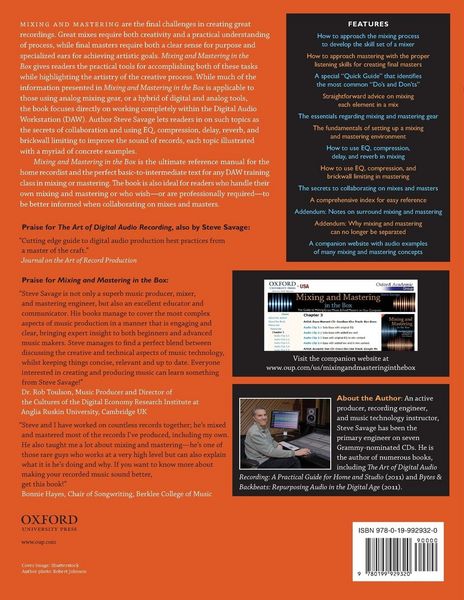
  • Produktbild: Mixing and Mastering in the Box
  • Produktbild: Mixing and Mastering in the Box
    • Contents

    • Introduction

    • Part I - Mixing and Mastering

    • Introduction to Part I

    • 1. The Starting Point

    • 1.1 Preparing to mix and master

    • 1.2 Where to mix and master

    • 1.3 The tools of mixing and mastering

    • 1.4 Introduction to the "Quick Guide "

    • 2. Quick Guide to Great Mixes and Masters: Five best practices

    • 2.1 Have a concept

    • 2.2 Monitor level

    • 2.3 Monitoring options

    • 2.4 Revise, revise, revise

    • 2.5 Live with your mix or master

    • 3. Quick Guide to Great Mixes and Masters: Four common mistakes

    • 3.1 Poor control of the low end

    • 3.2 Overly bright mixes and masters

    • 3.3 Overly compressed mixes and masters

    • 3.4 Trusting inadequate monitoring

    • Part II - Mixing

    • Introduction to Part II

    • 4. Building a Mix: The concepts and tools in detail

    • 4.1 Starting concepts and setting level

    • 4.2 Panning

    • 4.3 Processing: EQ

    • 4.4 Processing: Dynamics

    • 4.5 Processing: Effects

    • 4.6 Processing: What else is in the box?

    • 4.7 The stereo buss

    • 5. Automation and Recall: Fine-tuning

    • 5.1 Online versus off-line automation

    • 5.2 Details of online automation

    • 5.3 Details of off-line automation

    • 5.4 Timeline of automation

    • 5.5 From simple to complex mixes

    • 5.6 Fades

    • 5.7 Advanced automation techniques

    • 5.8 Recall

    • 6. Mixing Piece by Piece: How to approach individual elements

    • 6.1 Drums and percussion

    • 6.2 Bass

    • 6.3 Guitar

    • 6.4 Keyboards

    • 6.5 Vocals

    • 6.6 Horns

    • 6.7 Strings

    • 7. Mix Collaboration: The mix team

    • 7.1 How to communicate about mixes

    • 7.2 Levels of mixer intervention

    • 7.3 Managing remote mixing projects

    • 8. Delivering Mixes: Formats, mix types and multiple mixes

    • 8.1 Digital formats for mix delivery

    • 8.2 Full mixes, TV mixes, and clips

    • 8.3 Multiple versions of a single mix

    • PART III - Mastering

    • Introduction to part III

    • 9. Setting Up to Master: Tools and files

    • 9.1 Tools

    • 9.2 Creating a template

    • 9.3 Building the timeline

    • 10. How to Listen for Mastering: From your ear to action

    • 10.1 Level

    • 10.2 Frequency/EQ

    • 10.3 Dynamics and effects

    • 10.4 Consistency

    • 11. Creating a Master: The concepts and tools in detail

    • 11.1 Creating a reference track

    • 11.2 Processing: EQ

    • 11.3 Processing: Level

    • 11.4 Processing: Dynamics and effects

    • 11.5 What else is in the box?

    • 12. The Final Master: Creating and delivering

    • 12.1 Creating a master

    • 12.2 Formats and delivery options

    • 13. Mastering Collaboration: The mastering team

    • 13.1 How to talk about mastering

    • 13.2 Levels of mastering intervention

    • 13.3 Managing remote mastering projects

    • Addendum I: Notes on surround mixing and mastering

    • Addendum II: Why mixing and mastering can no longer be separated

    • Index