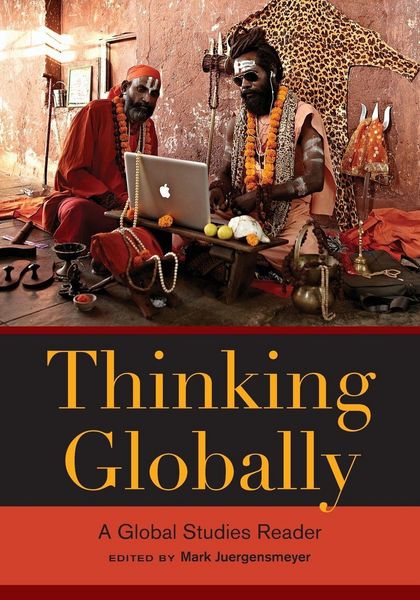
Produktbild: Thinking Globally

Thinking Globally A Global Studies research

51,99 €

inkl. gesetzl. MwSt., Versandkostenfrei


Beschreibung

Produktdetails

Einband

Taschenbuch

Erscheinungsdatum

20.12.2013

Herausgeber

Juergensmeyer Mark

Verlag

University Of California Press

Seitenzahl

456

Maße (L/B/H)

25,3/17,7/3,2 cm

Gewicht

771 g

Sprache

Englisch

ISBN

978-0-520-27844-8

Beschreibung

Rezension

"Thinking Globally is an outstanding model of the intellectual and practical issues involved with globalization and its study." - John Nemec, Associate Professor of Indian Religions and South Asian Studies, Department of Religious Studies, University of Virginia

Produktdetails

Einband

Taschenbuch

Erscheinungsdatum

20.12.2013

Herausgeber

Juergensmeyer Mark

Verlag

University Of California Press

Seitenzahl

456

Maße (L/B/H)

25,3/17,7/3,2 cm

Gewicht

771 g

Sprache

Englisch

ISBN

978-0-520-27844-8

Herstelleradresse

Libri GmbH
Europaallee 1
36244 Bad Hersfeld
DE

Email: gpsr@libri.de

Noch keine Bewertungen vorhanden

Verfassen Sie die erste Bewertung zu diesem Artikel

Helfen Sie anderen Kundinnen und Kunden durch Ihre Meinung.

Kundinnen und Kunden meinen

Bewertungen (0)

  • Produktbild: Thinking Globally
  • PREFACE:
    A Friendly Introduction to Global Studies

    A. INTRODUCTION
    1. THINKING  GLOBALLY
    What is globalization and how do we make sense of it? 
    Manfred Steger, “Globalization: A Contested Concept,” from Globalization: A Very Short Introduction 
    Thomas Friedman, “The World is Ten Years Old,” from The Lexus and the Olive Tree
    Paul James, “Approaches to Globalization,” Encyclopedia of Global Studies 
    Steven Weber, “How Globalization Went Bad,” from Foreign Policy

    2. GLOBALIZATION OVER TIME
    Globalization has a history—the current global era is prefaced by periods of economic interaction, social expansion, and intense cultural encounters.
    William McNeill, “Globalization: Long-Term Process or New Era in Human Affairs?” in New Global Studies
    Jane Burbank and Frederick Cooper, “Imperial Trajectories,” in Empires in World History
    Immanuel Wallerstein, “On the Study of Social Change,” in The Modern World System  
    Dominic Sachsenmeier, “Movements and Patterns: Environments of Global History” in Global Perspectives on Global History 

    B. THE MARCH OF GLOBALIZATION—BY REGIONS
    3. AFRICA: THE RISE OF ETHNIC POLITICS IN A GLOBAL WORLD
    The impact of the slave trade and colonialization on Africa, influence of African culture on the Americas, and African aspects of the global rise of ethnic politics.
    Nayan Chanda, “The African Beginning,” in Bound Together 
    Dilip Hiro, “Slavery,” in Encyclopedia of Global Studies
    Jeffrey Haynes, “Africa Diaspora Religions,” from Encyclopedia of Global Studies
    Jacob Olupona, from “Thinking Globally About African Religion,“ in The Oxford Handbook of Global Religion
    Okwudiba Nnoli, “The Cycle of ‘State-Ethnicity-State’ in African Politics,” from MOST Ethno-Net Africa

    4. THE MIDDLE EAST: RELIGIOUS POLITICS AND ANTI-GLOBALIZATION
    The rise of global religious cultures from the Middle East, and current religious politics as part of a global challenge to secularism.
    Mohammed Bamyeh, “The Ideology of the Horizons” in The Social Origins of Islam
    Said Arjomand, “Thinking Globally About Islam,” in Oxford Handbook of Global Religion 
    Jonathan Fox, “Are Middle East Conflicts More Religious?” in Middle East Quarterly
    Barah Mikail, “Religion and Politics in Arab Transitions,” FRIDE policy brief

    5. SOUTH AND CENTRAL ASIA: THE FLOW OF TRADE AND CULTURE
    The spread of Asian cultures from India and Central Asia via trade routes; the role of South Asia in global trade and information technology.
    Richard Foltz, “The Silk Road and Its Travelers” in Religions of the Silk Road
    Morris Rossabi, “The Early Mongols,” in Khublai Khan: His Life and Times
    Vasudha Narayanan, “Hinduism” in The Encyclopedia of Global Studies
    Barbara D. Metcalf and Thomas R. Metcalf, “Revolt, the Modern State, and Colonized Subjects 1848-1885” in A Concise History of India
    Carol Upadhya and A.R. Vasavi, “Outposts of the Global Information Economy” in In an Outpost of the Global Economy: Work and Workers in India’s Technology Industry 

    6. EAST ASIA: GLOBAL ECONOMIC EMPIRES
    The role of East Asia in global economic history, and the rise of new economies in China, Japan, and South Korea based on global trade.
    Kenneth Pomeranz, “Exotic Goods and the Velocity of Fashion,” in T he Great Divergence: China, Europe, and the Making of the Modern World Economy
    Andre Gunder Frank, “The 21st Century Will Be Asian” from The Nikkei Weekly
    Steven Radelet, Jeffrey Sachs, and Jong-Wha Lee, “Economic Growth in Asia” in Emerging Asia
    Ho-fung Hung, “Is the Rise of China Sustainable?” China and the Transformation of Global Capitalism

    7. SOUTHEAST ASIA AND THE PACIFIC: THE EDGES OF GLOBALIZATION
    The emergence of Southeast Asia from colonial control; the rise of Australia, New Zealand and Pacific Islands on the edges of globalization.
    Georges Coedes, “Conclusion,” in The Indianized States of Southeast Asia
    Benedict Anderson, “The Last Wave,” in Imagined Communities
    Sucheng Chan, “Vietnam, 1945-2001: The Global Dimensions of Decolonization, War, Revolution, and Refugee Outflows.”
    Celeste Lipow MacLeod, “Asian Connections,” in Multiethnic Australia: Its History and Future
    Joel Robbins, “Pacific Islands Religious Communities, in Oxford Handbook of Global Religion

    8. EUROPE AND RUSSIA: NATIONALISM AND TRANSNATIONALISM
    The role of Europe in creating the concept of the nation, transnational politics in the Soviet Union, and the rise of the European Union.
    Peter Stearns, “The 1850s as Turning Point: The Birth of Globalization?” in Globalization in World History
    Eric Hobsbawm, “The Nation as Novelty,” from Nations and Nationalism since 1780
    Seyla Benhabib, “Citizens, Residents, and Aliens in a Changing World” from The Postnational Self
    Odd Arne Wested, “The Empire of Justice: Soviet Ideology and Foreign Interventions” in The Global Cold War 
    Jurgen Habermas, “Citizenship and National Identity: Some Reflections on the Future of Europe” in Praxis International

    9: THE AMERICAS: DEVELOPMENT STRATEGIES
    The European conquest of the Americas, the rise of new societies, and varying patterns of economic development within a global context.
    Charles C. Mann, “Prologue,” 1493: Discovering the New World Columbus Created 
    Tzvetan Todorov, “Conquest: The Reasons for the Victory,” in The Conquest of America
    Francis Fukuyama, “Introduction” in Falling Behind: Explaining the Development Gap Between Latin America and the United States
    Denis Lynn Daly Heyck, “Introduction” in Surviving Globalization in Three Latin American Communities 

    C.  TRANSNATIONAL GLOBAL ISSUES
    10. GLOBAL FORCES IN THE NEW WORLD ORDER
    Paradigms for thinking about the new world order (or disorder) in the post-Cold War global era.
    Benjamin Barber, “Introduction” from Jihad vs. McWorld
    Samuel Huntington, “The New Era in World Politics-A Multipolar, Multicivilizational World,” from T he Clash of Civilizations and the Remaking of World Order
    Michael Hardt and Antonio Negri, “Preface” to Empire  
    Saskia Sassen, "Cities," Encyclopedia of Global Studies

    11. THE EROSION OF THE NATION-STATE
    The fading strength of the nation-state and the rise of alternative conceptions of world order.
    Kenichi Ohmae, “The Cartographic Illusion” from The End of the Nation-State
    Susan Strange, “The Westfailure System”  from Review of International Studies
    Zygmunt Bauman, “After the Nation-State, What?” in Globalization: The Human Consequences.
    William Robinson, “The Transnational State” from  A Theory of Global Capitalism

    12. RELIGIOUS POLITICS AND THE NEW WORLD ORDER
    The religious challenge to the secular state in new conceptions of political order.
    Monica  Duffy Toft, Daniel Philpott, Timothy  Samuel Shah, “The Twenty-First Century as God’s Century,” in God’s Century: Resurgent Religion and Global Politics
    Mark Juergensmeyer,  “Religion in the New Global Order”
    Olivier Roy, “Al Qaeda and the New Terrorists” from Globalized Islam: The Search for a New Ummah 
    Richard Falk, "Gaining Perspectives on the Present,” from Religion and Humane Global Governance

    13. TRANSNATIONAL ECONOMY AND GLOBAL LABOR
    Economic globalization-- its relation to national economies, the growth of transnational corporations, and the changing role of labor.
    Richard P. Appelbaum, “Outsourcing,” in The Encyclopedia of Global Studies
    Nelson Lichtenstein, “The Wal-Mart Template for Global Capitalism”  in New Labor Forum
    Robert B. Reich, "Who is Us?"
    Jagdish Bhagwati, from “Two Critiques of Globalization,” in In Defense of Globalization
    Joseph Stiglitz, from “The Way Ahead” in Globalization and its Discontents 

    14. GLOBAL FINANCE AND FINANCIAL INEQUALITY
    Changes in the concept of money and international financial markets.
    Benjamin J. Cohen, “Money in International Affairs” from The Geography of Money
    Stephen J. Kobrin, “Electronic Cash and the End of National Markets” from USIA Electronic Journal
    Glenn Firebaugh, “Massive Global Income Inequality,” in The New Geography of Global Income Inequality
    Dani Rodrik, “Globalization for Whom?” Harvard Magazine 

    15. DEVELOPMENT AND THE ROLE OF WOMEN
    Competing views of development and the role of women in the global economy.
    Alvin Y. So, “Conclusion” from Social Change and Development
    Mayra Buvinic, “Women in Poverty: A New Global Underclass” from Foreign Policy pop
    Kum Kum Bhavnani, John Foran, Priya Kuriyan, Debashish Munshi, “From the Edges of Development” from On the Edges of Development: Cultural Interventions

    16. THE HIDDEN GLOBAL ECONOMY OF SEX AND DRUGS
    Illegal traffic in people and drugs, and the global attempts to control them.
    David Shirk, “Introduction,” The Drug War in Mexico: Confronting a Common Threat
    Eduardo Porter, “Numbers Tell of Failure in Drug War,” New York Times
    Kevin Bales, from “The New Slavery,” in Disposable People: New Slavery in the Global Economy 
    Barbara Ehrenreich and Arlie Russell Hochschild, “Introduction” Global Woman: Nannies, Maids, and Sex Workers in the Global Economy

    17. GLOBAL ENVIRONMENTAL AND HEALTH CRISES
    The principal environmental and health problems that transcend national boundaries and global attempts to alleviate them.
    Catherine Gautier, “Climate Change,” Encyclopedia of Global Studies
    Ron Fujita, "Turning the Tide," in Heal the Ocean: Solutions for Saving our Seas
    Hakan Seckinelgin, “HIV/AIDS” in Encyclopedia of Global Studies 

    18. GLOBAL COMMUNICATIONS AND NEW MEDIA
    The role of new media—video, internet, social networking—on global culture and organization.
    Yudhishthir Raj Isar, “Global Culture and Media,” from The Encyclopedia of Global Studies 
    Michael Curtin, “Media Capital in Chinese Film and Television”  in Playing to the World’s Biggest Audience: The Globalization of Chinese Film and TV
    Natana DeLong-Bas, ”The New Social Media and the Arab Spring,” Oxford Islamic Studies Online
    Pippa Norris, “The Worldwide Digital Divide,” Harvard University Kennedy School of Government

    19. THE GLOBAL MOVEMENT FOR HUMAN RIGHTS
    Transnational networks supporting human rights and legal protection for all.
    Micheline Ishay, “Globalization and Its Impact,” The History of Human Rights: From Ancient Times to the Globalization Era
    Alison Brysk, “Transnational Threats and Opportunities,” in Globalization and Human Rights
    Eve Darian-Smith , “Human Rights as an Ethic of Progress,” in Laws and Societies in Global Contexts: Contemporary Approaches 
    David Held, “Changing Forms of Global Order,” Cosmopolitanism 

    20. THE FUTURE OF GLOBAL CIVIL SOCIETY
    The emerging sense of global citizenship, and nongovernmental organizations and movements comprising a new “global civil society”—is this the global future?
    Mary Kaldor, “Social Movements, NGOs and Networks” from Global Civil Society
    Jan Nederveen Pieterse, “Shaping Globalization” in Global Futures
    Giles Gunn, “Being Other-Wise” from Ideas to Die for: Cosmopolitanism in a Global Era
    Kwame Anthony Appiah, “Making Conversation” from Cosmopolitanism: Ethics in a World of Strangers

    ACKNOWLEDGEMENTS