KI-Beratung Beta

Gutscheinbedingungen

**Gültig am 25.11.2026 auf fremdsprachige Bücher online auf thalia.at und in der Thalia App. Einzelne Artikel können ausgeschlossen sein. Ausgenommen sind preisgebundene Artikel & eBooks. Pro Einkauf einmal einlösbar. Click & Collect nur bei Onlinevorabzahlung möglich. Keine Barauszahlung. Nicht kombinierbar mit anderen Aktionen und Gutscheinen. Gutschein wird auf max. 500€ Bestellwert angerechnet. Nicht gültig für Geschenkkarten, Versandkosten und Services.

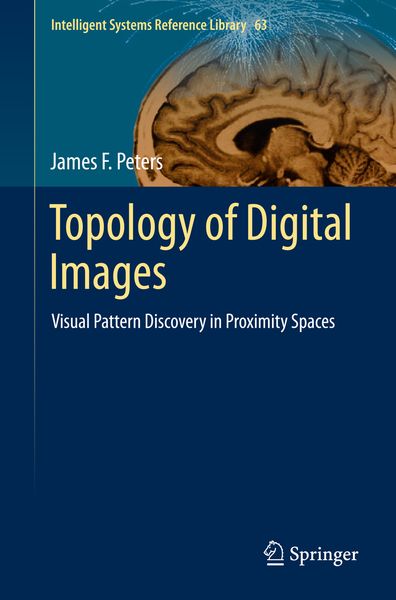
Produktbild: Topology of Digital Images
Band 63

Topology of Digital Images Visual Pattern Discovery in Proximity Spaces

99,99 €

inkl. gesetzl. MwSt., Versandkostenfrei


Beschreibung

This book carries forward recent work on visual patterns and structures in digital images and introduces a near set-based a topology of digital images. Visual patterns arise naturally in digital images viewed as sets of non-abstract points endowed with some form of proximity (nearness) relation. Proximity...

Beschreibung

This book carries forward recent work on visual patterns and structures in digital images and introduces a near set-based a topology of digital images. Visual patterns arise naturally in digital images viewed as sets of non-abstract points endowed with some form of proximity (nearness) relation. Proximity relations make it possible to construct uniform topologies on the sets of points that constitute a digital image. In keeping with an interest in gaining an understanding of digital images themselves as a rich source of patterns, this book introduces the basics of digital images from a computer vision perspective. In parallel with a computer vision perspective on digital images, this book also introduces the basics of proximity spaces. Not only the traditional view of spatial proximity relations but also the more recent descriptive proximity relations are considered. The beauty of the descriptive proximity approach is that it is possible to discover visual set patterns among sets that are non-overlapping and non-adjacent spatially. By combining the spatial proximity and descriptive proximity approaches, the search for salient visual patterns in digital images is enriched, deepened and broadened. A generous provision of Matlab and Mathematica scripts are used in this book to lay bare the fabric and essential features of digital images for those who are interested in finding visual patterns in images. The combination of computer vision techniques and topological methods lead to a deep understanding of images.

Rezension

From the reviews:

“This book presents the recent research results of visual patterns in proximity spaces in a very easy to follow way. … a research exposition for mathematicians, computer scientists, engineers and for all who want to familiarize with the recent research in this field. It can be also treated as the textbook for students and for all who want to deeply understand images through their topology. It can be used for a self studying and as a course book as well.” (Agnieszka Lisowska, zbMATH, Vol. 1295, 2014)

Produktdetails

Einband

Gebundene Ausgabe

Erscheinungsdatum

14.02.2014

Abbildungen

XVI, 411 p. 250 illus., 158 illus. in color.

Verlag Springer Berlin

Produktdetails

Einband

Gebundene Ausgabe

Erscheinungsdatum

14.02.2014

Abbildungen

XVI, 411 p. 250 illus., 158 illus. in color.

Verlag Springer Berlin
Seitenzahl

411

Maße (L/B/H)

24,1/16/2,9 cm

Gewicht

753 g

Sprache

Englisch

ISBN

978-3-642-53844-5

Herstelleradresse

Springer-Verlag KG
Sachsenplatz 4-6
1201 Wien
AT

Email: ProductSafety@springernature.com

Noch keine Bewertungen vorhanden

Verfassen Sie die erste Bewertung zu diesem Artikel

Helfen Sie anderen Kundinnen und Kunden durch Ihre Meinung.

Kundinnen und Kunden meinen

Bewertungen (0)

Die Leseprobe wird geladen.
  • Produktbild: Topology of Digital Images
  • Preface.-

    1 Topology of Digital Images: Basic Ingredients.-

    2 Structures Arising from Sets of Pixels.-

    3 Visualisations and Covers.-

    4 Linear Filtering and Visual Patterns in Images.-

    5 Edges, Lines, Ridges, and Nearness Structures.-

    6 Corners and Symmetric Proximity.-

    7 Separation of Image Regions and Set Patterns.-

    8 Descriptive Raster Spaces.-

    9 Component Analysis and Uniform Spaces.-

    10 Shapes and Shape Set Patterns.-

    11 Texture and Texture Set Patterns.-

    12 Pattern-Based Picture Classification.-

    13 Appendix: Matlab and Mathematica Scripts.-

    14 Notes and Further Readings.