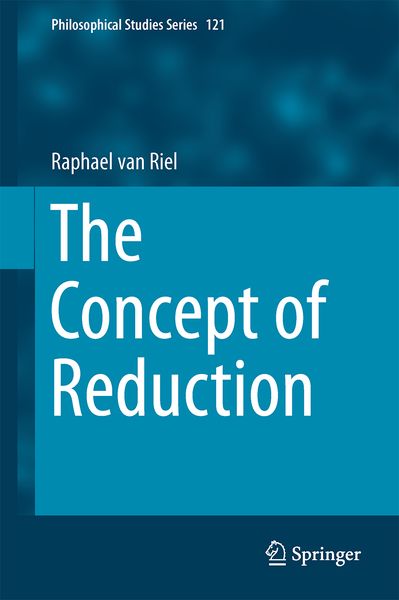
The Concept of Reduction
-
- Hardcover ausgewählt
- Taschenbuch
- eBook
-
Sprache:Englisch
51,99 €
inkl. gesetzl. MwSt.,
Beschreibung
Produktdetails
Einband
Gebundene Ausgabe
Erscheinungsdatum
06.03.2014
Abbildungen
XII, 226 p. 3 illus.
Verlag
SpringerSeitenzahl
226
Maße (L/B/H)
24,1/16/1,9 cm
Gewicht
530 g
Sprache
Englisch
ISBN
978-3-319-04161-2
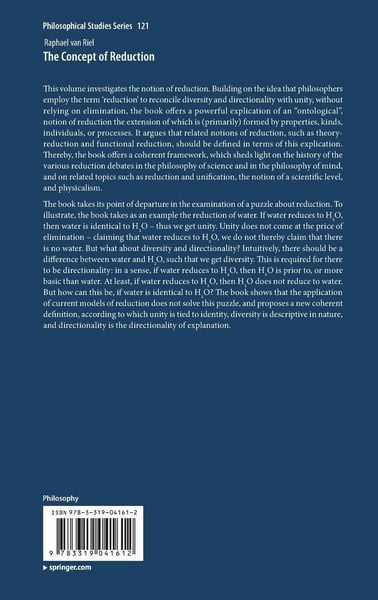
This volume investigates the notion of reduction. Building on the idea that philosophers employ the term ‘reduction’ to reconcile diversity and directionality with unity, without relying on elimination, the book offers a powerful explication of an “ontological”, notion of reduction the extension of which is (primarily) formed by properties, kinds, individuals, or processes. It argues that related notions of reduction, such as theory-reduction and functional reduction, should be defined in terms of this explication. Thereby, the book offers a coherent framework, which sheds light on the history of the various reduction debates in the philosophy of science and in the philosophy of mind, and on related topics such as reduction and unification, the notion of a scientific level, and physicalism.
The book takes its point of departure in the examination of a puzzle about reduction. To illustrate, the book takes as an example the reduction of water. If water reduces to H 2 O, then water is identical to H 2 O – thus we get unity. Unity does not come at the price of elimination – claiming that water reduces to H 2 O, we do not thereby claim that there is no water. But what about diversity and directionality? Intuitively, there should be a difference between water and H 2 O, such that we get diversity. This is required for there to be directionality: in a sense, if water reduces to H 2 O, then H 2 O is prior to, or more basic than water. At least, if water reduces to H 2 O, then H 2 O does not reduce to water. But how can this be, if water is identical to H 2 O? The book shows that the application of current models of reduction does not solve this puzzle, and proposes a new coherent definition, according to which unity is tied to identity, diversity is descriptive in nature, and directionality is the directionality of explanation.
Noch keine Bewertungen vorhanden
Verfassen Sie die erste Bewertung zu diesem Artikel
Helfen Sie anderen Kundinnen und Kunden durch Ihre Meinung.
Kurze Frage zu unserer Seite
Vielen Dank für Ihr Feedback
Wir nutzen Ihr Feedback, um unsere Produktseiten zu verbessern. Bitte haben Sie Verständnis, dass wir Ihnen keine Rückmeldung geben können. Falls Sie Kontakt mit uns aufnehmen möchten, können Sie sich aber gerne an unseren Kund*innenservice wenden.
zum Kundenservice