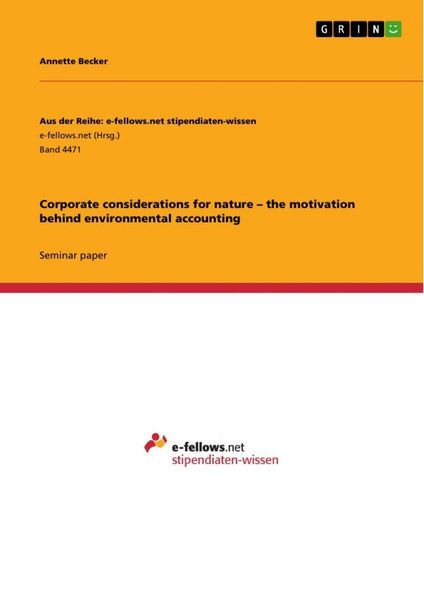
Corporate considerations for nature - the motivation behind environmental accounting
-
- Taschenbuch ausgewählt
- eBook
-
Sprache:Englisch
17,95 €
inkl. gesetzl. MwSt.,
- Kostenlose Lieferung ab 30 € Einkaufswert
- Versandkostenfrei für Bonuscard-Kund*innen
Beschreibung
Produktdetails
Einband
Taschenbuch
Erscheinungsdatum
25.11.2013
Verlag
GRINSeitenzahl
28
Maße (L/B/H)
21/14,8/0,3 cm
Gewicht
56 g
Auflage
1. Auflage
Sprache
Englisch
ISBN
978-3-656-53798-4
Seminar paper from the year 2013 in the subject Philosophy - Miscellaneous, grade: 1,7, University of Bayreuth (Insititut für Philosophie), course: Advanced Arguments in Business Ethics, language: English, abstract: The tendency to show environmental commitment in economic sciences has been growing during the last decades. Terms like green, ecological or environmental economics have been promoted, most famously in the first green wave, when the book "The Limits to Growth" in 1972 and the Brundtland Report "Our Common Future" in 1987, and more recently, when the Stern Review on the Economics of Climate Change in 2006 and the Fifth Assessment Report of the Intergovernmental Panel on Climate Change (IPCC) in 2013, were published. But how come the business world started to care about the environment in the past, without any comprehensive standard forcing them to do so legally on a national or global level? It has been felt that the financial accounting framework was not adequate to provide the information required by various internal and external stakeholders on environmental costs and liabilities, and steps taken by companies to mitigate global warming (Idowu et al. 2013, p. 1035). The endeavour was that the complete costs incurred by an enterprise including external, environmental costs like consumption of non-renewable resources, damages to the environment and degradation of nature, ought to be considered. These external costs, which are also called externalities or societal costs, are caused by the impact of organizational activities, products and services on natural environmental resources and society, but for which the organization doesn't bear any financial liability. In other words, "external costs result from corporate activities but are not internalized through regulations and prices. The boundaries of these costs are not static." (ibid. p. 1035).
Kundinnen und Kunden meinen
Verfassen Sie die erste Bewertung zu diesem Artikel
Helfen Sie anderen Kund*innen durch Ihre Meinung
Kurze Frage zu unserer Seite
Vielen Dank für Ihr Feedback
Wir nutzen Ihr Feedback, um unsere Produktseiten zu verbessern. Bitte haben Sie Verständnis, dass wir Ihnen keine Rückmeldung geben können. Falls Sie Kontakt mit uns aufnehmen möchten, können Sie sich aber gerne an unseren Kund*innenservice wenden.
zum Kundenservice