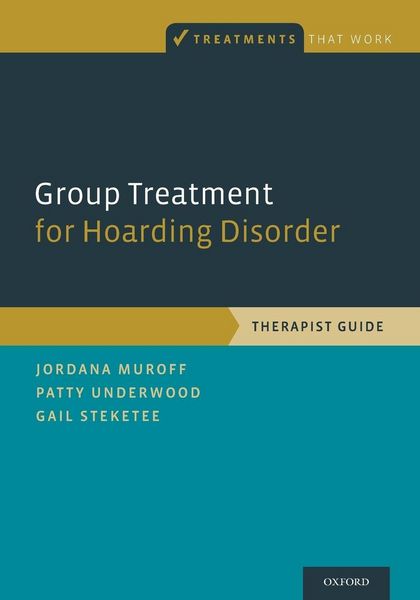
Group Treatment for Hoarding Disorder Therapist Guide
-
- Taschenbuch ausgewählt
- eBook
-
Sprache:Englisch
91,99 €
inkl. gesetzl. MwSt.,
Beschreibung
Produktdetails
Einband
Taschenbuch
Erscheinungsdatum
01.07.2014
Verlag
Oxford University PressSeitenzahl
384
Maße (L/B/H)
25,4/17,8/2,1 cm
Gewicht
721 g
Sprache
Englisch
ISBN
978-0-19-934096-5
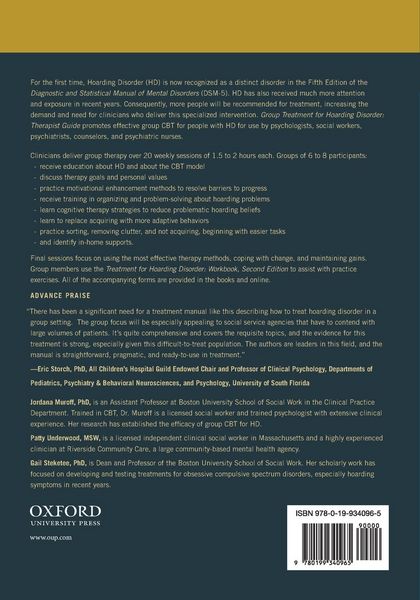
For the first time, Hoarding Disorder (HD) is now recognized as a distinct disorder in the fifth edition of the Diagnostic and Statistical Manual of Mental Disorders (DSM-5), separate from OCD. HD has also received much more attention and exposure in recent years. Consequently, more people will be recommended for treatment, increasing the demand and need for clinicians who deliver this specialized intervention.
Group Treatment for Hoarding Disorder: Therapist Guide outlines a cognitive-behavioral therapy program for HD using a group model. Clinicians deliver group therapy over 20 weekly sessions of 1.5 to 2 hours each. A single experienced clinician can lead the group or a co-therapy model can be used with two clinicians, one experienced and one in training. Groups of 6 to 8 participants:
DT receive education about HD and about the CBT model
DT discuss therapy goals and personal values
DT practice motivational enhancement methods including identifying barriers to progress
DT receive training in organizing and problem-solving about hoarding problems
DT learn cognitive therapy strategies to reduce problematic hoarding beliefs and to replace acquiring with more adaptive behaviors
DT practice sorting, removing clutter, and not acquiring, beginning with easier tasks
DT and identify in-home supports.
Final sessions focus on reviewing the most effective therapy methods, coping with change, and highlighting strategies for maintaining gains. Group members use the Treatment for Hoarding Disorder: Workbook, Second Edition to assist with practice exercises. All of the necessary forms and worksheets are provided in the books and online. Treatment proceeds in a flexible session-by-session fashion with attention to group process. Written for psychologists, social workers, psychiatrists, counselors, and psychiatric nurses, this Therapist Guide will promote effective group treatment of people with hoarding disorder.
Noch keine Bewertungen vorhanden
Verfassen Sie die erste Bewertung zu diesem Artikel
Helfen Sie anderen Kundinnen und Kunden durch Ihre Meinung.
Kurze Frage zu unserer Seite
Vielen Dank für Ihr Feedback
Wir nutzen Ihr Feedback, um unsere Produktseiten zu verbessern. Bitte haben Sie Verständnis, dass wir Ihnen keine Rückmeldung geben können. Falls Sie Kontakt mit uns aufnehmen möchten, können Sie sich aber gerne an unseren Kund*innenservice wenden.
zum Kundenservice