KI-Beratung Beta

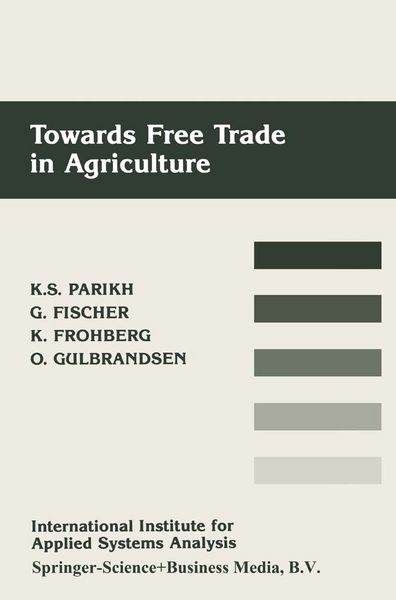
Produktbild: Towards Free Trade in Agriculture
- 11%

Towards Free Trade in Agriculture

11% sparen

96,99 € UVP 109,99 €

inkl. gesetzl. MwSt., Versandkostenfrei


Beschreibung

Agriculture seems to be a difficult sector to manage for most governments. Developing countries face tough dilemmas in deciding on appropriate price poli eies to stimulate food production and maintain stable, preferably low, prices for poor consumers. Governments in developed countries face similar difficult...

Beschreibung

Agriculture seems to be a difficult sector to manage for most governments. Developing countries face tough dilemmas in deciding on appropriate price poli eies to stimulate food production and maintain stable, preferably low, prices for poor consumers. Governments in developed countries face similar difficult deci sions. They are called upon to give income guarantees to farmers whose incomes are unstable and relatively low when compared to those in the nonagricultural sector. These guarantees often lead to ever-increasing budgetary outlays and unwanted agricultural surpluses. High prices make new investments and the application of new technologies more attractive than world prices warrant, and a process is set in motion where technological innovation attains amomenturn of its own, in turn requiring price policies that maintain their rates of return. Surpluses are disposed of with subsidies in domestic markets or in the international market. Price competition reduces the market share of other exporters, who may be efficient producers, unless they are willing to engage in subsidy competition. This lowers export earnings and farm incomes or depletes the public resources of developing countries that export competing products. Retaliatory measures have led to frictions and further distortions of world prices. Every so orten the major agricultural exporters - the USA, the EC, Aus tralia, or Canada - accuse one another of unfair intervention. Though they have agreed to discuss agricultural trade liberalization under GATT negotiations, if anything, the expenditure on farm support has continued to increase in both the EC and the USA.

Produktdetails

Einband

Taschenbuch

Erscheinungsdatum

13.11.2013

Abbildungen

XI, 357 p.

Verlag Springer Netherland

Produktdetails

Einband

Taschenbuch

Erscheinungsdatum

13.11.2013

Abbildungen

XI, 357 p.

Verlag Springer Netherland
Seitenzahl

357

Maße (L/B/H)

23,5/15,5/2,1 cm

Gewicht

563 g

Auflage

1988

Sprache

Englisch

ISBN

978-94-017-3560-5

Herstelleradresse

Springer-Verlag GmbH
Tiergartenstr. 17
69121 Heidelberg
DE

Email: ProductSafety@springernature.com

Noch keine Bewertungen vorhanden

Verfassen Sie die erste Bewertung zu diesem Artikel

Helfen Sie anderen Kundinnen und Kunden durch Ihre Meinung.

Kundinnen und Kunden meinen

Bewertungen (0)

  • Produktbild: Towards Free Trade in Agriculture
  • 1. Issues in Trade Liberalization.- 2. Agricultural Distortions: Magnitudes and Driving Forces.- 3. The Analytical Approach.- 4. A Perspective on Agriculture until 2000: The Reference Scenario.- 5. Reducing Trade Distortions in OECD Countries.- 6. Unilateral Trade Liberalization by the EC or the USA.- 7. Trade Liberalization by Developing Countries.- 8. Agricultural Trade Liberalization by All Market Economies.- 9. Findings and Policy Conclusions.- A1. Economic Theory of Trade Liberalization: Some Selected Results.- A2. Modes, Means, and Estimates of Protection.- A3. The Impact of Trade Liberalization from the Country Perspective.- A4. Countries and Groupings.- References.