
Distributed Manipulation
-
- Hardcover
- Taschenbuch ausgewählt
-
Sprache:Englisch
95,99 €
UVP
109,99 €
inkl. gesetzl. MwSt.,
Beschreibung
Produktdetails
Einband
Taschenbuch
Erscheinungsdatum
13.07.2013
Abbildungen
VIII, 261 p.
Herausgeber
Karl F. Böhringer + weitereVerlag
Springer UsSeitenzahl
261
Maße (L/B/H)
23,5/15,5/1,5 cm
Gewicht
417 g
Auflage
Softcover Reprint of the Original 1st 2000 edition
Sprache
Englisch
ISBN
978-1-4613-7051-2
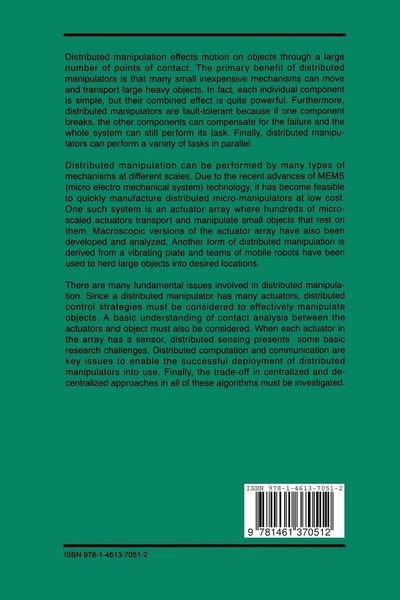
Distributed manipulation effects motion on objects through a large number of points of contact. The primary benefit of distributed manipulators is that many small inexpensive mechanisms can move and transport large heavy objects. In fact, each individual component is simple, but their combined effect is quite powerful. Furthermore, distributed manipulators are fault-tolerant because if one component breaks, the other components can compensate for the failure and the whole system can still perform its task. Finally, distributed manipulators can perform a variety of tasks in parallel.
Distributed manipulation can be performed by many types of mechanisms at different scales. Due to the recent advances of MEMS (micro-electro-mechanical system) technology, it has become feasible to quickly manufacture distributed micro-manipulators at low cost. One such system is an actuator array where hundreds of micro-scaled actuators transport and manipulate small objects that rest on them. Macroscopic versions of the actuator array have also been developed and analyzed. Another form of distributed manipulation is derived from a vibrating plate, and teams of mobile robots have been used to herd large objects into desired locations.
There are many fundamental issues involved in distributed manipulation. Since a distributed manipulator has many actuators, distributed control strategies must be considered to effectively manipulate objects. A basic understanding of contact analysis between the actuators and object must also be considered. When each actuator in the array has a sensor, distributed sensing presents some basic research challenges. Distributed computation and communication are key issues to enable the successful deployment of distributed manipulators into use. Finally, the trade-off in centralized and de-centralized approaches in all of these algorithms must be investigated.
Noch keine Bewertungen vorhanden
Verfassen Sie die erste Bewertung zu diesem Artikel
Helfen Sie anderen Kundinnen und Kunden durch Ihre Meinung.
Kurze Frage zu unserer Seite
Vielen Dank für Ihr Feedback
Wir nutzen Ihr Feedback, um unsere Produktseiten zu verbessern. Bitte haben Sie Verständnis, dass wir Ihnen keine Rückmeldung geben können. Falls Sie Kontakt mit uns aufnehmen möchten, können Sie sich aber gerne an unseren Kund*innenservice wenden.
zum Kundenservice