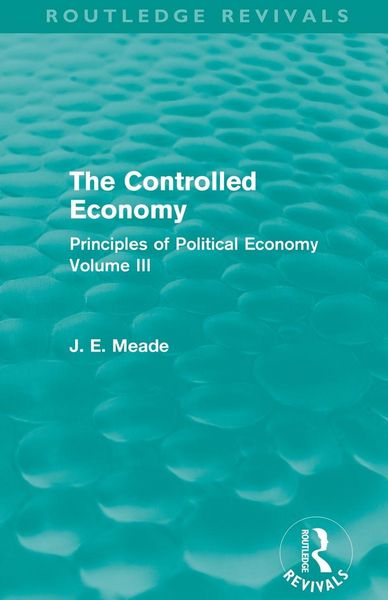
The Controlled Economy (Routledge Revivals) Principles of Political Economy Volume III
-
- Englisch ausgewählt
82,99 €
inkl. gesetzl. MwSt.,
Beschreibung
Produktdetails
Einband
Taschenbuch
Erscheinungsdatum
23.10.2013
Verlag
Taylor and FrancisSeitenzahl
394
Maße (L/B/H)
21,6/14/2,1 cm
Gewicht
458 g
Sprache
Englisch
ISBN
978-0-415-62176-2
First published in 1971 this volume applies the tools of static and of dynamic analysis (outlined in The Stationary Economy and The Growing Economy) to the control of a dynamic economy. This involves a discussion of subjects such as the theory of indicative planning, and the planning by the government of its monetary, fiscal, and incomes policies for the purposes of the short-run stabilization of the economy and of ensuring the best long-run use of the community's resources. Special emphasis is laid on the planning of such policies in conditions in which many future events remain inevitably uncertain.
This book considers these issues in relation to a competitive, free-enterprise economy; and little or no reference is made to problems of monopoly or of distinctions between social and private costs and benefits, due to indivisibilities and externalities in economic life.
Noch keine Bewertungen vorhanden
Verfassen Sie die erste Bewertung zu diesem Artikel
Helfen Sie anderen Kundinnen und Kunden durch Ihre Meinung.
Kurze Frage zu unserer Seite
Vielen Dank für Ihr Feedback
Wir nutzen Ihr Feedback, um unsere Produktseiten zu verbessern. Bitte haben Sie Verständnis, dass wir Ihnen keine Rückmeldung geben können. Falls Sie Kontakt mit uns aufnehmen möchten, können Sie sich aber gerne an unseren Kund*innenservice wenden.
zum Kundenservice