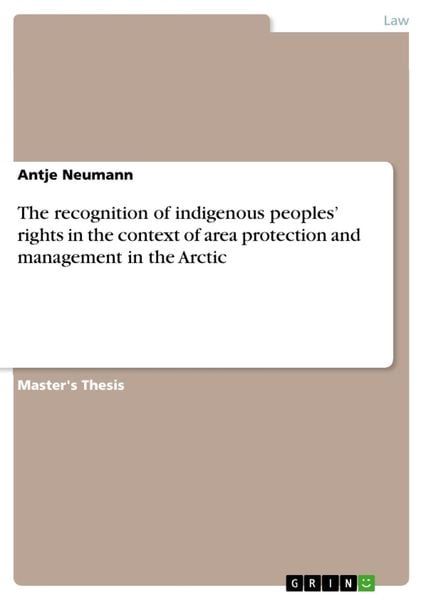
The recognition of indigenous peoples' rights in the context of area protection and management in the Arctic
-
- Taschenbuch
- eBook ausgewählt
-
Form:Einzelkauf Download
-
Sprache:Englisch
39,99 €
inkl. gesetzl. MwSt.Beschreibung
Produktdetails
Format
ePUB
Kopierschutz
Nein
Family Sharing
Nein
Text-to-Speech
Ja
Erscheinungsdatum
05.03.2013
Verlag
GRINSeitenzahl
171 (Printausgabe)
Dateigröße
214 KB
Auflage
1. Auflage
Sprache
Englisch
EAN
9783656382232
Master's Thesis from the year 2010 in the subject Law - Comparative Legal Systems, Comparative Law, grade: 9,5 ETCS, , course: Master Programm "Polar Law", Recht der Polarregionen (Arktis und Antarktis), language: English, abstract: The issue of increased human activities in the context of area protection and
management is of very high relevance, specifically with respect to the Arctic. Due
to climate change, which continues to be widespread in the Arctic, and in some
cases, dramatic, new prospects for economic development arise. Reduced sea ice,
for example, is very likely to increase marine transport and access to resources.
At the same time, the region is faced with numerous environmental challenges
like those of projected shifting of vegetation zones and wide-ranging impacts on
animal species' diversity, ranges, and distribution. On the base of these
developments, it is very likely that interests of maximum resource extraction and
energy production conflict with those of keeping the environment pristine. In
consequence, "an extension of natural reserves/wilderness parks both on land and
at sea might need to be considered as the price for letting local populations and
incomers enjoy more unrestrained development in the remaining areas".
The Arctic is home to many indigenous peoples, including reindeer herders,
hunters, fishermen and nomads. They all share one common feature: their
dependency on a healthy environment to support their livelihoods and chosen
ways of life. They are the descendants of peoples who followed the retreating icecap in Europe, spread out over northern Siberia and the Russian Far East, and
crossed the Bering Strait some 4,000 years ago or more. Indigenous peoples are
particularly impacted by climate change because of their cultural and physical
dependence on the environment, and their frequent lack of access to the resources
necessary to avoid the impacts of detrimental changes in their environment. In
such a situation they might find themselves in the middle of those conflicting
interests described above: on the one hand, defending their environment from
external desirousness and from this point of view supporting the designation of
certain areas as especially protected for their livelihoods, on the other hand,
having an interest to participate in economic developments and to be engaged in
the exploration of natural resources. Against this background, indigenous
peoples' rights are of important significance in the context of area protection and
management in the Arctic.[...]
management is of very high relevance, specifically with respect to the Arctic. Due
to climate change, which continues to be widespread in the Arctic, and in some
cases, dramatic, new prospects for economic development arise. Reduced sea ice,
for example, is very likely to increase marine transport and access to resources.
At the same time, the region is faced with numerous environmental challenges
like those of projected shifting of vegetation zones and wide-ranging impacts on
animal species' diversity, ranges, and distribution. On the base of these
developments, it is very likely that interests of maximum resource extraction and
energy production conflict with those of keeping the environment pristine. In
consequence, "an extension of natural reserves/wilderness parks both on land and
at sea might need to be considered as the price for letting local populations and
incomers enjoy more unrestrained development in the remaining areas".
The Arctic is home to many indigenous peoples, including reindeer herders,
hunters, fishermen and nomads. They all share one common feature: their
dependency on a healthy environment to support their livelihoods and chosen
ways of life. They are the descendants of peoples who followed the retreating icecap in Europe, spread out over northern Siberia and the Russian Far East, and
crossed the Bering Strait some 4,000 years ago or more. Indigenous peoples are
particularly impacted by climate change because of their cultural and physical
dependence on the environment, and their frequent lack of access to the resources
necessary to avoid the impacts of detrimental changes in their environment. In
such a situation they might find themselves in the middle of those conflicting
interests described above: on the one hand, defending their environment from
external desirousness and from this point of view supporting the designation of
certain areas as especially protected for their livelihoods, on the other hand,
having an interest to participate in economic developments and to be engaged in
the exploration of natural resources. Against this background, indigenous
peoples' rights are of important significance in the context of area protection and
management in the Arctic.[...]
Noch keine Bewertungen vorhanden
Verfassen Sie die erste Bewertung zu diesem Artikel
Helfen Sie anderen Kundinnen und Kunden durch Ihre Meinung.
Kurze Frage zu unserer Seite
Vielen Dank für Ihr Feedback
Wir nutzen Ihr Feedback, um unsere Produktseiten zu verbessern. Bitte haben Sie Verständnis, dass wir Ihnen keine Rückmeldung geben können. Falls Sie Kontakt mit uns aufnehmen möchten, können Sie sich aber gerne an unseren Kund*innenservice wenden.
zum Kundenservice