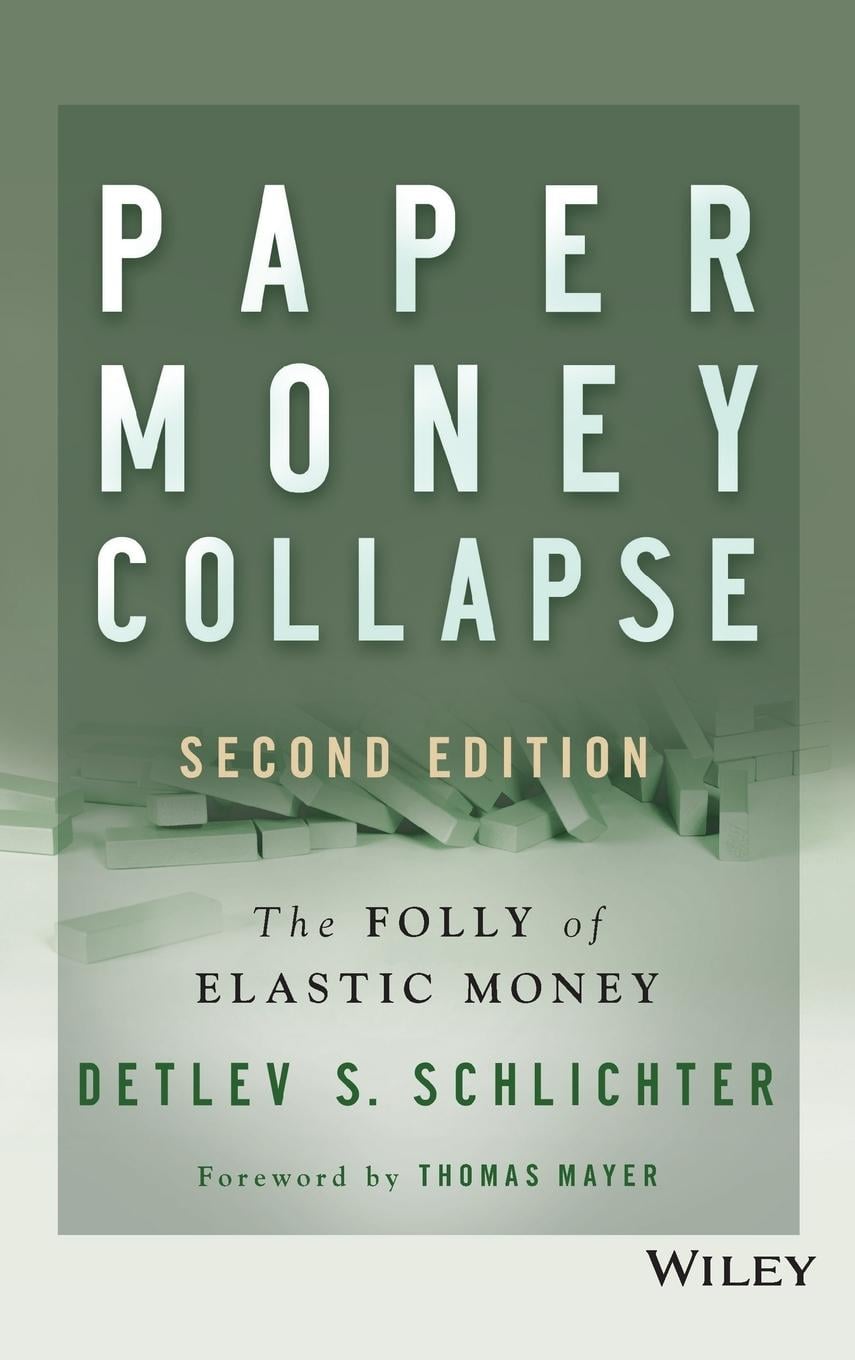
Paper Money Collapse The Folly of Elastic Money
37,99 €
inkl. gesetzl. MwSt.,
Beschreibung
Produktdetails
Einband
Gebundene Ausgabe
Erscheinungsdatum
21.07.2014
Verlag
John Wiley & Sons IncSeitenzahl
336
Maße (L/B/H)
23,5/15,7/2,3 cm
Gewicht
535 g
Auflage
2nd edition
Sprache
Englisch
ISBN
978-1-118-87732-6
Explore the inevitable collapse of the fiat monetary system
Paper Money Collapse: The Folly of Elastic Money, Second Edition challenges the mainstream consensus on money and monetary policy. While it is today generally believed that the transition from 'hard' and inflexible commodity money (such as a gold standard) to entirely flexible and potentially unlimited fiat money under national central banks allows for superior economic stability, Paper Money Collapse shows that the opposite is true. Systems of highly elastic and constantly expanding money are not only unnecessary, even for growing economies, they are always extremely destabilizing. Over time, they must lead to substantial imbalances, including excessive levels of debt and distorted asset prices, that will require ever faster money production to sustain. Ultimately, however, there is no alternative to a complete liquidation of these distortions. Based on insights of many renowned economists and in particular of the Austrian School of Economics, the book explains through rigorous logic and in precise language why our system of flexible fiat money is incompatible with a market economy and therefore unsustainable. Paper money systems have always led to economic disintegration--without exception--throughout history. It will not be different for our system and we may be closer to the endgame than many think.
The updated second edition incorporates:
* A new introduction and an extended outlook section that discusses various "endgames"
* Responses to criticisms, alternative views, and a critical assessment of 'solutions'
* Comments on recent policy trends, including attempts to exit the 'easy money' policy mode
* An evaluation of new crypto-currency Bitcoin
Paper Money Collapse: The Folly of Elastic Money, Second Edition clarifies the problem of paper money clearly and eloquently, and proposes multiple routes to a solution.
Paper Money Collapse: The Folly of Elastic Money, Second Edition challenges the mainstream consensus on money and monetary policy. While it is today generally believed that the transition from 'hard' and inflexible commodity money (such as a gold standard) to entirely flexible and potentially unlimited fiat money under national central banks allows for superior economic stability, Paper Money Collapse shows that the opposite is true. Systems of highly elastic and constantly expanding money are not only unnecessary, even for growing economies, they are always extremely destabilizing. Over time, they must lead to substantial imbalances, including excessive levels of debt and distorted asset prices, that will require ever faster money production to sustain. Ultimately, however, there is no alternative to a complete liquidation of these distortions. Based on insights of many renowned economists and in particular of the Austrian School of Economics, the book explains through rigorous logic and in precise language why our system of flexible fiat money is incompatible with a market economy and therefore unsustainable. Paper money systems have always led to economic disintegration--without exception--throughout history. It will not be different for our system and we may be closer to the endgame than many think.
The updated second edition incorporates:
* A new introduction and an extended outlook section that discusses various "endgames"
* Responses to criticisms, alternative views, and a critical assessment of 'solutions'
* Comments on recent policy trends, including attempts to exit the 'easy money' policy mode
* An evaluation of new crypto-currency Bitcoin
Paper Money Collapse: The Folly of Elastic Money, Second Edition clarifies the problem of paper money clearly and eloquently, and proposes multiple routes to a solution.
Kundinnen und Kunden meinen
Verfassen Sie die erste Bewertung zu diesem Artikel
Helfen Sie anderen Kund*innen durch Ihre Meinung
Kurze Frage zu unserer Seite
Vielen Dank für Ihr Feedback
Wir nutzen Ihr Feedback, um unsere Produktseiten zu verbessern. Bitte haben Sie Verständnis, dass wir Ihnen keine Rückmeldung geben können. Falls Sie Kontakt mit uns aufnehmen möchten, können Sie sich aber gerne an unseren Kund*innenservice wenden.
zum Kundenservice