KI-Beratung Beta

Gutscheinbedingungen

**Gültig bis 11.11.2026 auf Spielzeug, Schreibwaren, Filme, Geschenke & Trends, Musik, tolino eReader & Zubehör, Hörbücher und Hörbuch-Downloads, nicht preisgebundene Bücher und Kalender online auf thalia.at und in der Thalia App. Einzelne Artikel können ausgeschlossen sein. Aufgrund der Buchpreisbindung sind deutschsprachige Bücher und eBooks ausgenommen. Zusätzlich ausgenommen sind Abos & Flatrates, Games, Geschenkkarten/-boxen, Shelfies, Software, Zeitschriften sowie einzelne Artikel von tonies®. Pro Einkauf einmal einlösbar. Click & Collect nur bei Onlinevorabzahlung möglich. Keine Barauszahlung. Nicht kombinierbar mit anderen Aktionen und Gutscheinen. Gutschein wird auf max. 500€ Bestellwert angerechnet. Nicht gültig für Versandkosten und Services.

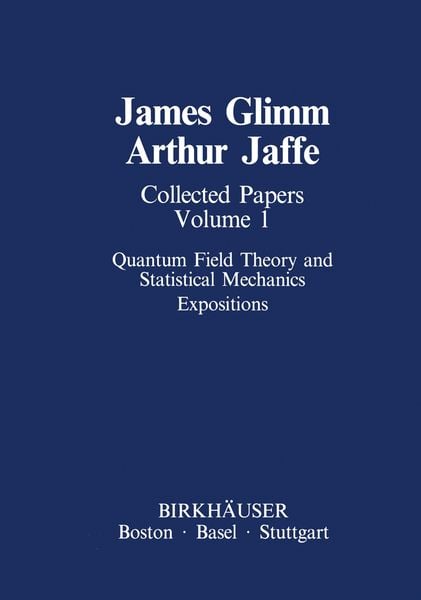
  • Produktbild: Collected Papers Vol.1: Quantum Field Theory and Statistical Mechanics
  • Produktbild: Collected Papers Vol.1: Quantum Field Theory and Statistical Mechanics
- 11%

Collected Papers Vol.1: Quantum Field Theory and Statistical Mechanics Expositions

Aus der Reihe Contemporary Physicists
11% sparen

96,99 € UVP 109,99 €

inkl. gesetzl. MwSt., Versandkostenfrei


Beschreibung

Bibliography . . . . . . . . . . . . . . . . . . . . . . . . . . . . . . . . . . . . . . . . . . . . . . . . . . . . 325 Critical point dominance in quantum field models. . . . . . . . . . . . . . . . . . . . 326 q>,' quantum field model in the single-phase regions: Differentiability of the mass and...

Beschreibung

Bibliography . . . . . . . . . . . . . . . . . . . . . . . . . . . . . . . . . . . . . . . . . . . . . . . . . . . . 325 Critical point dominance in quantum field models. . . . . . . . . . . . . . . . . . . . 326 q>,' quantum field model in the single-phase regions: Differentiability of the mass and bounds on critical exponents. . . . 341 Remark on the existence of q>:. . . • . . . . • . . . . • . . . . . . . . • . • . . . . . . . . . . • . 345 On the approach to the critical point . . . . . . . . . . . . . . . . . . . . . . . . . . . . . . . 348 Critical exponents and elementary particles. . . . . . . . . . . . . . . . . . . . . . . . . . 362 V Particle Structure Introduction. . . . . . . . . . . . . . . . . . . . . . . . . . . . . . . . . . . . . . . . . . . . . . . . . . . . . 371 Bibliography . . . . . . . . . . . . . . . . . . . . . . . . . . . . . . . . . . . . . . . . . . . . . . . . . . . . 371 The entropy principle for vertex functions in quantum field models. . . . . 372 Three-particle structure of q>4 interactions and the scaling limit . . . . . . . . . 397 Two and three body equations in quantum field models. . . . . . . . . . . . . . . 409 Particles and scaling for lattice fields and Ising models. . . . . . . . . . . . . . . . 437 The resummation of one particle lines. . . . . . . . . . . . . . . . . . . . . . . . . . . . . . . 450 VI Bounds on Coupling Constants Introduction. . . . . . . . . . . . . . . . . . . . . . . . . . . . . . . . . . . . . . . . . . . . . . . . . . . . . 479 Bibliography . . . . . . . . . . . . . . . . . . . . . . . . . . . . . . . . . . . . . . . . . . . . . . . . . . . . 479 Absolute bounds on vertices and couplings. . . . . . . . . . . . . . . . . . . . . . . . . . 480 The coupling constant in a q>4 field theory. . .. . . . . . . . . . . . . . . . . . . . . . . . 491 VII Confinement and Instantons Introduction. . . . . . . . . . . . . . . . . . . . . . . . . . . . . . . . . . . . . . . . . . . . . . . . . . . . . 497 Bibliography . . . . . . . . . . . . . . . . . . . . . . . . . . . . . . . . . . . . . . . . . . . . . . . . . . . . 497 Instantons in a U(I) lattice gauge theory: A coulomb dipole gas. . . . . . . . . . . . . . . . . . . . . . . . . . . . . . . . . . . . . . . 498 Charges, vortices and confinement. . . . . . . . . . . . . . . . . . . . . . . . . . . . . . . . . . 516 ix VIII Reflection Positivity Introduction. . . . . . . . . . . . . . . . . . . . . . . . . . . . . . . . . . . . . . . . . . . . . . . . . . . . . 531 Bibliography . . . . . . . . . . . . . . . . . . . . . . . . . . . . . . . . . . . . . . . . . . . . . . . . . . . . 531 A note on reflection positivity . . . . . . . . . . . . . . . . . . . . . . . . . . . . . . . . . . . . . 532 x Introduction This volume contains a selection of expository articles on quantum field theory and statistical mechanics by James Glimm and Arthur Jaffe. They include a solution of the original interacting quantum field equations and a description of the physics which these equations contain. Quantum fields were proposed in the late 1920s as the natural framework which combines quantum theory with relativ ity. They have survived ever since.

Produktdetails

Einband

Taschenbuch

Erscheinungsdatum

04.11.2011

Abbildungen

X, 418 p.

Verlag Birkhäuser Boston

Produktdetails

Einband

Taschenbuch

Erscheinungsdatum

04.11.2011

Abbildungen

X, 418 p.

Verlag Birkhäuser Boston
Seitenzahl

418

Maße (L/B/H)

25,4/17,8/2,4 cm

Gewicht

808 g

Auflage

Softcover reprint of the original 1st ed. 1985

Sprache

Englisch

ISBN

978-1-4612-5417-1

EU-Ansprechpartner

IBS Logistics
Benzstr. 21
48619 Heek
DE
contact@ibs-logistics.de

Herstelleradresse

Springer Basel
Picassoplatz 4
4052 Basel
CH
buchhandel-buch@springer.com

Noch keine Bewertungen vorhanden

Verfassen Sie die erste Bewertung zu diesem Artikel

Helfen Sie anderen Kundinnen und Kunden durch Ihre Meinung.

Kundinnen und Kunden meinen

Bewertungen (0)

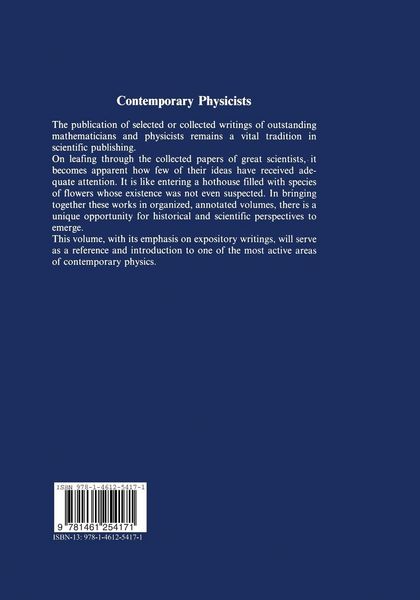
  • Produktbild: Collected Papers Vol.1: Quantum Field Theory and Statistical Mechanics
  • Produktbild: Collected Papers Vol.1: Quantum Field Theory and Statistical Mechanics
  • Collected Papers — Volume 1.- I Infinite Renormalization of the Hamiltonian Is Necessary.- II Quantum Field Theory Models: Part I. The ?22n Model.- Fock space.- Q space.- The Hamiltonian H (g).- Removing the space cutoff.- Lorentz covariance and the Haag-Kastler axioms.- II. The Yukawa Model.- Preliminaries.- First and second order estimates.- Resolvent convergence and self adjointness.- The Heisenberg picture.- III Boson Quantum Field Models: Part I. General Results.- Hermite operators.- Gaussian measures and the Schrödinger representation.- Hermite expansions and Fock space.- II. The Solution of Two-Dimensional Boson Models.- The interaction Hamiltonian.- The free Hamiltonian.- Self-adjointness of H (g).- The local algebras and the Lorentz group automorphisms.- IV Boson Quantum Field Models: Part III. Further Developments.- Locally normal representations of the observables.- The construction of the physical vaccum.- Formal perturbation theory and models in three space-time dimensions.- V The Particle Structure of the Weakly Coupled P(?)2 Model and Other Applications of High Temperature Expansions: Part I. Physics of Quantum Field Models.- Five years of models.- From estimates to physics.- Bound states and resonances.- Phase space localization and renormalization.- VI The Particle Structure of the Weakly Coupled P(?)2 Model and Other Applications of High Temperature Expansions: Part II. The Cluster Expansion.- The main results.- The cluster expansion.- Clustering and analyticity: proof of the main results.- Convergence: the main ideas.- An equation of Kirkwood-Salsburg type.- Covariance operators.- Derivatives of covariance operators.- Gaussian integrals.- Convergence: the proof completed.- VII Particles and Bound States and Progess Toward Unitarity and Scaling.-VIII Critical Problems in Quantum Fields.- IX Existence of Phase Transitions for ?24 Quantum Fields.- X Critical Exponents and Renormalization in the ?4 Scaling Limit.- Formulation of the problem.- The scaling and critical point limits.- Renormalization of the ?2(x) field.- Existence of the scaling limit.- The Josephson inequality.- XI A Tutorial Course in Constructive Field Theory.- e-tH as a functional integral.- Examples.- Applications of the functional integral representation.- Ising, Gaussian and scaling limits.- Main results.- Correlation inequalities.- Absence of even bound states.- Bound on g.- Bound on dm2/d? and particles.- The conjecture ?(6) ? 0.- Cluster expansions.- The region of convergence.- The zeroth order expansion.- The primitive expansion.- Factorization and partial resummation.- Typical applications.