KI-Beratung Beta

Gutscheinbedingungen

**Gültig bis 11.11.2026 auf Spielzeug, Schreibwaren, Filme, Geschenke & Trends, Musik, tolino eReader & Zubehör, Hörbücher und Hörbuch-Downloads, nicht preisgebundene Bücher und Kalender online auf thalia.at und in der Thalia App. Einzelne Artikel können ausgeschlossen sein. Aufgrund der Buchpreisbindung sind deutschsprachige Bücher und eBooks ausgenommen. Zusätzlich ausgenommen sind Abos & Flatrates, Games, Geschenkkarten/-boxen, Shelfies, Software, Zeitschriften sowie einzelne Artikel von tonies®. Pro Einkauf einmal einlösbar. Click & Collect nur bei Onlinevorabzahlung möglich. Keine Barauszahlung. Nicht kombinierbar mit anderen Aktionen und Gutscheinen. Gutschein wird auf max. 500€ Bestellwert angerechnet. Nicht gültig für Versandkosten und Services.

  • Produktbild: Progress in Atomic Spectroscopy
  • Produktbild: Progress in Atomic Spectroscopy

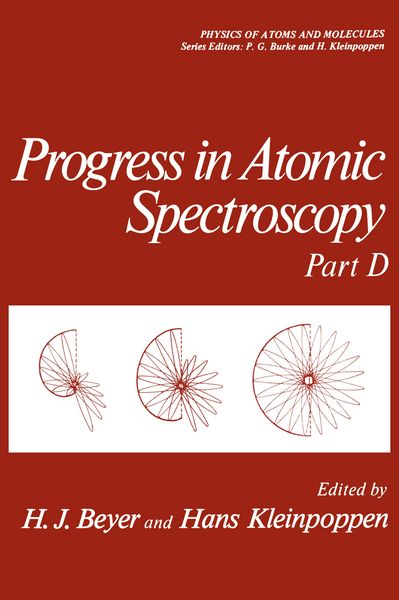
Progress in Atomic Spectroscopy Part D

99,99 €

inkl. gesetzl. MwSt., Versandkostenfrei


Beschreibung

Produktdetails

Einband

Taschenbuch

Erscheinungsdatum

17.10.2011

Abbildungen

XXIII, 514 p.

Herausgeber

H.J. Beyer + weitere

Verlag

Springer Us

Seitenzahl

514

Maße (L/B/H)

22,9/15,2/2,9 cm

Gewicht

773 g

Auflage

Softcover reprint of the original 1st ed. 1987

Sprache

Englisch

ISBN

978-1-4612-9036-0

Beschreibung

Produktdetails

Einband

Taschenbuch

Erscheinungsdatum

17.10.2011

Abbildungen

XXIII, 514 p.

Herausgeber

Verlag

Springer Us

Seitenzahl

514

Maße (L/B/H)

22,9/15,2/2,9 cm

Gewicht

773 g

Auflage

Softcover reprint of the original 1st ed. 1987

Sprache

Englisch

ISBN

978-1-4612-9036-0

Herstelleradresse

Springer-Verlag KG
Sachsenplatz 4-6
1201 Wien
AT

Email: ProductSafety@springernature.com

Noch keine Bewertungen vorhanden

Verfassen Sie die erste Bewertung zu diesem Artikel

Helfen Sie anderen Kundinnen und Kunden durch Ihre Meinung.

Kundinnen und Kunden meinen

Bewertungen (0)

  • Produktbild: Progress in Atomic Spectroscopy
  • Produktbild: Progress in Atomic Spectroscopy
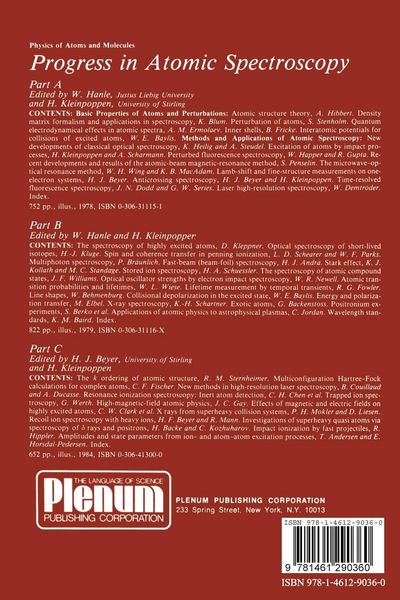
  • of Part D.- 1 Laser-Microwave Spectroscopy.- 1. Introduction.- 2. Classification of Laser-Microwave Spectroscopy.- 3. Measurements Based on Optical Pumping.- 4. Measurements Based on Double Resonance.- 5. Measurements Based on Nonlinear Phenomena.- 6. Other Schemes.- 7. Laser-Microwave Heterodyne Techniques for Spectroscopic Purposes.- 8. Concluding Remarks.- References.- 2 Collinear Fast-Beam Laser Spectroscopy.- 1. Introduction.- 2. Basic Concept and Experimental Realization.- 3. Experiments Based on the Doppler Effect.- 4. Spectroscopic Studies.- 5. Spectroscopy on Unstable Isotopes.- 6. Conclusion.- References.- 3 Radiofrequency Spectroscopy of Rydberg Atoms.- 1. Introduction.- 2. Rydberg Atoms.- 3. Core Polarization and Penetration.- 4. Experimental Techniques.- 5. Overview of the Results Obtained.- References.- 4 Rydberg Series of Two-Electron Systems Studied by Hyperfine Interactions.- 1. Introduction.- 2. Experimental Techniques.- 3. Even-Parity Rydberg Series of Alkaline-Earth Elements.- 4. Odd-Parity Rydberg Series of Alkaline-Earth Elements.- 5. Hyperfine Structure and Isotope Shifts of Rydberg States of Other Two-Electron Systems.- 6. Conclusion.- References.- 5 Parity Nonconservation in Atoms.- 1. Introduction.- 2. Theory.- 3. Circular Dichroism and Optical Rotation—Rigorous Discussion.- 4. Optical Rotation Experiments.- 5. Stark-PNC Experiments; Cesium and Thallium.- 6. Discussion of Results; Conclusions.- References.- 6 Energy Structure of Highly Ionized Atoms.- 1. Introduction.- 2. General Energy Relations in Isoelectronic Ions.- 3. Survey of the Low Configurations in Isoelectronic Sequences.- 4. The n = 2 Configurations.- 5. The Neon Sequence (N = 10).- 6. Ions with Ground Configurations of 3s and 3p Electrons.- 7. The Configurations 3dk.- 8. TheCopper Sequence (N = 29).- 9. The Silver Sequence (N = 47).- References.- 7 Inner-Shell Spectroscopy with Hard Synchrotron Radiation.- 1. Introduction.- 2. Instrumental Details.- 3. X-Ray Absorption by Free Atoms.- 4. X-Ray Absorption by Bound Atoms.- 5. Induced X-Ray Fluorescence and Auger-Electron Emission.- 6. Scattering of X-Rays.- References.- 8 Analysis and Spectroscopy of Collisionally Induced Autoionization Processes.- 1. Introduction.- 2. Description of Autoionizing States.- 3. Experimental Methods.- 4. Line Shapes and Interference Effects in Autoionization Spectroscopy.- 5. Spectroscopic Data for Various Atoms.- 6. Correlated and Uncorrelated Angular Distributions of Autoionization Electrons.- 7. Electron Emission from Quasimolecules.- References.- 9 Near Resonant Vacancy Exchange between Inner Shells of Colliding Heavy Particles.- 1. Introduction.- 2. Theoretical Methods.- 3. Two-State Systems.- 4. Multistate Systems.- 5. Conclusions.- References.- 10 Polarization Correlation in the Two-Photon Decay of Atoms.- 1. Introduction.- 2. Theoretical Considerations.- 3. Experimental Work.- 4. Discussion.- References.