Band 72
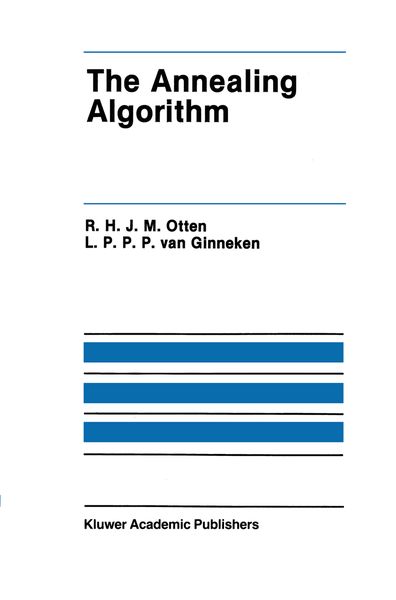
The Annealing Algorithm
-
- Hardcover
- Taschenbuch ausgewählt
- eBook
-
Sprache:Englisch
148,99 €
inkl. gesetzl. MwSt.,
Beschreibung
Produktdetails
Einband
Taschenbuch
Erscheinungsdatum
06.10.2011
Verlag
Springer UsSeitenzahl
202
Maße (L/B/H)
23,5/15,5/1,2 cm
Gewicht
335 g
Auflage
Softcover reprint of the original 1st ed. 1989
Sprache
Englisch
ISBN
978-1-4612-8899-2
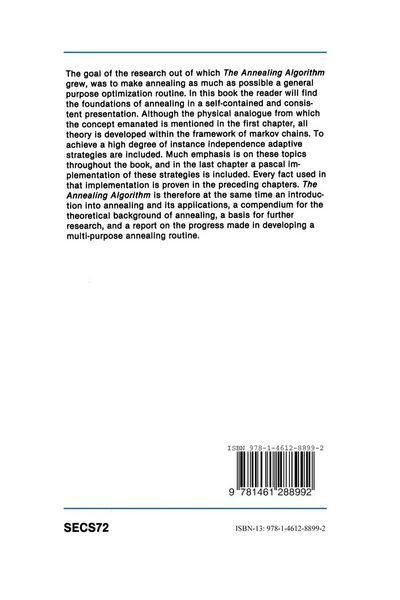
The goal of the research out of which this monograph grew, was to make annealing as much as possible a general purpose optimization routine. At first glance this may seem a straight-forward task, for the formulation of its concept suggests applicability to any combinatorial optimization problem. All that is needed to run annealing on such a problem is a unique representation for each configuration, a procedure for measuring its quality, and a neighbor relation. Much more is needed however for obtaining acceptable results consistently in a reasonably short time. It is even doubtful whether the problem can be formulated such that annealing becomes an adequate approach for all instances of an optimization problem. Questions such as what is the best formulation for a given instance, and how should the process be controlled, have to be answered. Although much progress has been made in the years after the introduction of the concept into the field of combinatorial optimization in 1981, some important questions still do not have a definitive answer. In this book the reader will find the foundations of annealing in a self-contained and consistent presentation. Although the physical analogue from which the con cept emanated is mentioned in the first chapter, all theory is developed within the framework of markov chains. To achieve a high degree of instance independence adaptive strategies are introduced.
Kundinnen und Kunden meinen
Verfassen Sie die erste Bewertung zu diesem Artikel
Helfen Sie anderen Kund*innen durch Ihre Meinung
Kurze Frage zu unserer Seite
Vielen Dank für Ihr Feedback
Wir nutzen Ihr Feedback, um unsere Produktseiten zu verbessern. Bitte haben Sie Verständnis, dass wir Ihnen keine Rückmeldung geben können. Falls Sie Kontakt mit uns aufnehmen möchten, können Sie sich aber gerne an unseren Kund*innenservice wenden.
zum Kundenservice