Gutscheinbedingungen

**Gültig bis 06.07.2026 auf fremdsprachige Bücher online auf thalia.at, in der Thalia App ab einem Mindestbestellwert von 30€ und in allen Thalia Buchhandlungen in Österreich. In den Buchhandlungen nur gültig auf lagernde Ware. Einzelne Artikel können ausgeschlossen sein. Ausgenommen sind preisgebundene Artikel & eBooks. Pro Einkauf einmal einlösbar. Nur gültig gegen Vorlage oder im Onlineshop hinterlegter Bonuscard. Infos zur Einlösung in der Buchhandlung sind auf der Bonuscard-Vorteilspreisseite zu finden. Click & Collect nur bei Onlinevorabzahlung möglich. Keine Einlösung bei Scan & Go-Bezahlung. Keine Barauszahlung. Nicht kombinierbar mit anderen Aktionen und Gutscheinen. Gutschein wird auf max. 500€ Bestellwert angerechnet. Nicht gültig für Versandkosten und Services.

  • Produktbild: Models of Discovery
  • Produktbild: Models of Discovery
Band 54 - 12%

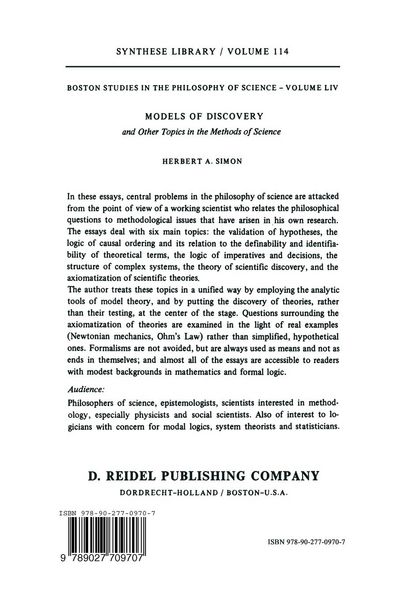
Models of Discovery and Other Topics in the Methods of Science

12% sparen

289,99 € UVP 329,99 €

inkl. gesetzl. MwSt., Versandkostenfrei


Beschreibung

Produktdetails

Einband

Taschenbuch

Erscheinungsdatum

28.02.1979

Verlag

Springer Netherland

Seitenzahl

475

Maße (L/B/H)

23,5/15,5/2,7 cm

Gewicht

741 g

Auflage

Softcover reprint of the original 1st ed. 1977

Sprache

Englisch

ISBN

978-90-277-0970-7

Beschreibung

Produktdetails

Einband

Taschenbuch

Erscheinungsdatum

28.02.1979

Verlag

Springer Netherland

Seitenzahl

475

Maße (L/B/H)

23,5/15,5/2,7 cm

Gewicht

741 g

Auflage

Softcover reprint of the original 1st ed. 1977

Sprache

Englisch

ISBN

978-90-277-0970-7

Herstelleradresse

Springer-Verlag KG
Sachsenplatz 4-6
1201 Wien
AT

Email: GPSR Kontakt

Noch keine Bewertungen vorhanden

Verfassen Sie die erste Bewertung zu diesem Artikel

Helfen Sie anderen Kundinnen und Kunden durch Ihre Meinung.

Kundinnen und Kunden meinen

Bewertungen (0)

  • Produktbild: Models of Discovery
  • Produktbild: Models of Discovery
  • Section 1 — Testing Theories of Empirical Phenomena.- to Section 1.- 1.1. Symmetric Tests of the Hypothesis That the Mean of One Normal Population Exceeds That of Another.- 1.2. Statistical Tests as a Basis for ‘Yes—No’ Choices.- 1.3. Prediction and Hindsight as Confirmatory Evidence.- 1.4. On Judging the Plausibility of Theories.- Section 2 — Causes and Possible Worlds.- to Section 2.- 2.1. Causal Ordering and Identifiability.- 2.2. On the Definition of the Causal Relation.- 2.3. Spurious Correlation: A Causal Interpretation.- 2.4. Cause and Counterfactual (with Nicholas Rescher).- Section 3 — The Logic of Imperatives.- to Section 3.- 3.1. The Logic of Rational Decision.- 3.2. The Logic of Heuristic Decision Making.- Section 4 — Complexity.- to Section 4.- 4.1. Theory of Automata: Discussion.- 4.2. Aggregation of Variables in Dynamic Systems (with Albert Ando).- 4.3. The Theory of Problem Solving.- 4.4. The Organization of Complex Systems.- Section 5 — Theory of Scientific Discovery.- to Section 5.- 5.1. Thinking by Computers.- 5.2. Scientific Discovery and the Psychology of Problem Solving.- 5.3. The Structure of Ill-Structured Problems.- 5.4. Does Scientific Discovery Have a Logic?.- 5.5. Discussion: The Meno Paradox.- Section 6 — Formalizing Scientific Theories.- to Section 6.- 6.1. The Axioms of Newtonian Mechanics.- 6.2. Discussion: The Axiomatization of Classical Mechanics.- 6.3. Definable Terms and Primitives in Axiom Systems.- 6.4. A Note on Almost-Everywhere Definability.- 6.5. The Axiomatization of Physical Theories.- 6.6. Ramsey Eliminability and the Testability of Scientific Theories (with Guy J. Groen).- 6.7. Identifiability and the Status of Theoretical Terms.- Name Index.