
Gutscheinbedingungen

**Gültig bis 22.07.2026 ab einem Mindestbestellwert von 40€ auf Spielzeug, Schreibwaren, Filme, Geschenke & Trends, Musik, tolino eReader & Zubehör, Hörbücher und Hörbuch-Downloads (außer Abo), nicht preisgebundene Bücher und Kalender online auf thalia.at und in der Thalia App. Einzelne Artikel können ausgeschlossen sein. Aufgrund der Buchpreisbindung sind deutschsprachige Bücher und eBooks ausgenommen. Zusätzlich ausgenommen sind preisgebundene Artikel, Abos & Flatrates, eBooks, Games, Geschenkkarten/-boxen, Shelfies, Software, Zeitschriften sowie einzelne Artikel von tonies®. Pro Einkauf einmal einlösbar. Click & Collect nur bei Onlinevorabzahlung möglich. Keine Barauszahlung. Nicht kombinierbar mit anderen Aktionen und Gutscheinen. Gutschein wird auf max. 500€ Bestellwert angerechnet. Nicht gültig für Versandkosten und Services. Preisgebundene Artikel sind vom Mindestbestellwert ausgeschlossen.

  • Produktbild: Science in Flux
  • Produktbild: Science in Flux
Band 28 - 13%

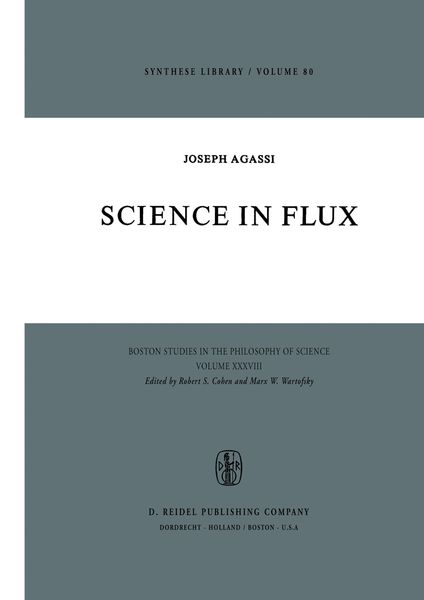
Science in Flux

13% sparen

209,99 € UVP 241,99 €

inkl. gesetzl. MwSt., Versandkostenfrei


Beschreibung

Produktdetails

Einband

Taschenbuch

Erscheinungsdatum

31.08.1975

Abbildungen

XXVI, 559 p.

Verlag

Springer Netherland

Seitenzahl

559

Maße (B/H)

15,5/23,5 cm

Gewicht

885 g

Auflage

Softcover Reprint of the Original 1st 1975 edition

Sprache

Englisch

ISBN

978-90-277-0612-6

Beschreibung

Produktdetails

Einband

Taschenbuch

Erscheinungsdatum

31.08.1975

Abbildungen

XXVI, 559 p.

Verlag

Springer Netherland

Seitenzahl

559

Maße (B/H)

15,5/23,5 cm

Gewicht

885 g

Auflage

Softcover Reprint of the Original 1st 1975 edition

Sprache

Englisch

ISBN

978-90-277-0612-6

Herstelleradresse

Libri GmbH
Europaallee 1
36244 Bad Hersfeld
DE

Email: GPSR Kontakt

Noch keine Bewertungen vorhanden

Verfassen Sie die erste Bewertung zu diesem Artikel

Helfen Sie anderen Kundinnen und Kunden durch Ihre Meinung.

Kundinnen und Kunden meinen

Bewertungen (0)

  • Produktbild: Science in Flux
  • Produktbild: Science in Flux
  • 1. A Prologue: On Stability and Flux.- References.- 2. Science in Flux: Footnotes to Popper.- I. Einstein has Upset the View that Science is Stable.- II. The Empirical Support of Some Scientific Theories Requires Explanation.- III. The Desire for Stability Makes Us See More of It than There is.- IV. Popper’s Theory Presents Science as an Endless Series of Debates.- V. Popper Makes Additional Assumptions.- VI. Rationality is a Means to an End.- References.- Appendix: The Role of Corroboration in Popper’s Philosophy.- Notes.- 3. On Novelty.- I. On the Novelty of Ideas in General.- II. Science and Truth.- III. Popper’s View of Science.- Notes.- Appendix: On the Discovery of General Facts.- 4. Replies To Diane: Popper On Learning From Experience81.- Note.- Appendix: Empiricism Without Inductivism.- 5. Sensationalism.- 1. Sensationalism vs. Theoretical Knowledge.- 2. Sensationalism vs. Empiricism.- 3. Sense-Experience vs. Experience.- 4. Sensationalism vs. Common Sense.- 5. Explanation vs. Consent.- 6. The Roots of Scientific Realism.- 7. Conclusion.- 6. When Should we Ignore Evidence in Favour of a Hypothesis?.- I. Can Observation Reports be Revoked?.- II. Can Refutation be Final?.- III. A Simple Issue Obfuscated.- IV. A Criterion for Rejection of Observation Reports?.- V. Does Popper Offer a Rule of Rejection?.- VI.Do We Need a Rate of Acceptance of Observation Reports?.- Appendix: Random Versus Unsystematic Observations.- 7. Testing as a Bootstrap Operation in Physics.- First Introduction: Reliability is not a Matter for Pure Science.- Second Introduction: The Duhem-Quine Thesis has a New Significance.- I. Conventionalists and the Problem of Induction.- II. Popper is Ambivalent Regarding Goodman’s Problem.- III. Bootstrap Operations in Testing.- IV. The Need forConstraints is Quite Real.- V. Science Constraints Itself by Auxiliary Hypotheses.- VI. Revolutions Occur when Bootstrap Operations Fail.- VII. Conclusion.- Appendix: Precision in Theory and in Measurement.- 8. Towards A Theory Of ‘Ad Hoc’ Hypotheses.- I. Ad hoc Hypotheses which become Factual Evidence.- II. The Conventional Element in Science.- III. Reducing the Conventions.- IV. Metaphysics and ad hoc Hypotheses.- V. What is a Mess?.- Appendix: The Traditional ad hoc Use of Instrumentalism.- 9. The Nature of Scientific Problems and their Roots in Metaphysics.- I. Scientific Research Centers Around a Few Problems.- II. The Anti-Metaphysical Tradition is Outdated.- III. A Historical Note on Science and Metaphysics.- IV. Pseudo-Science is not the Same as Non-Science.- V. Popper’s Theory of Science.- VI. Superstition, Pseudo-Science, and Metaphysics Use Instances in Different Ways.- VII. Metaphysical Doctrines are Often Insufficient Frame-works for Science.- VIII. The Role of Interpretations in Physics.- IX. The History of Science as the History of Its Metaphysical Frameworks.- Appendix: What is a Natural Law?.- 10. Questions of Science and Metaphysics.- I. How Do we Select Questions?.- II. We Select Questions Within Given Metaphysical Frame-works.- III.The Literature on Questions.- IV.The Literature on the Logic of Questions.- V.The Instrumentalist View on the Choice of Questions.- VI. Collingwood’s Peculiarity.- VII. The Logic of Multiple-Choice-Questions.- VIII. Bromberger on Why-Questions.- IX. The Need for a Metaphysical Theory of Causality.- X.Collingwood in a New Garb.- Appendix: The Anti-Scientific Metaphysician.- Notes.- 11. The Confusion Between Physics And Metaphysics in the Standard Histories of Sciences.- Appendix: Reply to Commentators.- 12.TheConfusion Between Science and Technology in the Standard Philosophies of Science.- Appendix: Planning for Success: A Reply to Professor Wisdom.- Notes.- 13. Positive Evidence in Science and Technology.- I. Kant’s Scandal.- II. Whitehead’s Scandal.- III.The Facts About Induction.- IV.Success and Rationality.- V. The Sociology of Knowledge.- Appendix: Duhem’s Instrumentalism and Autonomism.- 14. Positive Evidence as a Social Institution.- Appendix: The Logic of Technological Development.- 15. Imperfect Knowledge.- I. Equating Imperfect Knowledge with Science is Questionable.- II. Equating Imperfect Knowledge with Rational Belief is an Error.- III. Imperfect Knowledge-Claims are Qualified by Publicly Accepted Hypotheses.- Notes.- 16. Criteria for Plausible Arguments.- Note.- Appendix: The Standard Misinterpretation of Skepticism.- 17. Modified Conventionalism.- I. The Problem.- II. Science and Society.- III. Popper’s Problems of Demarcation.- IV. The Three Views Concerning Human Knowledge Revisited.- Appendix: Bartley’s Critique of Popper.- Notes.- 18. Unity and Diversity in Science.- Abstract.- I. Ambivalence Towards Unity: An Impression.- II. The Ethics of Science as a Unifier of Science.- III. Proof as the Unifier of Science.- IV. Manifest Truth as the Unifier of Science.- V. Unity of Science as a Dictator of Unanimity on All Questions.- VI. A Theory of Rational Disagreement.- References.- Appendix on Kant.- 19. Can Religion go Beyond Reason?.- I. Religion and Reason.- II. Dissatisfaction with Science and Religion.- III. Reason and Faith.- IV. The Question of Complementary Relationship.- V. Toward Intellectual Complementation.- VI. Possibilities of Cooperation.- VII. Defects of Both Rationalism and Religion.- VIII. Standards of Rational Thought and Action.-IX. Enlightenment and Self-Reliance.- X. The Sophisticated Religionists: Buber and Polangi.- XI. Science and Universalistic Religion.- Notes.- Appendix on Buber.- 20. Assurance and Agnosticism.- I. The Compleat Agnostic.- II. The Image of Inductive Science.- III. Empirical Facts About Assurance.- IV. The Non-Justificationist Mood.- V. Conversion to Autonomism.- VI. The Assured Agnostic.- Index of Works Cited.- Index of Names.- Index of Subjects.