Gutscheinbedingungen

**Gültig bis 04.08.2026 ab einem Mindestbestellwert von 30€ auf Spielzeug, Schreibwaren, Filme, Geschenke & Trends, Musik, tolino eReader & Zubehör, Hörbücher und Hörbuch-Downloads (außer Abo), nicht preisgebundene Bücher und Kalender online auf thalia.at und in der Thalia App. Einzelne Artikel können ausgeschlossen sein. Aufgrund der Buchpreisbindung sind deutschsprachige Bücher und eBooks ausgenommen. Zusätzlich ausgenommen sind preisgebundene Artikel, Abos & Flatrates, eBooks, Games, Geschenkkarten/-boxen, Shelfies, Software, Zeitschriften sowie einzelne Artikel von tonies®. Pro Einkauf einmal einlösbar. Click & Collect nur bei Onlinevorabzahlung möglich. Keine Barauszahlung. Nicht kombinierbar mit anderen Aktionen und Gutscheinen. Gutschein wird auf max. 500€ Bestellwert angerechnet. Nicht gültig für Versandkosten und Services. Preisgebundene Artikel sind vom Mindestbestellwert ausgeschlossen.

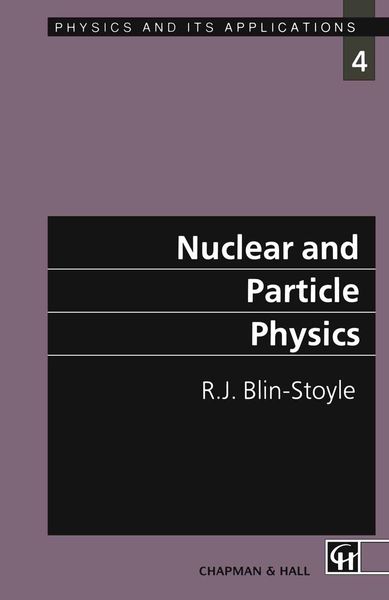
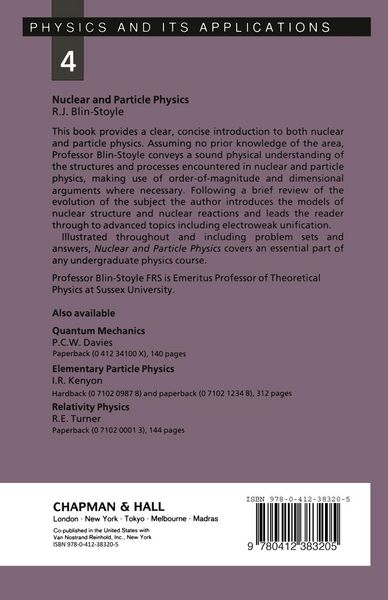
  • Produktbild: Nuclear and Particle Physics
  • Produktbild: Nuclear and Particle Physics

Nuclear and Particle Physics

49,99 €

inkl. gesetzl. MwSt., Versandkostenfrei


Beschreibung

Produktdetails

Einband

Taschenbuch

Erscheinungsdatum

30.04.1991

Verlag

Springer Netherland

Seitenzahl

224

Maße (L/B/H)

21,6/14/1,3 cm

Gewicht

293 g

Auflage

Softcover reprint of the original 1st ed. 1991

Sprache

Englisch

ISBN

978-0-412-38320-5

Beschreibung

Produktdetails

Einband

Taschenbuch

Erscheinungsdatum

30.04.1991

Verlag

Springer Netherland

Seitenzahl

224

Maße (L/B/H)

21,6/14/1,3 cm

Gewicht

293 g

Auflage

Softcover reprint of the original 1st ed. 1991

Sprache

Englisch

ISBN

978-0-412-38320-5

Herstelleradresse

Springer-Verlag KG
Sachsenplatz 4-6
1201 Wien
AT

Email: GPSR Kontakt

Noch keine Bewertungen vorhanden

Verfassen Sie die erste Bewertung zu diesem Artikel

Helfen Sie anderen Kundinnen und Kunden durch Ihre Meinung.

Kundinnen und Kunden meinen

Bewertungen (0)

  • Produktbild: Nuclear and Particle Physics
  • Produktbild: Nuclear and Particle Physics
  • 1 The nuclear atom.- 1.1 Properties of atoms.- 1.2 Radioactivity.- 1.3 Atomic structure and the nucleus.- 1.4 Nuclear constituents.- 2 General properties of the nucleus.- 2.1 Nuclear sizes.- 2.2 Nuclear mass and binding energy.- 2.3 Nuclear stability.- 2.4 Ground and excited states of nuclei.- 2.5 Nuclear spin.- 2.6 Nuclear parity.- 2.7 Nuclear electromagnetic moments.- 3 The internucleon potential.- 3.1 General form of the internucleon potential.- 3.2 The deuteron.- 3.3 Detailed form of the internucleon potential.- 3.4 Merson theory of the internucleon potential.- 4 Models of nuclear structure.- 4.1 The liquid drop model.- 4.2 The nuclear shell model.- 4.3 The collective model.- 4.4 Development of nuclear models.- 5 Nuclear reactions.- 5.1 Energetics.- 5.2 Nuclear reaction cross-section.- 5.3 The experimental approach to nuclear reactions.- 5.4 Nuclear reaction processes.- 5.5 Scattering and absorption.- 5.6 Coulomb excitation.- 5.7 Direct reactions.- 5.8 Compound nucleus reactions.- 5.9 Heavy ion reactions.- 5.10 Fission.- 5.11 Fusion and stellar energy.- 5.12 Comment.- 6 Alpha, beta and gamma decay.- 6.1 Nuclear lifetimes and decay probabilities.- 6.2 Natural radioactivity.- 6.3 Alpha decay.- 6.4 Gamma decay.- 6.5 Beta decay.- 7 Elementary particles and their interactions.- 7.1 Introduction.- 7.2 Tables of elementary particles.- 7.3 Intrinsic particle properties and conservation laws.- 7.4 Conclusions.- 8 The strong interaction.- 8.1 Non-strange hadrons.- 8.2 The quark structure of hadrons.- 8.3 Additional quarks.- 8.4 The quark-quark interaction.- 9 The weak interaction and unification.- 9.1 Introduction.- 9.2 The weak interaction.- 9.3 The electroweak interaction.- 9.4 CP violation.- 9.5 Grand unified theories (GUTs).- References.- Further reading.- Table of physical constants.- Problems.- Answers to problems.