• Produktbild: Mobile Communication Systems
  • Produktbild: Mobile Communication Systems

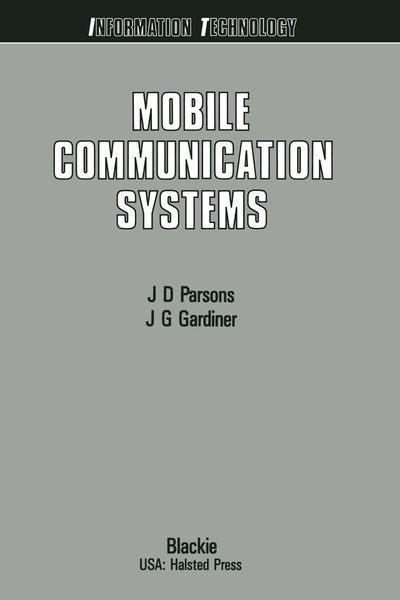
Mobile Communication Systems

51,99 €

inkl. gesetzl. MwSt., Versandkostenfrei


Beschreibung

Produktdetails

Einband

Taschenbuch

Erscheinungsdatum

01.08.1990

Verlag

Springer Us

Seitenzahl

292

Maße (L/B/H)

22,9/15,2/1,7 cm

Gewicht

449 g

Auflage

1989

Sprache

Englisch

ISBN

978-0-216-92261-7

Beschreibung

Produktdetails

Einband

Taschenbuch

Erscheinungsdatum

01.08.1990

Verlag

Springer Us

Seitenzahl

292

Maße (L/B/H)

22,9/15,2/1,7 cm

Gewicht

449 g

Auflage

1989

Sprache

Englisch

ISBN

978-0-216-92261-7

Herstelleradresse

Springer-Verlag KG
Sachsenplatz 4-6
1201 Wien
AT

Email: GPSR Kontakt

Noch keine Bewertungen vorhanden

Verfassen Sie die erste Bewertung zu diesem Artikel

Helfen Sie anderen Kundinnen und Kunden durch Ihre Meinung.

Kundinnen und Kunden meinen

Bewertungen (0)

  • Produktbild: Mobile Communication Systems
  • Produktbild: Mobile Communication Systems
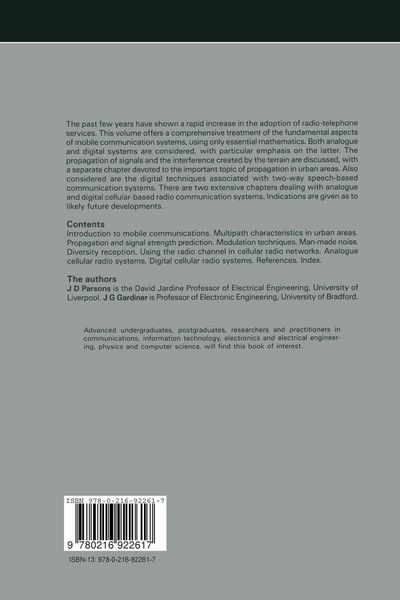
  • 1 Introduction to mobile communications.- 1.1 Background.- 1.2 Mobile radio system fundamentals.- 1.2.1 The operating frequency.- 1.2.2 Modulation.- 1.3 A simple mobile radio system.- 1.4 Practical communication systems.- 1.4.1 Links.- 1.4.2 Repeaters.- 1.4.3 Talk-through.- 1.4.4 Communication with selected mobiles.- 1.4.5 Continuous tone controlled signalling system (CTCSS).- 1.4.6 Selective calling.- 1.5 Paging.- 1.5.1 Simple paging systems.- 1.5.2 Voice paging system.- 1.5.3 Overlay paging system.- 1.5.4 Wide-area paging.- 1.6 Portables.- 1.7 Dialling systems.- 1.8 Radiophone services.- 1.9 Channel sharing.- 1.9.1 Trunking.- 1.10 Area coverage techniques.- 1.10.1 Alternative techniques.- 1.10.2 Cellular schemes.- 1.11 Present and future use of mobile radio.- References.- 2 Multipath characteristics in urban areas.- 2.1 Introduction.- 2.2 The nature of multipath propagation.- 2.3 Short-term fading.- 2.3.1 The scattering model.- 2.3.2 Angle of arrival and signal spectra.- 2.3.3 Fading envelope statistics.- 2.3.4 Level-crossing rate.- 2.3.5 Average fade duration.- 2.3.6 Spatial correlation of field components.- 2.3.7 Random FM.- 2.4 Frequency-selective fading.- 2.5 Channel characterization.- 2.6 Channel sounding techniques.- 2.7 Practical channel sounders.- 2.7.1 Data processing.- 2.8 Small-area characterization.- 2.8.1 Statistical characterization.- 2.9 Large-area characterization.- 2.9.1 Distribution of the channel parameters.- 2.10 Conclusions.- References.- 3 Propagation and signal strength prediction.- 3.1 Introduction.- 3.2 Fundamentals of VHF and UHF propagation.- 3.2.1 Propagation in free space.- 3.2.2 Propagation over a reflecting surface.- 3.2.3 The effect of surface roughness.- 3.3 Propagation over terrain obstacles.- 3.3.1 Fresnel zones.- 3.3.2 Diffraction over rounded objectacles.- 3.4 Multiple knife-edge diffraction.- 3.4.1 The Bullington equivalent knife-edge method.- 3.4.2 The Epstein-Peterson diffraction loss method.- 3.4.3 The Japanese atlas method.- 3.4.4 Picquenard’s method.- 3.4.5 The Deygout method.- 3.4.6 Comparison of the diffraction models.- 3.5 Propagation prediction models.- 3.6 Signal strength prediction in urban areas.- 3.6.1 Allsebrook’s method.- 3.6.2 Ibrahim’s method.- 3.7 Discussion.- 3.8 Signal variability.- 3.8.1 Statistical analysis of the signal.- 3.9 Large area statistics.- 3.10 Building penetration losses.- 3.10.1 Interference effects.- References.- 4 Modulation techniques.- 4.1 Introduction.- 4.2 Amplitude modulation.- 4.2.1 Reduced carrier modulation.- 4.2.2 Single-sideband modulation.- 4.3 Angle modulation.- 4.3.1 Bandwidth of angle-modulated signals.- 4.3.2 Criteria for determining bandwidth.- 4.3.3 Carson’s rule.- 4.3.4 Narrowband modulation.- 4.4 Implementation of AM systems.- 4.5 Single-sideband implementation.- 4.5.1 Filter method.- 4.5.2 Outphasing methods.- 4.5.3 Problems in SSB implementation.- 4.6 Demodulation.- 4.6.1 Coherent demodulation.- 4.6.2 Non-coherent (envelope) detection.- 4.7 Generation of FM signals.- 4.7.1 Direct methods.- 4.7.2 Indirect methods.- 4.8 FM demodulators.- 4.8.1 Frequency discriminators.- 4.8.2 Pulse-counting discriminators.- 4.8.3 Phase-locked loops.- 4.8.4 Quadrature detection.- 4.9 The effect of noise on AM systems.- 4.9.1 Noise performance of DSBSC and SSB.- 4.9.2 Noise performance of AM.- 4.9.3 Comparison of the modulation methods.- 4.10 The effect of noise on FM systems.- 4.10.1 The SNR-bandwidth interchange and FM threshold.- 4.10.2 Pre-emphasis and de-emphasis.- 4.11 The effects of multipath propagation.- 4.11.1 Practical SSB systems.- 4.12 Demodulation of data signals.- 4.13 Differentially encoded PSK (DPSK).- 4.14 The effect of noise in data communication systems.- 4.15 Carrier transmissions.- 4.16 The influence of multipath fading on data transmissions.- 4.16.1 Non-coherent FSK and DPSK.- 4.16.2 Coherent systems.- 4.17 System performance.- 4.18 The fully digital approach.- 4.18.1 The principal compromises.- 4.18.2 Quadrature amplitude modulation.- 4.18.3 Frequency modulation schemes.- References.- 5 Man-made noise.- 5.1 Introduction.- 5.2 Characterization of pulses.- 5.3 Characterization of impulsive noise.- 5.4 Measuring equipment.- 5.4.1 Bandwidth.- 5.4.2 Dynamic range.- 5.4.3 Sensitivity and noise figure.- 5.4.4 Impulse response considerations.- 5.5 Practical measuring systems.- 5.6 Measurement of noise amplitude distribution.- 5.7 Statistical characterization of noise.- 5.8 Impulsive noise measurements.- 5.9 Summary.- 5.10 Performance prediction techniques.- 5.10.1 The assessment of receiver performance.- 5.10.2 Prediction methods using APD.- 5.10.3 Prediction methods using NAD.- 5.10.4 The Bello and Esposito technique.- 5.10.5 Application to other receivers.- References.- 6 Diversity reception.- 6.1 Introduction.- 6.2 Basic diversity methods.- 6.2.1 Selection diversity.- 6.2.2 Maximal-ratio combining.- 6.2.3 Equal-grain combining.- 6.3 Improvements obtainable from diversity.- 6.3.1 Envelope probability distributions.- 6.3.2 Level-crossing rate and average fade duration.- 6.3.3 Random FM.- 6.4 Switched diversity.- 6.4.1 Cumulative probability distribution.- 6.5 The effect of diversity on data systems.- 6.6 Practical diversity systems.- 6.7 Predetection diversity.- 6.7.1 Phase-sweeping or ‘mode averaging’ diversity.- 6.8 Diversity systems using special receivers.- 6.8.1 Pilot-tone systems.- 6.8.2 Systems without pilot-tone.- 6.9 Switched diversity.- 6.10 Comparison.- 6.11 Postdetection diversity.- 6.11.1 Use of a modified phase-correction loop.- 6.11.2 Unified analysis of postdetection diversity.- 6.11.3 Postdetection selection and switched diversity.- 6.12 Time diversity.- 6.13 Discussion and conclusions.- References.- 7 Using the radio channel in cellular radio networkgs.- 7.1 The radio channel as a system component.- 7.2 Wideband versus narrowband.- 7.3 Cellular radio fundamentals.- 7.3.1 Why ‘cellular’?.- 7.3.2 Frequency re-use strategies.- 8 Analogue cellular radio systems.- 8.1 Channel structures.- 8.2 Specifications for the radio equipment.- 8.2.1 RF power levels.- 8.2.2 Modulation.- 8.2.3 Spectrum and channel designation.- 8.3 Network control activity.- 8.3.1 Dedicated control channels.- 8.3.2 Protecting data messages.- 8.3.3 Signalling formats.- 8.3.4 Supervision.- 8.4 System operation.- 8.4.1 Principal functions.- 8.4.2 Mobile scanning.- 8.4.3 Registration.- 8.4.4 Call origination.- 8.4.5 Call receipt.- 8.4.6 Hand-off.- 8.4.7 Call termination.- 8.5 Some system comparisons.- 9 Digital cellular radio systems.- 9.1 Digital versus analogue for second-generation cellular systems.- 9.2 Choice of basic system architecture.- 9.2.1 Single channel per carrier, FDMA.- 9.2.2 Time division multiple access.- 9.3 Essential techniques for digital implementation.- 9.3.1 Speech coding.- 9.3.2 Channel coding.- 9.3.3 Channel equalization.- 9.3.4 Frequency hopping.- 9.4 Example systems.- 9.4.1 An asymmetrical system—MATS-D.- 9.4.2 A wideband TDMA system—CD900.- 9.4.3 The GSM system—narrowband TDMA.- 9.5 Postscript.