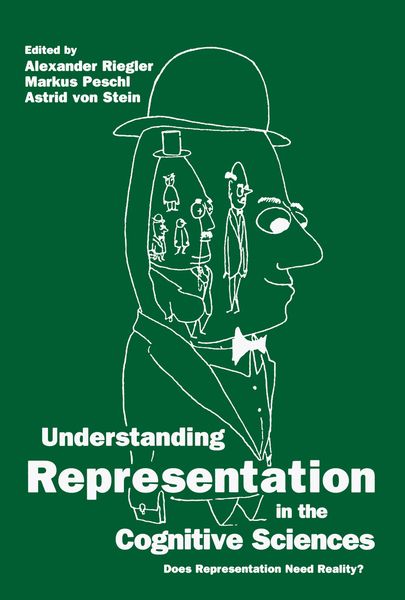

• Produktbild: Understanding Representation in the Cognitive Sciences
  • Produktbild: Understanding Representation in the Cognitive Sciences
- 12%

Understanding Representation in the Cognitive Sciences Does Representation Need Reality?

12% sparen

144,99 € UVP 164,99 €

inkl. gesetzl. MwSt., Versandkostenfrei


Beschreibung

Produktdetails

Einband

Taschenbuch

Erscheinungsdatum

26.04.2013

Herausgeber

Alexander Riegler + weitere

Verlag

Springer Us

Seitenzahl

304

Maße (L/B/H)

27,9/21/1,7 cm

Gewicht

765 g

Auflage

1999

Sprache

Englisch

ISBN

978-1-4757-7245-6

Beschreibung

Portrait

Alexander Riegler (Dipl.-Ing. Dr. Techn., Technische Universität Wien) arbeitet am Institut für Philosophie der Katholischen Universität Löwen (Belgien) und hat zuvor an den Universitäten Wien, Zürich und Brüssel geforscht und gelehrt. Er ist Herausgeber der interdisziplinären Fachzeitschrift ConstructivistFoundations. Seine mehr als 50 Publikationen befassen sich mit Problemen aus den Bereichen Künstliche Intelligenz, Kognitionswissenschaft, Evolutionstheorie und Analytische Philosophie.

Produktdetails

Einband

Taschenbuch

Erscheinungsdatum

26.04.2013

Herausgeber

Verlag

Springer Us

Seitenzahl

304

Maße (L/B/H)

27,9/21/1,7 cm

Gewicht

765 g

Auflage

1999

Sprache

Englisch

ISBN

978-1-4757-7245-6

Herstelleradresse

Springer-Verlag GmbH
Tiergartenstr. 17
69121 Heidelberg
DE

Email: GPSR Kontakt

Noch keine Bewertungen vorhanden

Verfassen Sie die erste Bewertung zu diesem Artikel

Helfen Sie anderen Kundinnen und Kunden durch Ihre Meinung.

Kundinnen und Kunden meinen

Bewertungen (0)

  • Produktbild: Understanding Representation in the Cognitive Sciences
  • Produktbild: Understanding Representation in the Cognitive Sciences
  • Position Paper.- Does Representation Need Reality?.- Overview of Contributions.- Different Facets of Representation.- The Connectionist Route to Embodiment and Dynamicism.- The Ontological Status of Representations.- Empirical and Metaphysical Anti-Representationalism.- Representation in Cognitive Neuroscience.- Cognition without Representation?.- Computational Approaches.- On Computing Systems and Their Environment.- Representation and Cognitive Explanation.- When Coffee Cups Are Like Old Elephants, or Why Representation Modules Don’t Make Sense.- The Recommendation Architecture: Relating Cognition to Physiology.- Cognition as a Dynamical System.- Neurodynamics and the Revival of Associationism in Cognitive Science.- The Dynamic Manifestation of Cognitive Structures in the Cerebral Cortex.- Response Selectivity, Neuron Doctrine, and Mach’s Principle in Perception.- Mental Representations: A Computational-Neuroscience Scheme.- Relevance of Action for Representation.- Sketchpads In and Beyond the Brain.- Inductive Learning with External Representations.- Does the Brain Represent the World? Evidence Against the Mapping Assumption.- Perception Through Anticipation. A Behaviour-Based Approach to Visual Perception.- Symbol Grounding nad Language.- Rethinking Grounding.- Reality: A Prerequisite to Meaningful Representation.- Explorations in Synthetic Pragmatics.- Communication and Social Coupling.- Does Semantics Need Reality?.- Empiricism and Social Reality: Can Cognitive Science Be Socialized?.- Habitus and Animats.- Processing Concepts and Scenarios: Electrophysiological Findings on Language Representation.- Constructivist Consequences: Translation and Reality.- Qualitative Aspects of Representation and Consciousness.- The Observer in the Brain.- Reality andRepresentation Qualia, Computers, and the “Explanatory Gap”.- Constructivism.- Can a Constructivist Distinguish between Experience and Representation?.- How Animals Handle Reality- The Adaptive Aspect of Representation.- Piaget’s Legacy: Cognition as Adaptive Activity.