Gutscheinbedingungen

**Gültig bis 06.07.2026 auf fremdsprachige Bücher online auf thalia.at, in der Thalia App ab einem Mindestbestellwert von 30€ und in allen Thalia Buchhandlungen in Österreich. In den Buchhandlungen nur gültig auf lagernde Ware. Einzelne Artikel können ausgeschlossen sein. Ausgenommen sind preisgebundene Artikel & eBooks. Pro Einkauf einmal einlösbar. Nur gültig gegen Vorlage oder im Onlineshop hinterlegter Bonuscard. Infos zur Einlösung in der Buchhandlung sind auf der Bonuscard-Vorteilspreisseite zu finden. Click & Collect nur bei Onlinevorabzahlung möglich. Keine Einlösung bei Scan & Go-Bezahlung. Keine Barauszahlung. Nicht kombinierbar mit anderen Aktionen und Gutscheinen. Gutschein wird auf max. 500€ Bestellwert angerechnet. Nicht gültig für Versandkosten und Services.

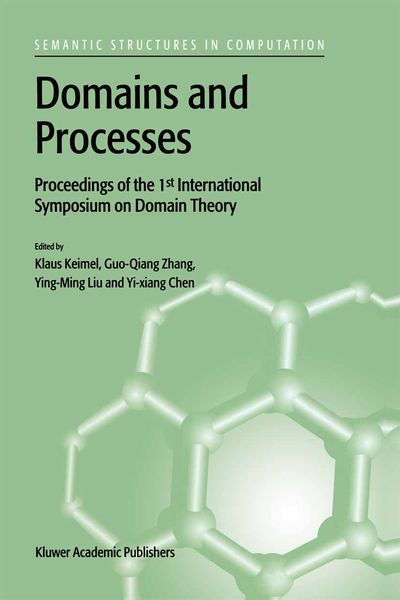
Produktbild: Domains and Processes
Band 1 - 12%

Domains and Processes Proceedings of the 1st International Symposium on Domain Theory Shanghai, China, October 1999

12% sparen

95,99 € UVP 109,99 €

inkl. gesetzl. MwSt., Versandkostenfrei


Beschreibung

Produktdetails

Einband

Taschenbuch

Erscheinungsdatum

17.09.2012

Herausgeber

Klaus Keimel + weitere

Verlag

Springer Netherland

Seitenzahl

273

Maße (L/B/H)

24/16/1,6 cm

Gewicht

471 g

Auflage

Softcover reprint of the original 1st ed. 2001

Sprache

Englisch

ISBN

978-94-010-3859-1

Beschreibung

Produktdetails

Einband

Taschenbuch

Erscheinungsdatum

17.09.2012

Herausgeber

Verlag

Springer Netherland

Seitenzahl

273

Maße (L/B/H)

24/16/1,6 cm

Gewicht

471 g

Auflage

Softcover reprint of the original 1st ed. 2001

Sprache

Englisch

ISBN

978-94-010-3859-1

Herstelleradresse

Springer-Verlag GmbH
Tiergartenstr. 17
69121 Heidelberg
DE

Email: ProductSafety@springernature.com

Noch keine Bewertungen vorhanden

Verfassen Sie die erste Bewertung zu diesem Artikel

Helfen Sie anderen Kundinnen und Kunden durch Ihre Meinung.

Kundinnen und Kunden meinen

Bewertungen (0)

  • Produktbild: Domains and Processes
  • 1 Encounters Between Topology and Domain Theory.- 1 Introduction.- 2 Introductory Domain Theory.- 3 The Scott Topology.- 4 Locally Compact Spaces.- 5 Spectral Theory.- 6 Round Ideal Completions.- 7 Ordered Spaces.- 8 Compact Pospaces.- 9 Spaces of Maximal Points.- 10 The Domain of Closed Formal Balls.- 11 Fixed Point Theory.- 12 The Probabilistic Power Domain.- 13 Open Problems and Research Directions.- 14 Topological Appendix.- 2 The Lawson Topology on Quasicontinuous Domains.- 1 Introduction.- 2 Quasicontiuous domains.- 3 Strictly complete regularity of the Lawson topology.- 3 Uk-admitting dcpos need not be sober.- 1 Introduction.- 2 Uk-admitting for locally compact dcpo’s.- 3 Uk-admitting does not always imply sober.- 4 The Largest Topologically Cartesian Closed Categories of Domains as Topological Spaces.- 1 Introduction and Preliminaries.- 2 Relations between tcc and ccc categories.- 3 FS is the largest tcc full subcategory of CONT1.- 4 F-FS is the largest tcc full subcategory of CONT.- 5 On the Equivalence of Some Approaches to Computability on the Real Line.- 1 Introduction.- 2 The TTE approach to real number computations.- 3 The domain-theoretic approach to real number computability.- 4 The language Real PCF.- 5 The equivalence results.- 6 Concluding remarks.- 7 Appendix.- 6 The continuous functionals of finite types over the reals.- 1 Introduction.- 2 The types.- 3 The hereditarily total objects.- 4 Density and co-density.- 5 Limit spaces.- 6 The traditional approach.- 7 Compact Semantics on Bc-domains.- 1 Introduction.- 2 Preliminaries and Characterizations for Semantics Continuity.- 3 The Compactness Theorem And Applications.- 4 Conclusion.- 8 Normal Subsets in Abstract Bases.- 1 Introduction.- 2 Prerequisites.- 3 Normal subsets and sub-domains.- 4 The dcpoclass of abstract bases and a fixed point theorem.- 9 Semantics of Logic Programs and Representation of Smyth Powerdomain.- 1 Introduction.- 2 Domains and information systems.- 3 Main representation theorem.- 4 Proofs.- 5 Examples.- 6 Semantics of disjunctive logic programs.- 7 Clausal logic over sequent structures.- 8 Conclusion.- 10 Domains of view: a foundation for specification and analysis.- 1 Introduction.- 2 Kripke modal transition systems.- 3 Fuzzy Kripke modal transition systems.- 4 Modal Markov chains.- 5 Modal relations.- 6 Related work.- 11 Semantic Theory and Proof System of Open Bisimulation for the ?-Calculus with Mismatching.- 1 Introduction.- 2 Operational Semantics of the ?-Calculus.- 3 Open Bisimulation and Its Symbolic Characterization.- 4 Proof System for Open Bisimulation.- 5 The Weak Case.- 6 Conclusions.- 12 Axiomatization without Prefix Combinator.- 1 Introduction.- 2 Preliminaries.- 3 Polyadic X-Calculus.- 4 A Process Calculus without Precedence.- 5 Ground Bisimilarity for Atomic X-Calculus.- 6 Axiomatization in the Absence of Prefix, Summation and Match Combinators.- 7 Final Remarks.