• Produktbild: Environment and Development: An Economic Approach
  • Produktbild: Environment and Development: An Economic Approach
Band 2

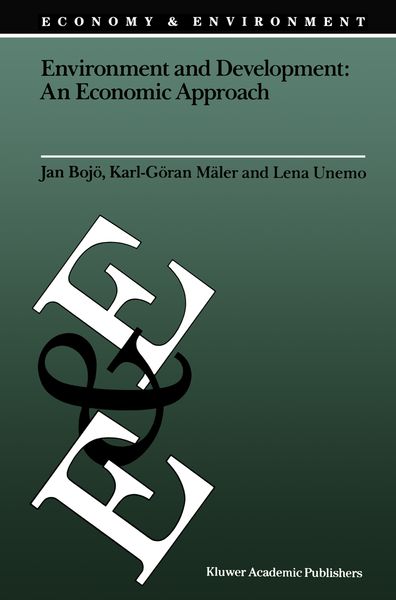
Environment and Development: An Economic Approach

Aus der Reihe Economy & Environment

49,99 €

inkl. gesetzl. MwSt., Versandkostenfrei


Beschreibung

Produktdetails

Einband

Taschenbuch

Erscheinungsdatum

20.09.2011

Verlag

Springer Netherland

Seitenzahl

175

Maße (L/B/H)

23,5/15,5/1 cm

Gewicht

277 g

Auflage

Softcover reprint of the original 1st ed. 1990

Sprache

Englisch

ISBN

978-94-010-6767-6

Beschreibung

Produktdetails

Einband

Taschenbuch

Erscheinungsdatum

20.09.2011

Verlag

Springer Netherland

Seitenzahl

175

Maße (L/B/H)

23,5/15,5/1 cm

Gewicht

277 g

Auflage

Softcover reprint of the original 1st ed. 1990

Sprache

Englisch

ISBN

978-94-010-6767-6

Herstelleradresse

Springer-Verlag KG
Sachsenplatz 4-6
1201 Wien
AT

Email: GPSR Kontakt

Noch keine Bewertungen vorhanden

Verfassen Sie die erste Bewertung zu diesem Artikel

Helfen Sie anderen Kundinnen und Kunden durch Ihre Meinung.

Kundinnen und Kunden meinen

Bewertungen (0)

  • Produktbild: Environment and Development: An Economic Approach
  • Produktbild: Environment and Development: An Economic Approach
  • 1. Summary.- 2. Introduction.- 2.1 Background.- 2.2 Sustainable Development.- 2.3 Disposition and Delimitations.- 3. Distortions in the Economic System and the Need for Economic Analysis.- 3.1 The “Bench-mark” Economy.- 3.2 Market Failures.- 3.2.1 Externalities.- 3.2.2 Risk Markets.- 3.2.3 Future Markets.- 3.2.4 Income Distribution.- 3.3 Policy Failures.- 3.3.1 International Trade Policy.- 3.3.2 Property Rights Definition and Enforcement.- 3.3.3 Population Policy.- 3.3.4 Price Policy.- 3.3.5 Tax Policy.- 3.3.6 Political Elites and Bureaucratic Suboptimization.- 3.3.7 Public Investment.- 3.3.8 Environmental Information.- 3.4 Summary.- 4. General Equilibrium Analysis and National Accounting.- 4.1 General Equilibrium Analysis.- 4.2 National Income Accounting and Environmental Resources.- 4.3 Aggregate Welfare Measures.- 4.4 Natural Resource Accounting and Computable General Equilibrium Models.- 5. Economic Analysis of Environmental Consequences.- 5.1 Major Steps in CBA.- 5.1.1 Planning Perspectives and Evaluation Criteria.- 5.1.2 Income Distribution.- 5.1.3 Discounting.- 5.1.4 Risk and Uncertainty.- 5.2 Valuation Approaches.- 5.2.1 Valuation Using Conventional Markets.- 5.2.1.1 Valuation of Changes in Production.- 5.2.1.2 Replacement Cost.- 5.2.1.3 Preventive Expenditure.- 5.2.1.4 Valuation of Human Capital.- 5.2.2 Valuation Using Implicit Markets.- 5.2.2.1 The Travel Cost Approach.- 5.2.2.2 Land and Property Value Approach.- 5.2.3 Valuation Using Artificial Markets.- 5.3 Complementary and Other Methods.- 5.4 Criticism against CBA.- 6. Case Studies.- 6.1 Agricultural Projects.- 6.1.1 Soil and Water Conservation — Farm Improvement and Soil Conservation in Lesotho.- 6.1.2 Soil and Water Conservation — Upland Agricultural Project in Korea.- 6.1.3 Range Management — The Eppalock Catchment in Australia.- 6.1.4 Agroforestry — An Afforestation Programme in Nigeria.- 6.2 Forestry Project — Nepal Hill Forest Development Project.- 6.3 Integrated Environmental Project — Environmental Protection in the Philippines.- 6.4 Recreation and Forestry — Preservation of Mountain Forests — The Vålå Valley in Sweden.- 6.5 Air Pollution.- 6.5.1 Air Pollution — The South Coast Air Basin Experiment in California.- 6.5.2 Valuation of Morbidity Reduction due to Pollution Abatement: Direct vs. Indirect Measurement.- 6.5.3 Air Pollution and Corrosion Damage.- 6.6 Water Pollution — Water Quality Management in Thailand.- 6.7 Environmental Degradation and Policy Failures.- 6.7.1 Deforestation in the Amazon: Regional Development Policies.- 6.7.2 Deforestation in the Amazon: Fiscal and Legal Provisions.