
KI-Beratung Beta

Gutscheinbedingungen

**Gültig bis 09.11.2026 auf tolino shine color (4016621130473), tolino vision color (4016621130183) und tolino vision color weiß (4016621131456) online auf thalia.at, in der Thalia App und in allen Thalia Buchhandlungen in Österreich. In den Buchhandlungen nur gültig auf lagernde Ware. Pro Einkauf einmal einlösbar. Nur gültig gegen Vorlage oder im Onlineshop hinterlegter Bonuscard. Infos zur Einlösung in der Buchhandlung sind auf der Bonuscard-Vorteilspreisseite zu finden. Click & Collect nur bei Onlinevorabzahlung möglich. Keine Einlösung bei Scan & Go-Bezahlung. Keine Barauszahlung. Nicht kombinierbar mit anderen Aktionen und Gutscheinen. Nicht gültig für Geschenkkarten, Versandkosten und Services. Nur solange der Vorrat reicht.

  • Produktbild: Astronautical Research 1971
  • Produktbild: Astronautical Research 1971

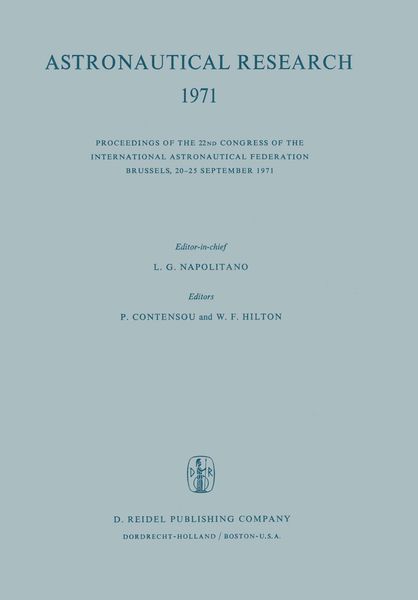
Astronautical Research 1971 Proceedings of the 22nd Congress of the International Astronautical Federation Brussels, 20–25 September 1971

51,99 €

inkl. gesetzl. MwSt., Versandkostenfrei


Beschreibung

Produktdetails

Einband

Taschenbuch

Erscheinungsdatum

09.12.2011

Herausgeber

L.G. Napolitano + weitere

Verlag

Springer Netherland

Seitenzahl

596

Maße (L/B/H)

24,4/17/3,3 cm

Auflage

Softcover reprint of the original 1st ed. 1973

Sprache

Englisch

ISBN

978-94-010-2561-4

Beschreibung

Produktdetails

Einband

Taschenbuch

Erscheinungsdatum

09.12.2011

Herausgeber

Verlag

Springer Netherland

Seitenzahl

596

Maße (L/B/H)

24,4/17/3,3 cm

Auflage

Softcover reprint of the original 1st ed. 1973

Sprache

Englisch

ISBN

978-94-010-2561-4

Herstelleradresse

Springer-Verlag GmbH
Tiergartenstr. 17
69121 Heidelberg
DE

Email: ProductSafety@springernature.com

Noch keine Bewertungen vorhanden

Verfassen Sie die erste Bewertung zu diesem Artikel

Helfen Sie anderen Kundinnen und Kunden durch Ihre Meinung.

Kundinnen und Kunden meinen

Bewertungen (0)

  • Produktbild: Astronautical Research 1971
  • Produktbild: Astronautical Research 1971
  • 1. La cooperation internationale dans le domaine de l’astronautique (Invited Lecture).- I/Basic Problems: A. Astrodynamics.- 2. Revue générale des méthodes automatiques de calcul de théories analytiques de satellites artificiels.- 3. Caractéristiques d’un programme de correction différentielle en géodésie dynamique.- 4. Coupled Librational Dynamics and Attitude Control of Satellites in Presence of Solar Radiation Pressure.- 5. Inertial Force Field Patterns Due to Nutational Motion of Spinning Satellites.- 6. Planar Librational Motion of a Gravity-Gradient Satellite During Deployment.- 7. Time-Optimal Semi-Active Attitude Control for the Pitch Motion of a Satellite.- B. Fluid Mechanics Aspects of Space Flight.- 8. Heat Transfer and Pressure Distribution on Sharp and Finite Bluntness Biconic and Hemispherical Geometries at Various Angles of Attack in a Mach 15-20 Flow.- 9. Hypersonic Low Temperature Ablation-An Experimental Study of Cross-hatched Surface Patterns.- 10. The Scattering of Gas Molecules from Metal Surfaces.- 11. Lifting Body Configurations for Sustained Hypersonic Flight.- C. Bioastronautics.- 12. Summary of a 90-Day Manned Test of a Regenerative Life Support System.- 13. Advanced Methods of Recovery for Space Life Support Systems.- II/Engineering And Management Aspects Of Space Technology: A. Space Transportation: Earth to Orbit.- 14. Space Transportation Report.- 15. A Nonlinear Programming Approach to Space Shuttle Trajectory Optimization.- B. Space Transportation: Orbit to Orbit.- 16. The Problem of Docking with a Passive Orbiting Object which Possesses Angular Momentum.- 17. Use of Orbit-to-Orbit Shuttles for Hyperbolic Rendezvous with Returning Planetary Spacecraft.- C. Propulsion.- 18. Plasma Thrusters for Secondary Propulsion.- 19. Prévision des domaines de fonctionnement instable d’un propulseur à propergol solide.- 20. Apollo Propulsion Systems Development and Flight Experience.- D. Structure and Materials.- 21. The POGO Phenomenon: Its Causes and Cure.- 22. Gaseous Hydrogen Embrittlement of Aerospace Materials.- 23. Fatigue Failure of Materials under Narrow Band Random Vibrations — Part 2.- E. Telemetering and Data Management.- 24. Data Management for the Skylab Program.- 25. Space Shuttle Data Management System.- III /Utilization And Applications Of Space Technology: A. Earth Resources Satellites.- 26. Global Monitoring and Remote Sensing from Satellites.- 27. The Growth of Remote Sensing through the Nimbus and ERTS Spacecraft.- 28. The Role of Applications Satellites in the Management of the Human Environment.- B. Scientific Spacecrafts.- 29. The German Aeronomy Satellite AEROS.- 30. GEOS-The First Scientific Geostationary Satellite Sponsored by ESRO.- 31. Skylab — A Manned Scientific Space Laboratory.- 32. The UK 5 Spacecraft for Experiments in X-Ray Astronomy.- C. Education.- 33. A Space Benefits Educational Program.- 34. A Case for Total Concept Design Courses in Education.- 35. Safety in Youth Rocket Experiments (SYRE) Session.- IV/First I.A.F. Student Conference.- 36. Transverse Acoustic Wave Amplification Due to Mass Injection Around a Submerged Nozzle.- 37. Axisymmetric Buckling of an Annular Plate.- 38. A Modulation Technique for Measuring Small Disturbances in the Upstream Flow Field of a Sharp Leading Edge in a Rarefied Hypersonic Flow.- 39. Diagnostics of an Argon Free Jet Expanded from a High Pressure Inductive Arc Source.- 40. An Experimental Investigation of Air Flow at an Inlet to a Centrifugal Compressor.