
KI-Beratung Beta

Gutscheinbedingungen

**Gültig am 20.11.2026 ab einem Mindestbestellwert von 30€ auf Spielzeug, Schreibwaren, Filme, Geschenke & Trends, Musik, tolino eReader & Zubehör, Hörbücher und Hörbuch-Downloads, nicht preisgebundene Bücher und Kalender online auf thalia.at und in der Thalia App. Einzelne Artikel können ausgeschlossen sein. Aufgrund der Buchpreisbindung sind deutschsprachige Bücher und eBooks ausgenommen. Zusätzlich ausgenommen sind Abos & Flatrates, Games, Geschenkkarten/-boxen, Shelfies, Software, Zeitschriften sowie einzelne Artikel von tonies®. Pro Einkauf einmal einlösbar. Click & Collect nur bei Onlinevorabzahlung möglich. Keine Barauszahlung. Nicht kombinierbar mit anderen Aktionen und Gutscheinen. Gutschein wird auf max. 500€ Bestellwert angerechnet. Nicht gültig für Versandkosten und Services. Preisgebundene Artikel sind vom Mindestbestellwert ausgeschlossen.

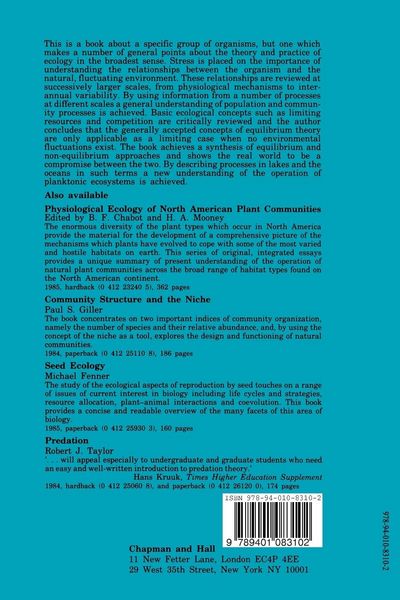
  • Produktbild: Phytoplankton Ecology
  • Produktbild: Phytoplankton Ecology
- 11%

Phytoplankton Ecology Structure, Function and Fluctuation

11% sparen

96,99 € UVP 109,99 €

inkl. gesetzl. MwSt., Versandkostenfrei


Beschreibung

1 Preamble.- 1.1 A brief introduction to the organisms.- 2 Ecological theory.- 2.1 An historical perspective: the concept of plenitude.- 2.2 Ecology and evolution.- 2.3 Equilibrium theory.- 2.4 The equilibrium theory of community structure.- 2.5 Criticisms of equilibrium theory.- 2.6 Non-equilibrium...

Beschreibung

1 Preamble.- 1.1 A brief introduction to the organisms.- 2 Ecological theory.- 2.1 An historical perspective: the concept of plenitude.- 2.2 Ecology and evolution.- 2.3 Equilibrium theory.- 2.4 The equilibrium theory of community structure.- 2.5 Criticisms of equilibrium theory.- 2.6 Non-equilibrium theory.- 2.7 Some ideas from non-equilibrium thermodynamics.- 3 Some basic physics.- 3.1 Scales of turbulent kinetic energy generation.- 3.2 The physics of surface waters.- 4 The chemical environment.- 4.1 The Redfield ratio.- 4.2 The major ions.- 4.3 The major nutrients.- 5 Defining the scales of interest.- 5.1 Patchiness in space and time.- 5.2 The biological response to variability in space and time.- 5.3 Models of competition between phytoplankton.- 6 The measurement of productivity and growth rates.- 6.1 The interpretation of kinetic measurements.- 6.2 The integration of metabolic pathways.- 6.3 Time scales and the effects of bottle containment.- 6.4 From kinetics to growth rates?.- 7 The concept of limiting nutrients.- 7.1 Rate processes in oligotrophic waters.- 7.2 The cycling of N and P in lakes and the oceans.- 7.3 Nutrient cycling, elemental ratios and the 'Redfield ratio'.- 7.4 Patterns in temporal fluctuations.- 7.5 Whole basin averages.- 8 Physiological scales: non-steady state conditions in the field.- 8.1 The effects of environmental variability on growth rates.- 8.2 Energy, nutrients and cell size: a synthesis.- 9 Seasonal patterns of distribution and abundance.- 9.1 Spatial distribution of biomass.- 9.2 The seasonal cycle of phytoplankton growth.- 9.3 Manipulation of the seasonal cycle of biomass.- 9.4 The influence of mixed layer physics on biomass distributions.- 9.5 Ecological succession.- 9.6 The seasonal succession and community structure ofphytoplankton.- 9.7 Sampling and counting problems: time and space scales.- 9.8 The seasonal successions of species: the ideal sequences.- 9.9 Nutrient ratios and the role of competition.- 10 Community structure and function in turbulent environments.- 10.1 Processes in phytoplankton successions.- 10.2 Structural trends in succession.- 10.3 Rates of succession.- 10.4 Succession in turbulent mixed layers.- 10.5 Manipulation of the species composition.- 10.6 Biomanipulation.- 11 Large number systems: empiricism.- 11.1 Observations of ecological diversity.- 11.2 Predictions of the distribution and occurrence of species.- 11.3 Phosphorus loadings and algal biomass.- 11.4 Manipulation of algal biomass.- 11.5 Phosphorus loadings and hypolimnial anoxia.- 11.6 Phosphorus loadings and the biomass of other organisms in the food chain.- 11.7 Size distributions in food chains.- 11.8 Phytoplankton biomass and fish production.- 12 Interannual variability.- 12.1 Long-term changes in phytoplankton abundance.- References.

Produktdetails

Einband

Taschenbuch

Erscheinungsdatum

09.10.2011

Abbildungen

XII, 384 p.

Verlag Springer Netherland

Produktdetails

Einband

Taschenbuch

Erscheinungsdatum

09.10.2011

Abbildungen

XII, 384 p.

Verlag Springer Netherland
Seitenzahl

384

Maße (L/B/H)

23,5/15,5/2,2 cm

Gewicht

604 g

Auflage

Softcover reprint of the original 1st ed. 1986

Sprache

Englisch

ISBN

978-94-010-8310-2

Herstelleradresse

Springer-Verlag KG
Sachsenplatz 4-6
1201 Wien
AT

Email: ProductSafety@springernature.com

Noch keine Bewertungen vorhanden

Verfassen Sie die erste Bewertung zu diesem Artikel

Helfen Sie anderen Kundinnen und Kunden durch Ihre Meinung.

Kundinnen und Kunden meinen

Bewertungen (0)

  • Produktbild: Phytoplankton Ecology
  • Produktbild: Phytoplankton Ecology
  • 1 Preamble.- 1.1 A brief introduction to the organisms.- 2 Ecological theory.- 2.1 An historical perspective: the concept of plenitude.- 2.2 Ecology and evolution.- 2.3 Equilibrium theory.- 2.4 The equilibrium theory of community structure.- 2.5 Criticisms of equilibrium theory.- 2.6 Non-equilibrium theory.- 2.7 Some ideas from non-equilibrium thermodynamics.- 3 Some basic physics.- 3.1 Scales of turbulent kinetic energy generation.- 3.2 The physics of surface waters.- 4 The chemical environment.- 4.1 The Redfield ratio.- 4.2 The major ions.- 4.3 The major nutrients.- 5 Defining the scales of interest.- 5.1 Patchiness in space and time.- 5.2 The biological response to variability in space and time.- 5.3 Models of competition between phytoplankton.- 6 The measurement of productivity and growth rates.- 6.1 The interpretation of kinetic measurements.- 6.2 The integration of metabolic pathways.- 6.3 Time scales and the effects of bottle containment.- 6.4 From kinetics to growth rates?.- 7 The concept of limiting nutrients.- 7.1 Rate processes in oligotrophic waters.- 7.2 The cycling of N and P in lakes and the oceans.- 7.3 Nutrient cycling, elemental ratios and the ‘Redfield ratio’.- 7.4 Patterns in temporal fluctuations.- 7.5 Whole basin averages.- 8 Physiological scales: non-steady state conditions in the field.- 8.1 The effects of environmental variability on growth rates.- 8.2 Energy, nutrients and cell size: a synthesis.- 9 Seasonal patterns of distribution and abundance.- 9.1 Spatial distribution of biomass.- 9.2 The seasonal cycle of phytoplankton growth.- 9.3 Manipulation of the seasonal cycle of biomass.- 9.4 The influence of mixed layer physics on biomass distributions.- 9.5 Ecological succession.- 9.6 The seasonal succession and community structure ofphytoplankton.- 9.7 Sampling and counting problems: time and space scales.- 9.8 The seasonal successions of species: the ideal sequences.- 9.9 Nutrient ratios and the role of competition.- 10 Community structure and function in turbulent environments.- 10.1 Processes in phytoplankton successions.- 10.2 Structural trends in succession.- 10.3 Rates of succession.- 10.4 Succession in turbulent mixed layers.- 10.5 Manipulation of the species composition.- 10.6 Biomanipulation.- 11 Large number systems: empiricism.- 11.1 Observations of ecological diversity.- 11.2 Predictions of the distribution and occurrence of species.- 11.3 Phosphorus loadings and algal biomass.- 11.4 Manipulation of algal biomass.- 11.5 Phosphorus loadings and hypolimnial anoxia.- 11.6 Phosphorus loadings and the biomass of other organisms in the food chain.- 11.7 Size distributions in food chains.- 11.8 Phytoplankton biomass and fish production.- 12 Interannual variability.- 12.1 Long-term changes in phytoplankton abundance.- References.