Gutscheinbedingungen

**Gültig bis 15.06.2026 auf Spiele & Spielzeug online auf thalia.at, in der Thalia App ab einem Mindestbestellwert von 30€ und in allen Thalia Buchhandlungen in Österreich. In den Buchhandlungen nur gültig auf lagernde Ware. Einzelne Artikel können ausgeschlossen sein. Ausgenommen sind preisgebundene Artikel sowie online auf thalia.at und in der Thalia App einzelne Artikel von tonies®. Pro Einkauf einmal einlösbar. Nur gültig gegen Vorlage oder im Onlineshop hinterlegter Bonuscard. Infos zur Einlösung in der Buchhandlung sind auf der Bonuscard-Vorteilspreisseite zu finden. Click & Collect nur bei Onlinevorabzahlung möglich. Keine Einlösung bei Scan & Go-Bezahlung. Keine Barauszahlung. Nicht kombinierbar mit anderen Aktionen und Gutscheinen. Gutschein wird auf max. 500€ Bestellwert angerechnet. Nicht gültig für Geschenkkarten, Versandkosten und Services.

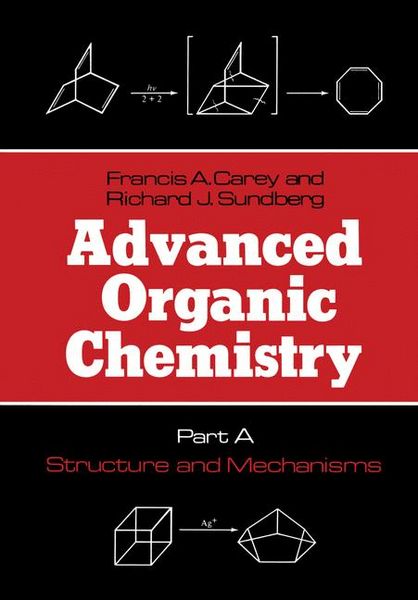
Produktbild: Advanced Organic Chemistry
- 11%

Advanced Organic Chemistry Part A: Structure and Mechanisms

11% sparen

77,99 € UVP 87,95 €

inkl. gesetzl. MwSt., Versandkostenfrei


Produktdetails

Einband

Taschenbuch

Erscheinungsdatum

25.11.2012

Verlag

Springer Us

Seitenzahl

584

Maße (L/B/H)

25,4/17,8/3,1 cm

Gewicht

1149 g

Auflage

1977

Sprache

Englisch

ISBN

978-1-4613-9794-6

Produktdetails

Einband

Taschenbuch

Erscheinungsdatum

25.11.2012

Verlag

Springer Us

Seitenzahl

584

Maße (L/B/H)

25,4/17,8/3,1 cm

Gewicht

1149 g

Auflage

1977

Sprache

Englisch

ISBN

978-1-4613-9794-6

Herstelleradresse

Springer US, New York, N.Y.
Heidelberger Platz 3
14197 Berlin
Deutschland
Email: sdc-bookservice@springer.com
Fax: +49 6221 3454229

Kundinnen und Kunden meinen

0 Bewertungen

Informationen zu Bewertungen

Zur Abgabe einer Bewertung ist eine Anmeldung im Konto notwendig. Die Authentizität der Bewertungen wird von uns nicht überprüft. Wir behalten uns vor, Bewertungstexte, die unseren Richtlinien widersprechen, entsprechend zu kürzen oder zu löschen.

Die Bewertungen sind nach Format, Anzahl Sterne und Datum sortiert.

Verfassen Sie die erste Bewertung zu diesem Artikel

Helfen Sie anderen Kund*innen durch Ihre Meinung

Kundinnen und Kunden meinen

0 Bewertungen filtern

  • Produktbild: Advanced Organic Chemistry
  • of Part A.- 1. Chemical Bonding and Molecular Structure.- 1.1. Valence-Bond Approach to Chemical Bonding.- 1.2. Bond Energies, Lengths, and Dipoles.- 1.3. Molecular Orbital Theory.- 1.4. Huckel Molecular Orbital Theory.- General References.- Problems.- 2. Stereochemical Principles.- 2.1. Enantiomeric Relationships.- 2.2. Diastereomeric Relationships.- 2.3. Dynamic Stereochemistry.- 2.4. Prochiral Relationships.- General References.- Problems.- 3. Conformational and Other Steric Effects.- 3.1. Steric Strain and Molecular Mechanics.- 3.2. Conformations of Acyclic Molecules.- 3.3. Conformations of Cyclohexane Derivatives.- 3.4. Carbocyclic Rings Other Than Six-Membered.- 3.5. Heterocyclic Conformational Analysis.- 3.6. Molecular Orbital Methods Applied to Conformational Analysis.- 3.7. Conformational Effects on Reactivity.- 3.8. Other Steric Effects on Reactivity.- General References.- Problems.- 4. Study and Description of Organic Reaction Mechanisms.- 4.1. Thermodynamic Data.- 4.2. Kinetic Data.- 4.3. Substituent Effects and Linear Free-Energy Relationships.- 4.4. Isotope Effects.- 4.5. Characterization of Reaction Intermediates.- 4.6. Catalysis.- 4.7. Solvent Effects.- 4.8. Basic Mechanistic Concepts: Kinetic Versus Thermodynamic Control, Hammond’s Postulate, the Curtin-Hammett Principle.- 4.9. Isotopes in Labeling Experiments.- 4.10. Stereochemistry.- General References.- Problems.- 5. Nucleophilic Substitution.- 5.1. The Limiting Cases—Substitution by the Ionization (Sn1) Mechanism.- 5.2. The Limiting Cases—Substitution by the Direct Displacement (SN2) Mechanism.- 5.3. Alternative Mechanistic Hypotheses.- 5.4. Carbonium Ions.- 5.5. Nucleophilicity.- 5.6. Leaving-Group Effects.- 5.7. Steric and Other Substituent Effects on Substitution and Ionization Rates.- 5.8. Stereochemistry of Nucleophilic Substitution.- 5.9. Secondary Kinetic Isotope Effects in Substitution Mechanisms.- 5.10. Neighboring-Group Participation.- 5.11. Carbonium Ion Rearrangements.- 5.12. Nonclassical Carbonium Ions and the Norbornyl Cation Problem.- 5.13. Synthetic Applications of Nucleophilic Substitution Reactions.- General References.- Problems.- 6. Polar Addition and Elimination Reactions.- 6.1. Addition of Hydrogen Halides to Alkenes.- 6.2. Acid-Catalyzed Hydration of Alkenes.- 6.3. Addition of Halogens.- 6.4. The E2, E1, and E1cb Mechanisms.- 6.5. Orientation Effects in Elimination Reactions.- 6.6. Stereochemistry of E2 Elimination Reactions.- 6.7. Dehydration of Alcohols.- 6.8. Eliminations Not Involving C-H Bonds.- General References.- Problems.- 7. Carbanions and Other Nucleophilic Carbon Species.- 7.1. Acidity of Hydrocarbons.- 7.2. Carbanions Stabilized by Functional Groups.- 7.3. Enols and Enamines.- General References.- Problems.- 8. Reactions of Carbonyl Compounds.- 8.1. Hydration and Addition of Alcohols to Aldehydes and Ketones.- 8.2. Addition-Elimination Reactions of Ketones and Aldehydes.- 8.3. Reactivity of Carbonyl Compounds toward Addition.- 8.4. Ester Hydrolysis and Related Reactions.- 8.5. Amide Hydrolysis.- 8.6. Acylation of Nucleophilic Oxygen and Nitrogen Groups.- 8.7. Intramolecular Catalysis.- General References.- Problems.- 9. Aromaticity and Electrophilic Aromatic Substitution.- 9.1. Aromaticity.- 9.1.1. The Concept of Aromaticity.- 9.1.2. The Annulenes.- 9.1.3. Aromaticity in Charged Rings.- 9.1.4. Fused-Ring Systems.- 9.1.5. Homoaromaticity.- 9.2. Electrophilic Aromatic Substitution Reactions.- 9.3. Structure-Reactivity Relationships.- 9.4. Specific Substitution Mechanisms.- 9.4.1. Nitration.- 9.4.2. Halogenation.- 9.4.3. Protonation and Hydrogen Exchange.- 9.4.4. Friedel-Crafts Alkylation and Related Reactions.- 9.4.5. Friedel-Crafts Acylation and Related Reactions.- 9.4.6. Coupling with Diazonium Compounds.- 9.4.7. Substitution of Groups Other Than Hydrogen.- 9.5. Theoretical Treatments of Aromatic Substitution Reactions.- General References.- Problems.- 10. Concerted Reactions.- 10.1. Electrocyclic Reactions.- 10.2. Sigmatropic Rearrangements.- 10.3. Cycloaddition and Cycloelimination Reactions.- General References.- Problems.- 11. Photochemistry.- 11.1. General Principles.- 11.2. Orbital Symmetry Considerations Related to Photochemical Reactions.- 11.3. Photochemistry of Carbonyl Groups.- 11.4. Photochemistry of Alkenes and Dienes.- 11.5. Photochemistry of Aromatic Compounds.- General References.- Problems.- 12. Free-Radical Reactions.- 12.1. Generation and Characterization of Free Radicals.- 12.1.1. Background.- 12.1.2. Stable Free Radicals.- 12.1.3. Direct Detection of Radical Intermediates.- 12.1.4. Sources of Free Radicals.- 12.1.5. Structural and Stereochemical Properties of Radical Intermediates.- 12.1.6. Charged Radical Species.- 12.2. Characteristics of Reaction Mechanisms Involving Radical Intermediates.- 12.2.1. Kinetic Characteristics of Chain Reactions.- 12.2.2. Structure-Reactivity Relationships.- 12.3. Free-Radical Substitution Reactions.- 12.3.1. Halogenation.- 12.3.2. Oxidation.- 12.3.3. Substitutions Involving Aryl Radicals.- 12.4. Free-Radical Addition Reactions.- 12.4.1. Addition of Hydrogen Halides.- 12.4.2. Addition of Halomethanes.- 12.4.3. Addition of Other Carbon Radicals.- 12.4.4. Addition of S-H Compounds.- 12.5. Intramolecular Free-Radical Reactions.- 12.6. Rearrangement and Fragmentation Reactions of Free Radicals.- 12.6.1. Rearrangement.- 12.6.2. Fragmentation.- 12.7. Electron-Transfer Reactions.- General References.- Problems.- References for Problems.