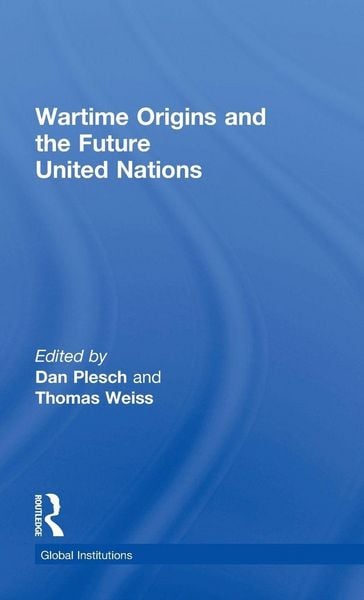

Wartime Origins and the Future United Nations Past As Prelude?
-
- Hardcover ausgewählt
- Taschenbuch
- eBook
-
Sprache:Englisch
237,99 €
inkl. gesetzl. MwSt.,
Beschreibung
Produktdetails
Einband
Gebundene Ausgabe
Erscheinungsdatum
15.01.2015
Herausgeber
Plesch Dan + weitereVerlag
Taylor and FrancisSeitenzahl
242
Maße (L/B/H)
22,2/14,5/1,8 cm
Gewicht
408 g
Sprache
Englisch
ISBN
978-0-415-71265-1
The inadequacy of existing political processes for global problem solving goes a long way toward explaining the fitful, tactical, and short-term responses to trans-boundary challenges that require sustained, strategic, and longer-run global perspectives and action. For all its warts, the point of departure for this work is the need to renovate the "United Nations"-which includes the First UN of member states, the Second UN of international civil servants, and the Third UN of nongovernmental organizations (NGOs), external experts, scholars, consultants, the private sector, and committed citizens. A substantial historical precedent with real-world traction for a revamped second generation or the next generation of intergovernmental organization is the founding of the UN system during World War II. This largely unknown or forgotten story is not on the radar screens of contemporary decision-makers and policy analysts or even of most scholars of international relations and law. Each chapter will focus on a distinctive issue that was central not only to wartime planning about a potential post-war world order but also remains so today. While much research has emphasized the ambitious origins of the collective security system that was still born with the onset of the Cold War, this project focuses on lesser-known illustrations whose pertinence for contemporary global governance will be obvious. Each chapter will take three snapshots: "Then," the imaginative and transnational thinking about solutions to post-war problems demonstrated a realization that victory in World War II required an intergovernmental "system" with enough power and competence to work-that is, the United Nations was not established as a liberal plaything and public relations ploy but rather as a vital necessity for post-war order and prosperity. "Now," what often seems a pale imitation of wartime thinking nonetheless reflects a growing and widespread recognition of the fundamental disconnect between the nature of trans-boundary problems and feasible solutions involving 193 UN member states. "Next steps," or the project's collective wisdom about the range of new thinking and new institutions that, in fact, may well have antecedents in wartime thinking and experimentation and could be labelled blue-prints for a "third generation" of intergovernmental organizations. This work will be essential reading for all students and scholars of the United Nations, International Organizations and Global Governance.
Kundinnen und Kunden meinen
Verfassen Sie die erste Bewertung zu diesem Artikel
Helfen Sie anderen Kund*innen durch Ihre Meinung
Kurze Frage zu unserer Seite
Vielen Dank für Ihr Feedback
Wir nutzen Ihr Feedback, um unsere Produktseiten zu verbessern. Bitte haben Sie Verständnis, dass wir Ihnen keine Rückmeldung geben können. Falls Sie Kontakt mit uns aufnehmen möchten, können Sie sich aber gerne an unseren Kund*innenservice wenden.
zum Kundenservice