KI-Beratung Beta

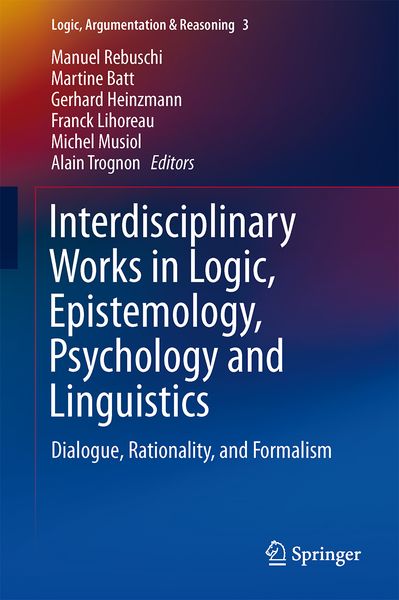
Produktbild: Interdisciplinary Works in Logic, Epistemology, Psychology and Linguistics
Band 3 - 10%

Interdisciplinary Works in Logic, Epistemology, Psychology and Linguistics Dialogue, Rationality, and Formalism

10% sparen

147,99 € UVP 164,99 €

inkl. gesetzl. MwSt., Versandkostenfrei


Beschreibung

This book presents comparisons of recent accounts in the formalization of natural language (dynamic logics and formal semantics) with informal conceptions of interaction (dialogue, natural logic and attribution of rationality) that have been developed in both psychology and epistemology. There are four...

Beschreibung

This book presents comparisons of recent accounts in the formalization of natural language (dynamic logics and formal semantics) with informal conceptions of interaction (dialogue, natural logic and attribution of rationality) that have been developed in both psychology and epistemology. There are four parts which explore: historical and systematic studies; the formalization of context in epistemology; the formalization of reasoning in interactive contexts in psychology; the formalization of pathological conversations.

Part one discusses the Erlangen School, which proposed a logical analysis of science as well as an operational reconstruction of psychological concepts. These first chapters provide epistemological and psychological insights into a conceptual reassessment of rational reconstruction from a pragmatic point of view.

The second focus is on formal epistemology, where there has recently been a vigorous contribution from experts in epistemic and doxatic logics and an attempt to account for a more realistic, cognitively plausible conception of knowledge.

The third part of this book examines the meeting point between logic and the human and social sciences and the fourth part focuses on research at the intersection between linguistics and psychology.

Internationally renowned scholars have contributed to this volume, building on the findings and themes relevant to an interdisciplinary scientific project called DiaRaFor (“Dialogue, Rationality, Formalisms”) which was hosted by the MSH Lorraine (Lorraine Institute for Social Sciences and Humanities) from 2007 to 2011.

Portrait

Franck Lihoreau is a Postdoctoral Research Fellow for the Portuguese Science and Technology Foundation (FCT) at the Philosophy of Language Institute (IFL), New University of Lisbon. His main research interests include epistemology, philosophical logic and linguistics, metaphysics, and the philosophy of fiction. He is the editor of a book on Knowledge and Questions (2008).

Produktdetails

Einband

Gebundene Ausgabe

Erscheinungsdatum

24.03.2014

Abbildungen

VIII, 372 p. 45 illus., 1 illus. in color.

Herausgeber Manuel Rebuschi + weitere

Produktdetails

Einband

Gebundene Ausgabe

Erscheinungsdatum

24.03.2014

Abbildungen

VIII, 372 p. 45 illus., 1 illus. in color.

Herausgeber
Verlag Springer
Seitenzahl

372

Maße (L/B/H)

24,1/16/2,6 cm

Gewicht

683 g

Sprache

Englisch

ISBN

978-3-319-03043-2

Herstelleradresse

Springer-Verlag KG
Sachsenplatz 4-6
1201 Wien
AT

Email: ProductSafety@springernature.com

Noch keine Bewertungen vorhanden

Verfassen Sie die erste Bewertung zu diesem Artikel

Helfen Sie anderen Kundinnen und Kunden durch Ihre Meinung.

Kundinnen und Kunden meinen

Bewertungen (0)

  • Produktbild: Interdisciplinary Works in Logic, Epistemology, Psychology and Linguistics
  • Chapter 1. General Introduction; Manuel Rebuschi, Martine Batt, Gerhard Heinzmann, Franck Lihoreau, Michel Musiol and Alain Trognon.- Part I Historical Context.- Chapter 2. Phenomenology, “Grundwissenschaft” and “Ideologiekritik”: Hermann Zeltner’s Critique of the Erlangen school; Christian Thiel.- Chapter 3. Geometry as a Measurement-Theoretical A Priori. Lorenzen’s Defense of Relativity against the Ontology of its Proponents; Oliver Schlaudt.- Chapter 4. Correspondence between Evert Willem Beth and Jean Piaget (1951-1955); Gerhard Heinzmann, Alain Trognon, and Frédérick Tremblay.- Part II Epistemology, Context, Formalism.- Chapter 5. Principles of Knowledge, Belief and Conditional Belief; Guillaume Aucher.- Chapter 6. Procedural Information and the Dynamics of Belief; Eric Pacuit.- Chapter 7. Reasoning about Knowledge in Context; Franck Lihoreau and Manuel Rebuschi.- Chapter 8. The Epistemic Closure Principle and the Assessment Sensitivity of Knowledge Attributions; Tomoyuki Yamada.- Part III Reasoning in Interactive Context.- Chapter 9. From Dialogue to Calculation; Martine Batt and Alain Trognon.- Chapter 10. Dialogue of Rationalities: A Case Study; Marcelo Dascal.- Chapter 11. Pragmatics of Veridicity; Denis Vernant.- Chapter 12. Rationality of Performance ; Edda Weigand.- Part IV Conversation, Pathology, Formalization.- Chapter 13. Modeling the Dynamic Effects of Discourse: Principles and Frameworks; Maxime Amblard and Sylvain Pogodalla.- Chapter 14. Dialogue Analysis: Pragmatic and Rhetorical Aspects; Jean Caelen and Anne Xuereb.- Chapter 15. Investigating Discourse Specificities in Schizophrenic Disorders; Michel Musiol and Frédéric Verhaegen.- Chapter 16. Using SDRT to Analyze Pathological Conversations. Logicality, Rationality and Pragmatic Deviances; Manuel Rebuschi, Maxime Amblard and Michel Musiol.- Index.