KI-Beratung Beta

  • Produktbild: Economic Evolution and Structural Adjustment
  • Produktbild: Economic Evolution and Structural Adjustment
Band 293

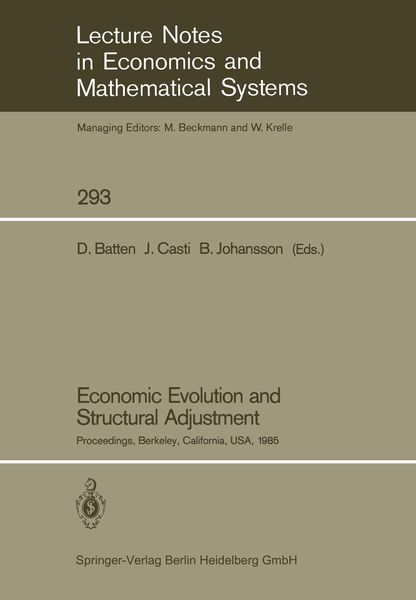
Economic Evolution and Structural Adjustment Proceedings of Invited Sessions on Economic Evolution and Structural Change Held at the 5th International Conference on Mathematical Modelling at the University of California, Berkeley, California, USA July 29–31, 1985

51,99 €

inkl. gesetzl. MwSt., Versandkostenfrei


Beschreibung

Since the beginning of the fifties, the ruling paradigm in the discipline of economics has been that of a competitive general equilibrium. Associated dynamic analyses have therefore been preoccupied with the stability of this equilibrium state, corresponding simply to studies of comparative statics....

Beschreibung

Since the beginning of the fifties, the ruling paradigm in the discipline of economics has been that of a competitive general equilibrium. Associated dynamic analyses have therefore been preoccupied with the stability of this equilibrium state, corresponding simply to studies of comparative statics. The need to permeate the boundaries of this paradigm in order to open up new pathways for genuine dynamic analysis is now pressing. The contributions contained in this volume spring from this very ambition. A growing circle of economists have recently been inspired by two distinct but complementary sources: (i) the pathbreaking work of Joseph Schumpeter, and (ii) recent contributions to physics, chemistry and theoretical biology. It turns out that problems which are firmly rooted in the economic discipline, such as innovation, technological change, business cycles and economic development, contain many clear parallels with phenomena from the natural sciences such as the slaving principle, adiabatic elimination and self-organization. In such dynamic worlds, adjustment processes and adaptive behaviour are modelled with the aid of the mathematical theory of nonlinear dynamical systems. The dynamics is defined for a much wider set of conditions or states than simply a set of competitive equilibria. A common objective is to study and classify ways in which the qualitative properties of each system change as the parameters describing the system vary.

Portrait

John L. Casti, Ph.D., is a professor at the Santa Fe Institute and the Technical University of Vienna and the author of Would-Be Worlds and Five Golden Rules (both published by Wiley) as well as The Cambridge Quintet.

Produktdetails

Einband

Taschenbuch

Erscheinungsdatum

09.09.1987

Abbildungen

VI, 387 p. 21 illus.

Herausgeber David Batten + weitere

Produktdetails

Einband

Taschenbuch

Erscheinungsdatum

09.09.1987

Abbildungen

VI, 387 p. 21 illus.

Herausgeber
Verlag Springer Berlin
Seitenzahl

387

Maße (L/B/H)

24,4/17/2,2 cm

Gewicht

681 g

Sprache

Englisch

ISBN

978-3-540-18183-5

Herstelleradresse

Springer-Verlag KG
Sachsenplatz 4-6
1201 Wien
AT

Email: ProductSafety@springernature.com

Noch keine Bewertungen vorhanden

Verfassen Sie die erste Bewertung zu diesem Artikel

Helfen Sie anderen Kundinnen und Kunden durch Ihre Meinung.

Kundinnen und Kunden meinen

Bewertungen (0)

  • Produktbild: Economic Evolution and Structural Adjustment
  • Produktbild: Economic Evolution and Structural Adjustment
  • 1 Economic Dynamics, Evolution and Structural Adjustment.- A: Dynamic Competition and Economic Evolution.- 2 Creativity and Economic Dynamics Modelling.- 3 The General Theory of Disequilibrium Economics and of Economic Evolution.- 4 The Balanced Path of Economic Development: A Fable for Growth Merchants.- 5 Competitive Growth of Firms in an Industry.- 6 Technical Progress, Capital Accumulation, and Effective Demand: A Self-Organization Model.- 7 Technological Vintages and Substitution Processes.- 8 Log-Linear Relative Dynamics: Unification of Theories.- B: Periodic Cycles and Structural Adjustment.- 9 The Schumpeter Clock.- 10 Complex Dynamics in Continuous Models of the Business Cycle.- 11 Generalizations of Goodwin’s Growth Cycle Model.- 12 A Multisector Model of the Trade Cycle.- 13 (M, R)-Systems as a Framework for Modeling Structural Change in a Global Industry.- C: Location and Spatial Dynamics.- 14 Continuous Models of Spatial Dynamics.- 15 The Onset of Turbulence in Discrete Relative Multiple Spatial Dynamics.- 16 Adoption and Diffusion of Innovations and Evolution of Spatial Systems.- List of Contributors.